
Beware Boiúna offers a compelling reason to look beyond the size of its snake: its characters enter the rainforest with different ideas about what they are entitled to do there. A medical mission promises assistance, a mechanic brings local knowledge and personal obligations, and a pursuing antagonist brings revenge. The creature interrupts all three agendas. Whether that collision sustains an entertaining movie is where critical opinion divides.
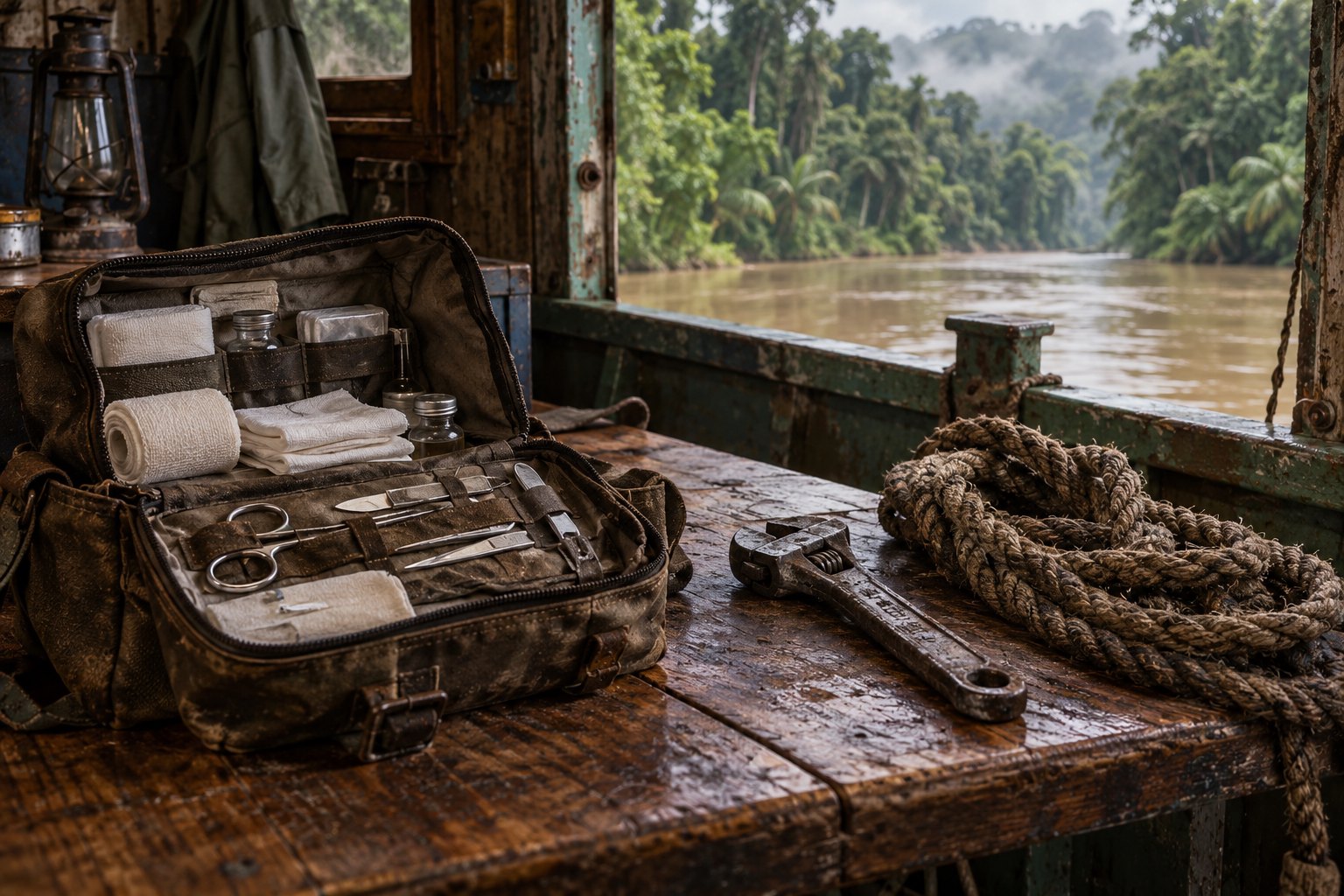
Spoilers follow for the setup and selected suspense sequences. This critical reading draws on published accounts of the film and a filmmaker interview; it is not a firsthand screening review. The illustrations are conceptual artwork.
What kind of creature feature is Beware Boiúna?
Directed by Mike P. Nelson, the film stars Jessica Rothe as Alli, Kiana Madeira as Lena, and Logan Marshall-Green as Brennan Malloy. Its medical expedition becomes a survival struggle in the Amazon. Michael Gingold’s favorable review describes substantial human conflict before the serpent becomes a sustained presence, while acknowledging that some attacks suffer from excessive camera movement. That combination suggests an adventure whose appeal depends heavily on investment in its endangered people. [Gingold’s review](https://rue-morgue.com/movie-review-killer-snake-adventure-beware-boiuna-is-properly-scaled/)
For viewers expecting a continuous procession of elaborate monster attacks, that structure matters. Delaying a creature can strengthen anticipation, but the intervening drama must generate its own pressure. A frightening premise alone cannot make a long wait feel purposeful.
Alli and Lena bring different kinds of competence
Alli’s humanitarian purpose provides an accessible starting point: she wants to help. Lena’s position is more complicated. She works aboard the boat and is searching for her missing brother, giving her a personal connection to the region that extends beyond the expedition. Josh Bate’s account emphasizes this difference between the visiting medic’s intentions and Lena’s familiarity with the environment. [Bate’s character discussion](https://theholofiles.com/2026/09/17/beware-boiuna-review-fantastic-fest/)
My reading is that their partnership contains the film’s most promising dramatic question: what happens when the person accustomed to offering help must depend on somebody else’s expertise? Medical knowledge remains valuable, but it cannot answer every question about movement, machinery, territory, or danger. Survival requires recognizing the limits of one’s competence.
Lena’s search also prevents her from being understood solely as the visitor’s guide. She has unfinished business of her own. Her decisions can therefore be evaluated against something more specific than whether they advance Alli’s journey. That distinction matters whenever a film places outsiders at the entrance to somebody else’s home.
Brennan’s revenge needs a clear moral reading
The pursuit begins with human violence. Published plot accounts describe Brennan’s brother Shawn attempting to assault Alli; resistance involving the two women ends with Shawn’s accidental death, prompting Brennan’s retaliation. That sequence is essential to understanding the conflict. [The account of the confrontation](https://www.rendyreviews.com/movie-reviews/beware-boina-review)
Brennan’s bereavement can explain his anger without justifying his pursuit. Treating those ideas as interchangeable would distort the women’s position: defending themselves does not make them responsible for accommodating the survivor’s revenge. A character can experience recognizable pain and still choose to inflict further harm.
From this perspective, the chase asks how private grievance spreads danger through a group. Brennan treats his loss as a reason to pursue others; everyone caught in that pursuit must then live with the consequences. The snake enlarges a crisis that already exists between people.
This is also why character motivation deserves scrutiny beyond a simple hero-and-villain checklist. Our discussion of power, responsibility, and the desire to play the savior in Digger approaches a related interpretive problem: a person’s preferred account of their actions is only the beginning of the analysis.
The smallest threat makes the body vulnerable
One reported sequence brings the danger down to an intimate scale: Alli removes botfly larvae from Callum’s back. Nelson explained that the production used prosthetic effects and controlled fluids, with Rothe physically performing the extraction. [Nelson’s explanation of the practical effect](https://www.cinemablend.com/movies/beware-boiuna-director-mike-p-nelson-interview-reveals-pulled-off-grossest-scene)
The useful contrast is between something enormous outside the body and something tiny already inside it. A giant predator creates the possibility of escape; infestation makes distance irrelevant. For Alli, the situation also gives assistance a concrete form. Helping means undertaking an unpleasant task while another person depends on her steadiness.
As an idea, this is stronger than an interchangeable pause for gore. It connects bodily vulnerability with the expedition’s original purpose. The characters are more than potential meals when their skills can relieve one another’s suffering.
Why Lena’s mud sequence attracts agreement
A striking point of agreement emerges between otherwise divergent reviews. Brian Tallerico, who strongly criticizes the film, praises a sequence in which Lena becomes trapped in deep mud while the serpent threatens nearby. Steve Prokopy likewise singles it out in a more receptive assessment. [Tallerico’s review](https://www.rogerebert.com/reviews/beware-boiuna-horror-movie-review-2026), [Prokopy’s review](https://thirdcoastreview.com/film-tv/2026/10/02/fantastic-fest-review-beware-boiuna)
The predicament explains its appeal. Lena needs to escape, but movement can worsen her position. The audience can understand the danger without needing an elaborate explanation of the creature’s abilities. Her body, the surrounding material, and the approaching threat establish an immediate problem.
That provides a useful standard for judging the other attacks: can viewers understand what a character needs to do and why doing it is difficult? Concealing a monster can preserve mystery. Concealing the practical stakes risks weakening suspense.
Disagreement about the overall film therefore need not invalidate agreement about a particular scene. As our essay on how to assess a divided critical response argues, a persuasive judgment needs specific evidence. Here, Lena’s predicament supplies precisely that kind of test case.
The deeper question: who gets to decide?
Lena describes Boiúna as “Mother of the Waters,” a being that “decides who lives and who dies,” according to Gingold’s account. Those brief lines give the creature an authority that exceeds ordinary predation. They are the film’s characterization of the serpent, not a comprehensive explanation of Amazonian belief. [The reported dialogue](https://rue-morgue.com/movie-review-killer-snake-adventure-beware-boiuna-is-properly-scaled/)
The interpretation I find most productive concerns control. Alli’s helpful intentions, Lena’s personal search, and Brennan’s revenge all encounter circumstances they cannot command. Their differences remain morally meaningful, even when danger reaches everyone.
That leaves Beware Boiúna with a potentially uncomfortable tension: caring about the people in peril while questioning the assumption that the landscape exists for their purposes. Its most interesting promise is the possibility that survival requires more than overpowering a creature. It requires understanding whose knowledge matters, whose actions created the crisis, and where human authority ends.
Original content by this site's editorial team. Published: October 5, 2026 at 00:20:22 PDT (Los Angeles time)