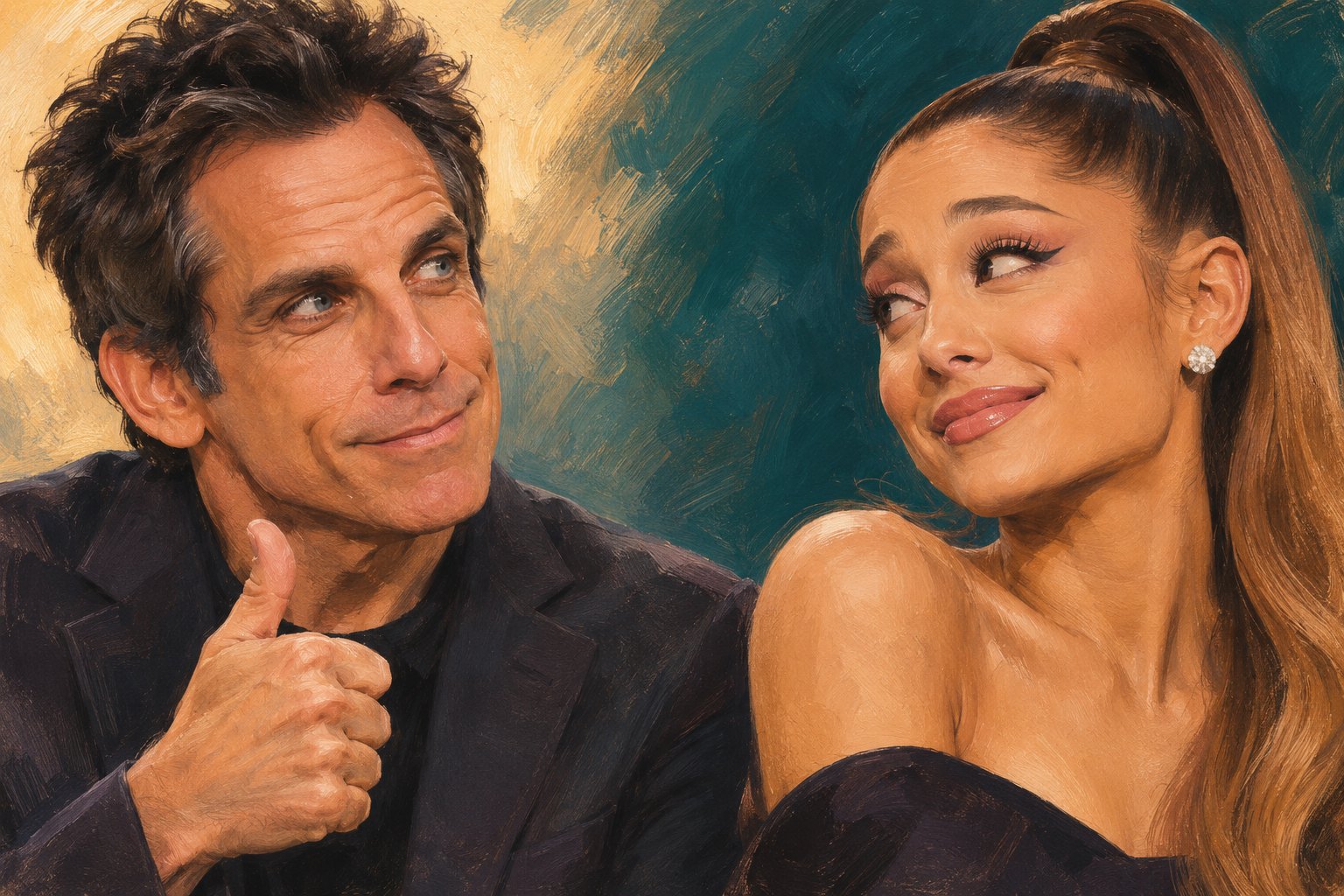
Ben Stiller says Ariana Grande exceeded his expectations in Focker-in-Law, and he would be willing to make a fifth Meet the Parents film, according to The Hollywood Reporter. Those are encouraging signals for anyone interested in the pairing. They also raise a more useful question than whether a familiar comedy franchise can keep going: can a new performer give its relationships somewhere different to go?
Stiller’s enthusiasm supplies a reason to pay attention to Grande. It does not, by itself, establish the quality of the finished movie or confirm another installment. The distinction matters because an actor’s pleasure in a collaboration and an audience’s response to a film are related but separate things.
This is spoiler-free commentary on Stiller’s remarks and their implications, rather than a scene-by-scene review of Focker-in-Law. Assessing its specific jokes, character turns, or ending would require evidence beyond those remarks.
What Stiller’s Praise Actually Tells Us
The most meaningful part of the news is its specificity: Stiller is responding to Grande as someone he worked with. That gives his assessment a different perspective from a casting announcement or a prediction based on celebrity appeal. A scene partner experiences the choices another performer makes within an exchange, including choices an audience may barely register.
Still, the phrase about exceeding expectations leaves an important variable undefined: the expectations themselves. It cannot tell us how demanding the role is, which scenes succeed, or whether the writing consistently supports the performance. Turning that broad endorsement into detailed claims about Grande’s delivery would go beyond what has been established.
My reading is that the praise creates a promising point of entry. It directs attention toward the collaboration rather than treating Grande’s presence as an attraction in isolation. For a comedy built around people reacting to one another, that is the more interesting place to look.
Why a Comedy Performance Has to Be Judged Between the Jokes
A memorable comic performance is not simply a collection of funny lines. It also gives other actors something to respond to. A pause can invite an interruption. A calm answer can make someone else’s panic look absurd. A character’s refusal to acknowledge an insult can become funnier than a carefully prepared comeback.
These are criteria for evaluating the Stiller–Grande pairing, not descriptions of verified scenes in Focker-in-Law. The distinction keeps the critical question open: does the interaction generate the humor, or does the film mostly ask recognizable performers to deliver material that could belong to anyone?
The strongest answer would be a relationship with its own rhythm. Viewers should gradually understand what each person expects from the other, what repeatedly goes wrong, and why neither simply walks away. Once those expectations are established, even a small change in behavior can carry a substantial laugh.
That is also why a performer can be excellent without making an entire movie excellent. Local chemistry may brighten an exchange while the larger story remains underdeveloped. Stiller’s endorsement makes the chemistry worth examining; it cannot settle the structural question.
The Character Test: Who Gets to Define the Situation?
A useful way to approach family comedy is to track who believes they have the right to judge everyone else. One person may regard scrutiny as concern. Another may experience the same scrutiny as humiliation. Both can feel justified, which gives the conflict more energy than a simple division between a reasonable person and an obvious fool.
For Grande’s contribution to have lasting dramatic value, my critical standard would be that her character possess an intelligible viewpoint. Being surprising, likable, or disruptive is not enough on its own. A character becomes more substantial when the audience can understand what she wants even while laughing at how she pursues it.
The same standard applies to Stiller’s side of the relationship. A familiar performer should remain capable of losing an argument, misreading an encounter, or discovering that another person’s interpretation is fair. Otherwise, the newcomer has entered a contest whose outcome was decided before the scene began.
Our character-focused discussion of You’ve Got Mail approaches a related critical problem: charm does not automatically resolve an imbalance between people. In a family comedy, laughter can make a conflict enjoyable without making either participant right.

A Fifth Film Needs More Than Willing Participants
Stiller’s willingness to return is a statement of interest. It should not be read as confirmation that a fifth film has been approved, scheduled, or given a story. What it does establish is that he has not dismissed the possibility.
Artistically, another installment would need a conflict that survives a simple question: why must these people encounter this problem now? Familiar faces can make an opening scene welcoming, but recognition cannot provide the consequences that keep a story moving.
A productive sequel changes the meaning of an established relationship. Someone who once wanted approval might discover the discomfort of granting it. Someone accustomed to authority might have to ask for help. These are possible dramatic directions, not predictions about this franchise’s plans. Their value lies in forcing characters to make choices that familiarity alone cannot answer.
The less rewarding alternative is escalation without development: greater embarrassment, louder confrontations, and more elaborate mishaps that leave everyone emotionally where they started. Bigger incidents can provide individual laughs. A new reason for the characters to need one another provides a movie.
What Viewers Should Take From the News
If Grande’s involvement is your main reason for being interested, Stiller’s praise is relevant encouragement. If you want reassurance about the film’s overall consistency, it is insufficient evidence. Neither response requires dismissing his enthusiasm; they simply ask different questions of it.
When assessing the finished film, the most revealing moments will be those that connect performance to consequence. Does a funny exchange alter a relationship? Does a disagreement expose something the characters would rather conceal? Does anyone behave differently afterward? Those questions distinguish a satisfying character comedy from a sequence of amusing encounters.
They also prevent a familiar reviewing shortcut: treating one standout performer as a complete verdict. A strong contribution deserves recognition on its own terms, while the film still needs to earn its pacing, emotional turns, and resolution.
The Deeper Question Is Whether Belonging Can Change
The most compelling possibility behind Stiller’s endorsement is that welcoming a new performer might correspond to a genuine shift in the dramatic balance. For me, family comedy becomes richest when acceptance requires adjustment from the people doing the accepting. Admission into a group means less if the group refuses to reconsider any of its assumptions.
That broader question also connects with our retrospective on family reconciliation in Secrets & Lies: bringing people together and resolving what separates them are different achievements.
Stiller’s praise gives Grande’s contribution a compelling spotlight. His openness to a fifth film gives the franchise a possible horizon. The artistic opportunity between those two statements is clear: let a new presence change the relationships enough that another chapter has something meaningful to explore.
Original content by this site's editorial team. Published: November 28, 2026 at 18:22:51 PST (Los Angeles time)