
Arch Manning’s running sits at the center of the Austin American-Statesman’s assessment of Texas at LSU: his mobility provided an essential lifeline. That argument deserves attention because quarterback evaluation can become narrowly focused on passing. A player’s ability to recognize usable space, commit to it, and carry the ball changes what an offense can accomplish when a throw is difficult or unavailable.
The useful question is how that value works. Calling a quarterback a dangerous runner describes a capability; explaining when that capability matters requires attention to decisions, blocking, defensive positioning, and game situation. Here, film study means football footage. The analysis below examines the tactical significance of the Manning discussion without presenting unverified play sequences or coaching intentions as established facts.
A quarterback’s legs can preserve the next opportunity
The most important run in a possession need not be its longest. Yardage gains acquire meaning from the problem they solve. A modest gain that reaches the first-down marker can be more consequential than a longer run that leaves an offense facing another difficult conversion.
That distinction helps explain why the discussion of Manning at LSU should begin with usefulness rather than spectacle. Speed makes an escape visually exciting. Situational awareness determines whether the escape advances the offense’s immediate objective. The distance to the marker, the location of approaching defenders, and the available route forward all matter.
There is also a difference between extending a play and extending a possession. Moving within or outside the pocket may buy time for a pass. Committing to a run may create a new set of downs. Those outcomes can look similar in a quick highlight, but they reveal different decisions. Evaluating Manning’s mobility means keeping both possibilities in view.
Separate a scramble from a designed quarterback run
A scramble and a designed run can end with the same image: a quarterback carrying the ball through traffic. Their underlying logic differs. On a scramble, movement develops as an answer to a passing situation. On a designed run, the blocking and spacing are organized around a planned rushing opportunity.
That difference changes the questions an analyst should ask. For a scramble, look at what happened before the quarterback tucked the ball. Was pressure arriving? Was there room to step forward? Did a running lane become available while defenders followed receivers? For a designed run, watch how blockers move and where the offense tries to establish an advantage.
A single camera angle may leave those questions unresolved. A quarterback taking off quickly does not, by itself, prove that a run was called. Likewise, a momentary pause does not establish that he abandoned a passing read. Assignments require stronger evidence than body language alone.
For Manning, the distinction matters because improvisation and planned rushing demonstrate different forms of value. One can rescue a difficult situation; the other can be part of the offense’s intended answer from the start. A useful assessment credits the relevant skill instead of treating every carry as the same achievement.
Read the space around Manning
The ball carrier attracts the eye, but the surrounding players explain much of what becomes possible. A blocker who maintains contact, a receiver who carries a defender away, or a defender who takes an aggressive path can influence a running lane before the quarterback reaches it.
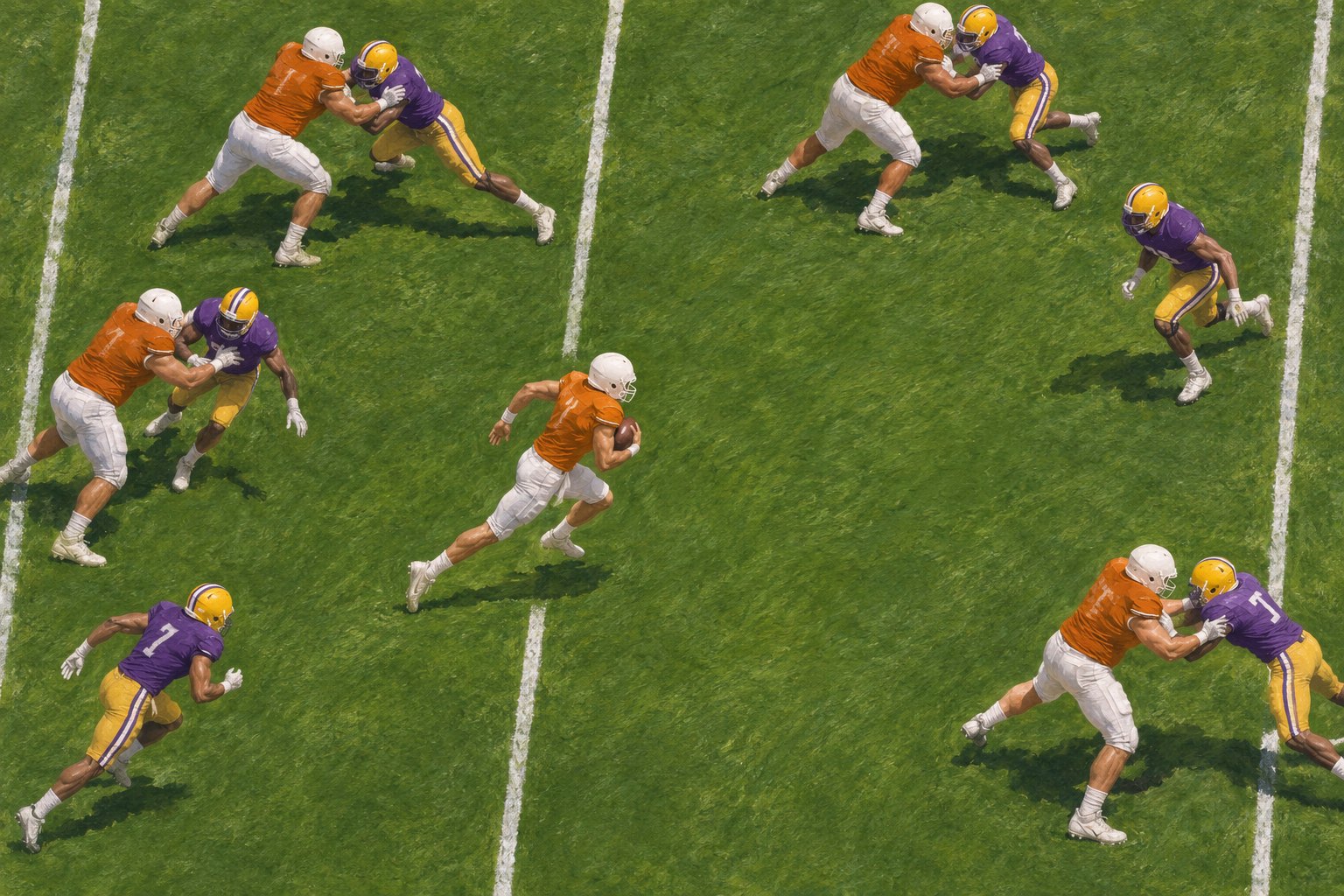
Quarterback movement also creates competing demands for a defense. A defender approaching the passer must consider the possibility of an escape. A player responsible for a receiver may have to react when the quarterback becomes a runner. An effective defense coordinates those responsibilities; an opening can emerge when the timing or spacing breaks down.
These are general mechanisms, not claims about LSU’s assignments on particular snaps. Applying them to the matchup requires seeing the relevant players throughout the play. The key is to identify who occupied the space before Manning entered it, then ask what changed.
That approach complements our guide to reading the action before an interception: the decisive moment becomes more intelligible when attention extends beyond the player holding the football.
Judge the decision before celebrating the result
A productive run is evidence of a successful outcome. It does not automatically establish that running was the best available choice. Conversely, a short gain can reflect sensible judgment when the alternatives are worse. Good evaluation keeps the decision and its result connected without making them interchangeable.
For a quarterback, committing too early can close off a passing opportunity. Waiting too long can allow a usable gap to disappear. Mobility therefore involves more than acceleration. It requires recognizing when the balance of options has changed.
Game context adds another layer. Time remaining, down, distance, field position, and possession needs affect the value of a carry. A run that helps one situation may complicate another. Without those details, praise should remain specific to what can actually be established.
My view is that this makes quarterback running more intellectually interesting than its frequent description as pure athleticism suggests. The physical act is visible. The judgment that makes it useful can be much harder to isolate.
A practical way to revisit the Texas–LSU discussion
When reviewing Manning’s carries, use a consistent sequence rather than beginning with a verdict:
- Establish the problem. Note the down, distance, clock, and field position when they are visible.
- Watch the opening movement. Follow the quarterback and blockers before focusing on the eventual running lane.
- Locate the commitment. Identify when the quarterback stops presenting a passing threat and becomes a runner.
- Trace the available space. Watch how teammates and defenders shape his route.
- Evaluate the consequence. Ask what the carry made possible for the offense’s next action.
This method also keeps a compelling individual moment from becoming an unsupported claim about the entire team. Our discussion of clutch performances and unfinished comebacks explores that broader temptation: a dramatic solution can coexist with problems that remain unresolved.
What Manning’s mobility asks us to reconsider
The deeper value of the Texas–LSU discussion is its challenge to a rigid picture of quarterback competence. Passing remains central to the position, but the player’s responsibility is to navigate the situation in front of him. Running can be an expression of that responsibility.
The strongest interpretation of Manning’s importance is therefore about adaptability. His legs belong in the evaluation because movement offers another way to sustain an offense. Understanding that contribution requires looking past the exhilaration of an escape to the choices and collective work that give it meaning.
Original content by this site's editorial team. Published: November 16, 2026 at 09:36:05 PST (Los Angeles time)