
Robert Pattinson has been cast as James Bond in the next 007 movie, according to USA Today. The announcement answers the immediate casting question. The more interesting creative question is what kind of man will emerge beneath the familiar tailoring: someone who enjoys commanding a room, someone who treats charm as professional equipment, or someone whose confidence conceals constant calculation.
My interest in this casting lies in that tension. A compelling Pattinson Bond would need to make elegance feel active. His ease should persuade other characters to lower their guard while giving the audience reasons to keep watching his eyes.
This is casting commentary, not a review of the forthcoming film. The casting news alone provides no basis for evaluating its plot, dialogue, action, or ending. What it does offer is an opportunity to examine the character demands that will determine whether this interpretation works.
The first challenge: make confidence believable
Bond’s outward confidence is easy to imitate. A measured entrance, an expensive-looking jacket, and an unhurried reply can establish the outline within seconds. Sustaining that confidence across a story requires something more precise: the sense that he is assessing a situation even when he appears to be enjoying it.
For Pattinson, I would want the performance to distinguish between social confidence and operational certainty. Bond might understand exactly how to win someone’s attention while remaining unsure whether that person is telling the truth. Those two states can coexist. Their friction gives an apparently relaxed conversation a second layer.
Consider the acting problem in hypothetical terms. Another character offers Bond a reassuring explanation. Does he accept it, pretend to accept it, or momentarily wish he could? A small delay before answering could communicate any of those possibilities, provided the surrounding scene establishes what he stands to lose.
That is where a casting choice becomes characterization. The actor needs decisions to play, and the screenplay needs to make those decisions consequential. Without that connection, mystery can become a succession of handsome, unreadable close-ups.
Charm should change the balance of a scene
My strongest preference for Pattinson’s interpretation would be charm with a specific purpose. A joke might buy time. An apparently candid admission might encourage someone else to reveal more. A courteous gesture might disguise an attempt to take control.
But charm also becomes interesting when it fails. If everyone automatically finds Bond irresistible, the film removes a valuable source of resistance. Someone who sees through his routine forces him to improvise, and improvisation reveals more about a character than effortless success.
The people around him therefore matter enormously. A colleague should have professional judgment that exists independently of his approval. An adversary should be capable of noticing his tactics. A romantic partner should have reasons for attraction, hesitation, or refusal that the film takes seriously.
That emphasis on relationships connects with our character analysis of Drax and Mantis: supporting characters help define what a central figure understands, misunderstands, and needs to learn. Bond will seem more intelligent if the people challenging him are intelligent too.
Watchfulness can make stillness exciting
A spy performance has to communicate attention. Before a confrontation becomes physical, viewers should be able to sense that Bond has noticed something: an unexpected hesitation, a change in someone’s manner, an answer that arrives too quickly.
This does not require a conspicuous reaction shot every time. Blocking, editing, and sound can help establish the distinction between what the room notices and what Bond notices. Pattinson’s performance would then have room to work quietly inside that distinction.
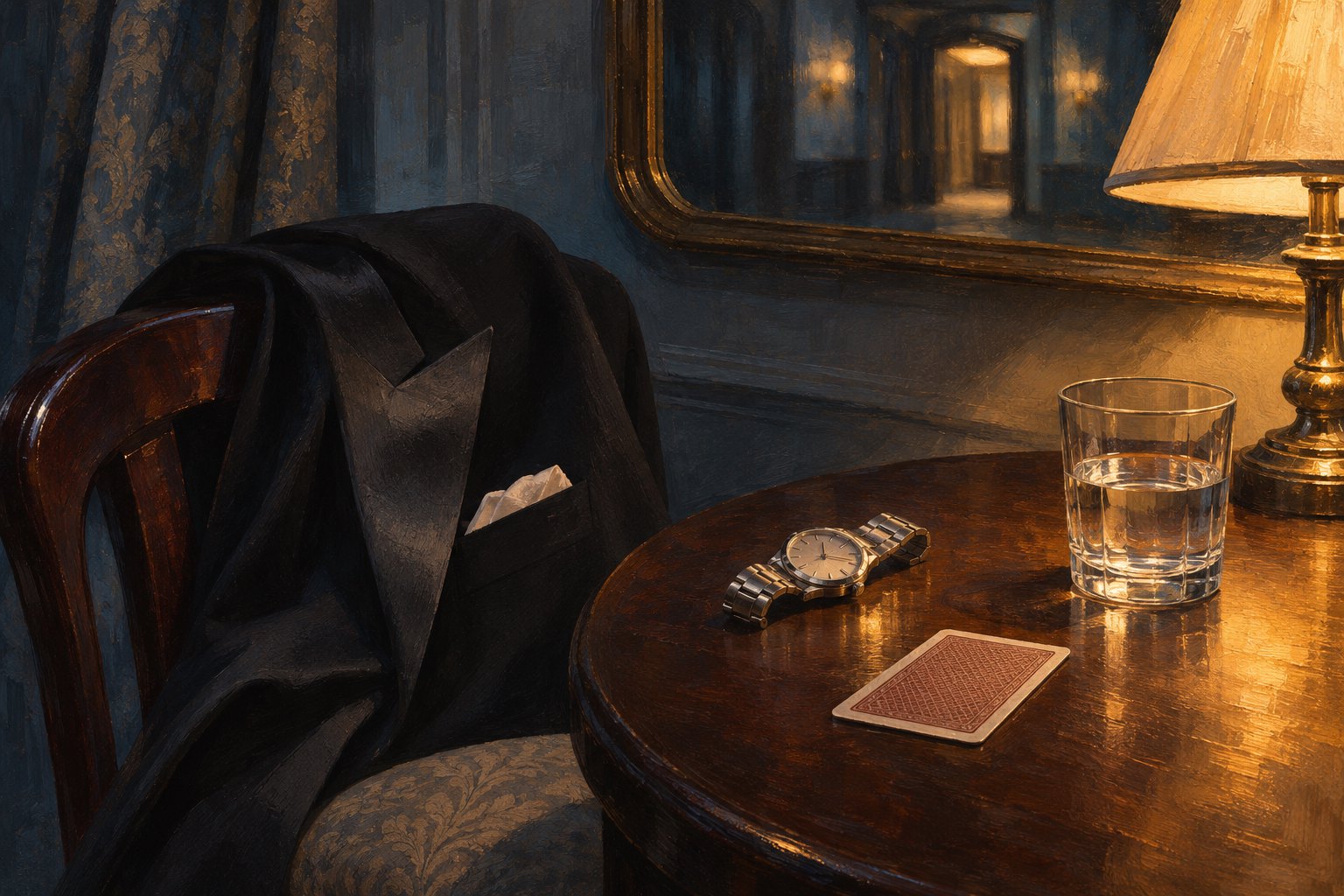
The illustration evokes the private interval behind public polish. That interval is dramatically useful: the moment when a man who has been performing ease can finally stop performing it. A film can reveal exhaustion, doubt, or renewed concentration without turning the scene into a speech about his inner life.
For me, the best test would be whether a quiet scene remains absorbing before the audience knows what it is preparing us for. If attention itself becomes suspenseful, the eventual action has already begun at the level of character.
Humor needs room beside the danger
A severe interpretation would risk narrowing Bond’s emotional range. Humor can communicate self-possession, impatience, affection, or evasion. It gives an actor different ways to respond to pressure and gives the audience different ways to read him.
The familiar introduction, “Bond. James Bond,” offers a useful example of how delivery changes meaning. As a franchise signature, it can announce confidence. As a social gesture, it can be inviting, challenging, or deliberately theatrical. This is a reference to Bond’s established screen identity, not a claim about dialogue in Pattinson’s film.
I would welcome an interpretation that recognizes the pleasure Bond takes in his own presentation. That pleasure need not erase danger. It can make the interruption of danger sharper: the conversation was enjoyable, and now someone has made it lethal.
The challenge is tonal judgment. A joke that reveals how Bond handles fear can deepen a scene. A joke that asks viewers to stop caring about its consequences can drain it.
Vulnerability should affect his choices
Emotional depth cannot be supplied by a troubled expression alone. Vulnerability matters when it changes what Bond does: whose account he believes, how much information he shares, or whether he allows a personal attachment to complicate a professional decision.
These are possibilities for evaluating the role, not predictions about the next film’s story. They identify a practical distinction between a character who looks wounded and one whose experiences shape his behavior.
Our discussion of why a new starring role hinges on character raises a related issue. Casting creates an opportunity; the writing must give the performer something specific to pursue, resist, or misunderstand.
For Pattinson’s Bond, I would look especially closely at trust. Professional suspicion may protect him, but it can also prevent useful cooperation. A story that makes both consequences visible would give his guardedness dramatic weight.
The deeper opportunity: a man who controls his presentation
What makes this casting worth discussing is the possibility of a Bond whose self-presentation becomes part of the suspense. The audience can enjoy the confidence while wondering how much effort it costs him to maintain it.
My preferred interpretation would let that uncertainty survive without making the character emotionally inaccessible. We should understand his immediate intentions even when we cannot fully explain him. We should see when his composure helps, when it misleads others, and when it prevents him from admitting something necessary.
Pattinson’s name establishes the next face of 007. The film’s deeper achievement would be to make us watch that face for changes: the instant a calculation fails, a joke becomes sincere, or trust becomes more frightening than danger. That is where a familiar screen identity could begin to feel newly human.
Original content by this site's editorial team. Published: November 16, 2026 at 07:49:51 PST (Los Angeles time)