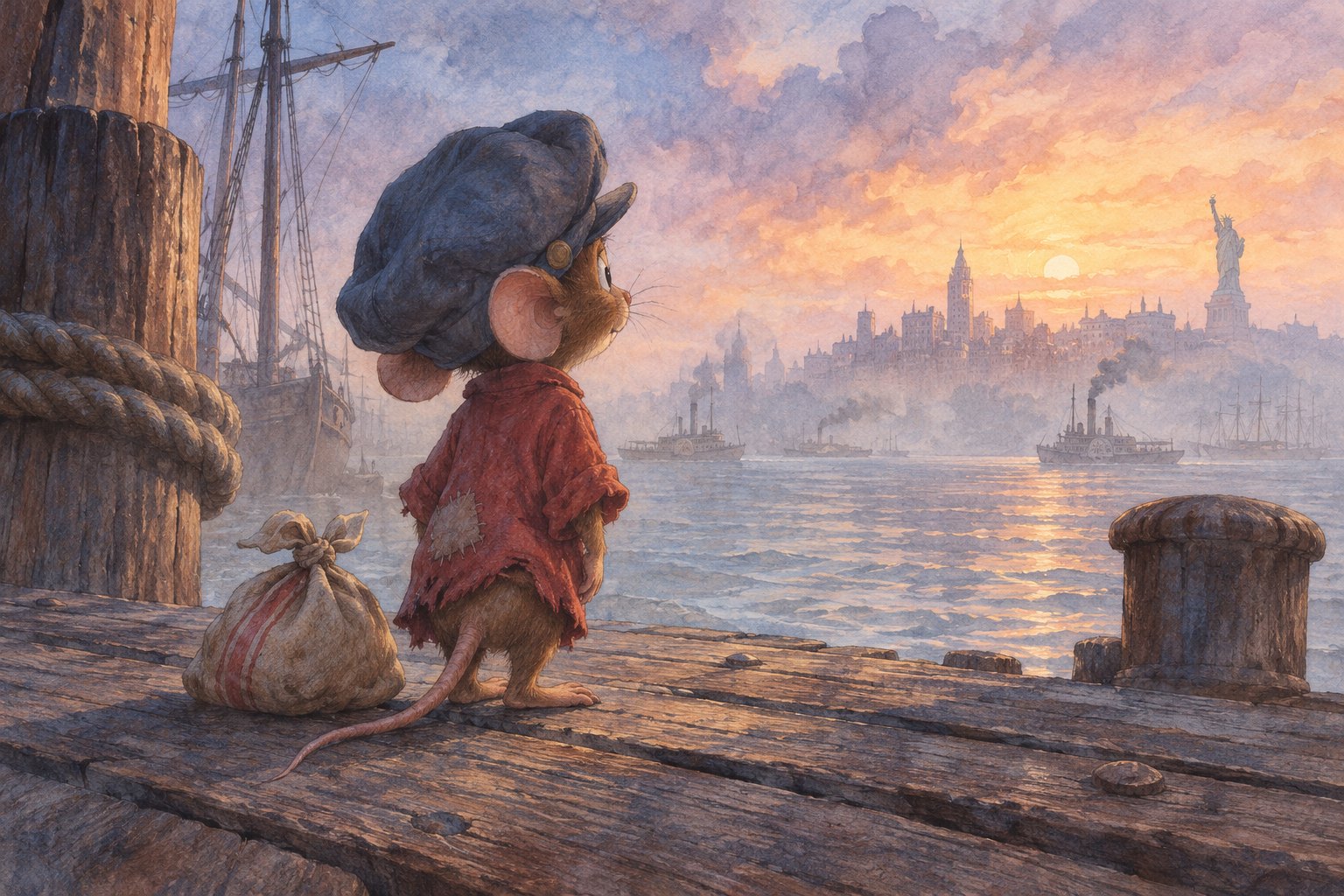
An American Tail still hurts because reaching America does not end Fievel Mousekewitz’s ordeal. Arrival leaves him alone in a place that his father promised would be safe. Forty years after its theatrical release on November 21, 1986, Don Bluth’s animated adventure remains an unusually uneasy family movie: affectionate toward the American dream, painfully alert to the people it can disappoint. The release date and directing credit are documented in the [AFI film catalog](https://catalog.afi.com/Film/67249-AN-AMERICAN-TAIL).
The anniversary invites a fresh look at why this story can feel even more immediate today. My reading is that its lasting force comes from a child’s practical definition of belonging. Freedom means little to Fievel until someone helps him find his family. Through that limited, urgent perspective, the film makes displacement personal without making it small.
Spoilers follow for the entire film, including its ending.
Papa’s promise makes safety sound simple
The Mousekewitz family’s Jewish identity is present from the opening Hanukkah celebration. Their departure follows the destruction of their home during an attack. These details give their journey a specific emotional foundation: they have something to escape and a family life worth preserving.
Papa’s assurance, “There are no cats in America,” offers a child an understandable picture of safety. It also exposes the weakness in his optimism. He imagines protection as a property of geography, something the family will acquire simply by crossing an ocean.
From Papa’s perspective, that certainty is an act of care. A parent facing danger needs to make the next step seem possible. Yet the film allows his loving intentions and his mistaken confidence to occupy the same space. Fievel inherits both his hope and his dangerously incomplete account of the world.
The oversized cap Papa gives him makes that inheritance visible. Fievel looks like a child wearing a future he cannot yet fill. The hat is comforting, awkward, and easy to lose—an excellent physical expression of the security he takes for granted.
Fievel discovers how vulnerability becomes profitable
A storm separates Fievel from his family during the crossing. His subsequent search through New York forms the central adventure, as the [official Amblin synopsis](https://amblin.com/movie/an-american-tail/) describes. What makes that search unsettling is how quickly his need for help becomes useful to someone else.
Warren T. Rat sells him into sweatshop labor. The betrayal works because Fievel has no reason to understand the difference between an adult who offers assistance and an adult who recognizes an opportunity. His innocence is appealing to us and exploitable within the story.
Warren’s eventual exposure as a disguised cat sharpens that idea. He profits from the very danger against which the mice want protection. His disguise makes exploitation difficult to identify from appearances alone; friendliness and familiarity provide no guarantee of solidarity.
Fievel’s experience also changes the meaning of scale. A street becomes an exhausting distance, an unfamiliar interior a trap. The city feels enormous because the person navigating it has so little control. That is the animation’s strongest dramatic resource: making ordinary surroundings express a child’s dependence.
Tanya keeps the family emotionally connected
Tanya’s insistence that her brother survives prevents the story from belonging entirely to Fievel. While he struggles to reach his family, she struggles to keep a place for him within it. Her parents’ grief and her persistence represent different ways of enduring uncertainty.
The sibling duet “Somewhere Out There” gives that uncertainty room to breathe. Its power lies in the separation between the singers. They cannot comfort each other directly, but the film allows the audience to experience their attachment as something shared.

To my ear, the vulnerability of the children’s performance matters more than musical polish. The scene sounds like people trying to steady themselves. Its simplicity gives the emotion somewhere to settle after the chases, jokes, and crowded encounters.
This is also why the film belongs beside stories about the emotional cost of being alone. Our look at Kevin McCallister’s vulnerability in Home Alone considers a related strength: a resourceful child can still desperately need someone to come back.
Tiger makes friendship a choice
Tiger’s friendship with Fievel complicates the film’s basic division between cats and mice. Their encounter creates space for recognition across a boundary Fievel has been taught to fear. Tiger responds to his distress and helps him escape.
The sequence is funny, but its generosity has consequences. Tiger must act against the expectations of his own group. Compassion becomes credible because it changes what he does.
That distinction keeps the film’s allegory from closing into a simple rule about appearances. Warren conceals his predatory behavior beneath a disguise; Tiger’s intimidating appearance conceals a capacity for tenderness. Fievel needs to learn judgment without losing the ability to trust.
Tony and Bridget offer a more everyday version of the same principle. Their assistance gives belonging a practical shape. Someone stays nearby, makes an introduction, or provides somewhere to rest. As in our review of hospitality in Planes, Trains and Automobiles, warmth becomes meaningful through what people make room for in their lives.
Where the storytelling strains
For all its emotional precision, An American Tail can be frustratingly mechanical. Repeated near-reunions keep Fievel and his family apart through obstacles that sometimes feel arranged principally to prolong our distress. Once we understand the pattern, suspense risks becoming impatience.
The broad supporting characters also pull attention away from the family. Their exaggerated manners bring comic energy, but several feel more like quick sketches than people with an interior life. The movie moves between frightening peril and theatrical silliness with uneven results.
Still, its willingness to sustain sadness is a major strength. A frightened child does not experience every interruption as an entertaining adventure. The film gives loneliness duration. For family viewing, that matters more than the reassuring surface of cute animal characters: the separation and danger can be intense.
The ending turns an inherited story into collective action
The mice’s mechanical Giant Mouse of Minsk transforms Papa’s family tale into a means of resisting the cats. Later, the reunion returns attention to the original emotional need: father and son finding each other.
I find that progression more persuasive than a victory achieved through individual bravery alone. Fievel contributes an idea, but others must help make it work. A story carried from the old home becomes useful in the new one. His background supplies a resource for belonging rather than an obstacle to it.
The recurring encouragement “Never say never” gains weight through that experience. The film’s dialogue can be checked against the [film transcript](https://www.springfieldspringfield.co.uk/movie_script.php?movie=an-american-tail). Heard as advice, the phrase is almost impossibly easy. Lived through separation and disappointment, it becomes harder: hope requires people willing to keep searching.
At forty, the film’s deepest insight is that safety must be made tangible. A country’s promise becomes real through protection, cooperation, and care. Fievel’s happy ending feels earned when that promise finally takes a form he can recognize—a familiar voice answering him.
Original content by this site's editorial team. Published: November 28, 2026 at 08:51:49 PST (Los Angeles time)