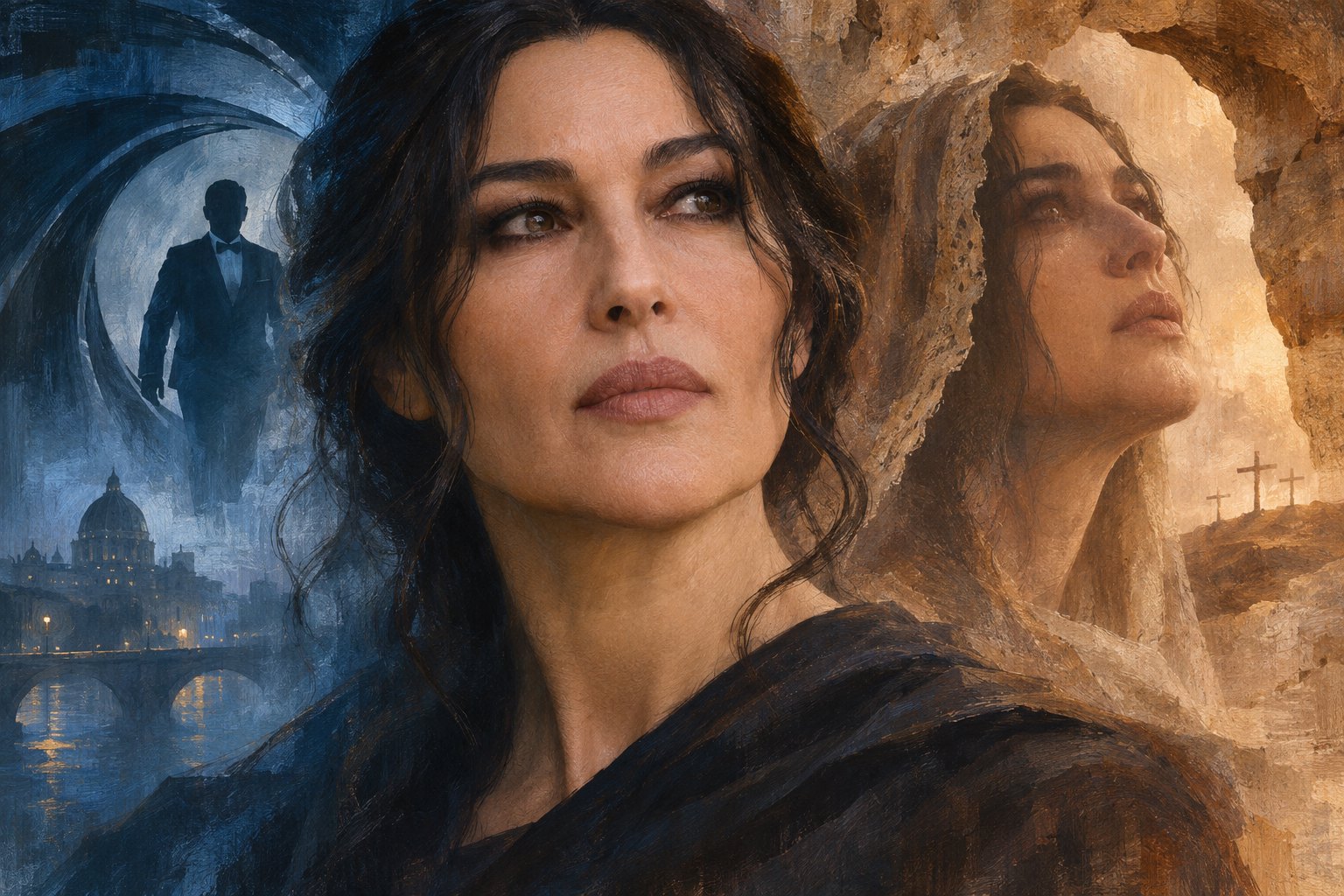
Monica Bellucci’s discussion of James Bond, Mel Gibson, and onscreen nudity connects three subjects that are often treated separately: who gets to appear on screen, what an actor’s body communicates, and how a director shapes that communication. In Variety’s coverage of her Marrakech masterclass, Bellucci described the significance of playing a mature woman in Spectre, explained her interest in working with Gibson, and discussed nudity as part of an actor’s craft.
Her Mary Magdalene in Gibson’s The Passion of the Christ offers a particularly revealing test of those ideas. This is a performance built around watching, kneeling, reaching, and remaining present. My assessment: Bellucci provides some of the film’s most affecting human detail, although the screenplay gives her too little independent life. Her restraint also exposes a weakness in the surrounding spectacle: more suffering does not automatically produce more understanding.
Spoilers follow for The Passion of the Christ. This review discusses graphic violence and crucifixion.
Why Mary Magdalene changes the viewing experience
Gibson’s 2004 film concentrates on Jesus’ final hours, with Jim Caviezel playing Jesus, Maia Morgenstern playing his mother, Mary, and Bellucci playing Mary Magdalene. Arrest, interrogation, scourging, and crucifixion form the narrative’s central movement. Flashbacks interrupt that progression with glimpses of relationships and teachings that the present-tense violence threatens to overwhelm.
From Magdalene’s perspective, the story is about watching someone who offered protection become a target himself. She cannot command the soldiers or reverse the authorities’ decisions. Her available actions are smaller: accompany Mary, attend to what violence leaves behind, and continue looking when looking becomes unbearable.
That limited position gives Bellucci a demanding task. Tears alone cannot distinguish a character from the surrounding mourners. The performance needs an underlying relationship, something that makes this woman’s grief specific. A brief flashback supplies it—and also reveals one of the film’s consequential interpretive choices.
The interrupted stoning gives her grief a history
The film depicts Magdalene as the woman Jesus protects from a threatened stoning. Its visual emphasis falls on the ground, the separating gesture, and the movement toward safety. Rather than delivering an extended explanation, the sequence turns a change in physical position into a change in possibility: someone exposed to collective violence is given a way out.
That identification belongs to the film’s interpretation. The Gospel episode of the woman caught in adultery does not name her as Mary Magdalene. Treating the two as interchangeable makes the movie’s characterization seem more straightforwardly scriptural than it is.
Within the film, however, the memory establishes a painful reversal. Magdalene has experienced mercy as intervention. Now the person who intervened for her is being brutalized, and she cannot offer an equivalent rescue. Bellucci’s distress becomes legible as gratitude confronted by powerlessness.
The scene also helps explain why silence can work here. The character has a remembered action to carry into the present. We do not need her to explain that debt of feeling aloud. We do need the film to provide enough of her life for the feeling to belong to a person, rather than merely symbolize devotion.
The courtyard turns grief into physical work
After the scourging, Mary and Magdalene wipe Jesus’ blood from the courtyard. The sequence makes the aftermath of violence an activity rather than an abstract emotion. Kneeling and cleaning cannot undo what happened, but they allow the women to respond through care.
For me, this is where Bellucci’s contribution matters most. The soldiers’ actions have made a human body into something to punish. The women’s actions insist that what remains deserves attention. The contrast is expressed through hands, posture, and proximity.

Morgenstern carries the distinct anguish of a mother watching her son suffer. Bellucci works beside that relationship without trying to duplicate it. Magdalene’s presence suggests that grief can include supporting another person whose loss is differently intimate.
The limitation is that solidarity does much of the work that fuller characterization might have done. We see how Magdalene responds to catastrophe, but receive relatively little sense of how she thinks outside it. Her performance makes the role emotionally persuasive without making it dramatically complete.
When the dialogue promises more than the images can show
During the journey to crucifixion, Jesus tells Mary, “I make all things new.” The line places a promise of renewal against an image of bodily collapse. It asks the audience to understand the suffering as purposeful even while the people closest to Jesus experience it as immediate, devastating loss.
Magdalene’s perspective complicates that promise. Belief does not remove the sight in front of her. Bellucci helps preserve the distance between a theological explanation and a human being’s capacity to endure what is happening.
Later, “Father, forgive them” offers a response to cruelty that refuses retaliation. The challenge for the movie is whether its visual language can sustain that generosity. The prolonged attention to wounds sometimes narrows the experience into anticipation of the next injury.
My reservation is about repetition. Once the brutality is established, additional detail can reduce the space available for the witnesses’ changing emotions. Bellucci and Morgenstern restore that space whenever the camera allows their reactions to become more than punctuation between assaults.
What Bond and onscreen nudity add to the discussion
Bellucci’s comments about nudity concern performance, not this particular role. Their relevance here is a question of craft: what does physical presence tell us about a character? Costume, exposure, stillness, and movement acquire meaning through context. None guarantees either dignity or exploitation by itself.
The same distinction helps explain her Bond casting. Our analysis of Lucia Sciarra’s limited choices in Spectre considers the difference between giving an actress visibility and giving her character substantial agency. Magdalene presents another version of that problem. She is emotionally necessary to the film, yet rarely controls its movement.
Nor should Bellucci’s account of choosing to work with Gibson settle anyone’s judgment of the finished movie. An actor can value a collaboration while viewers question its results. As our commentary on disagreement in film criticism argues, persuasive evaluation needs evidence from the work itself.
A witness whose presence becomes the argument
The deepest value of Bellucci’s performance lies in its refusal to make helplessness emotionally empty. Magdalene cannot stop the execution. She can remain connected to the person being executed and to those who love him. Her attention becomes a form of fidelity when intervention is no longer possible.
That gives The Passion of the Christ a quieter measure of conviction than its escalating violence. Faith appears in the willingness to stay, to remember mercy, and to perform an inadequate but necessary act of care. Bellucci makes those gestures credible.
The film does not develop Magdalene enough to fulfill all that promise. Still, her presence offers a compelling way to assess its achievement and its excesses: the wounds establish what has been done to a body; the witnesses reveal what that body means to other people.
Original content by this site's editorial team. Published: November 28, 2026 at 05:16:34 PST (Los Angeles time)