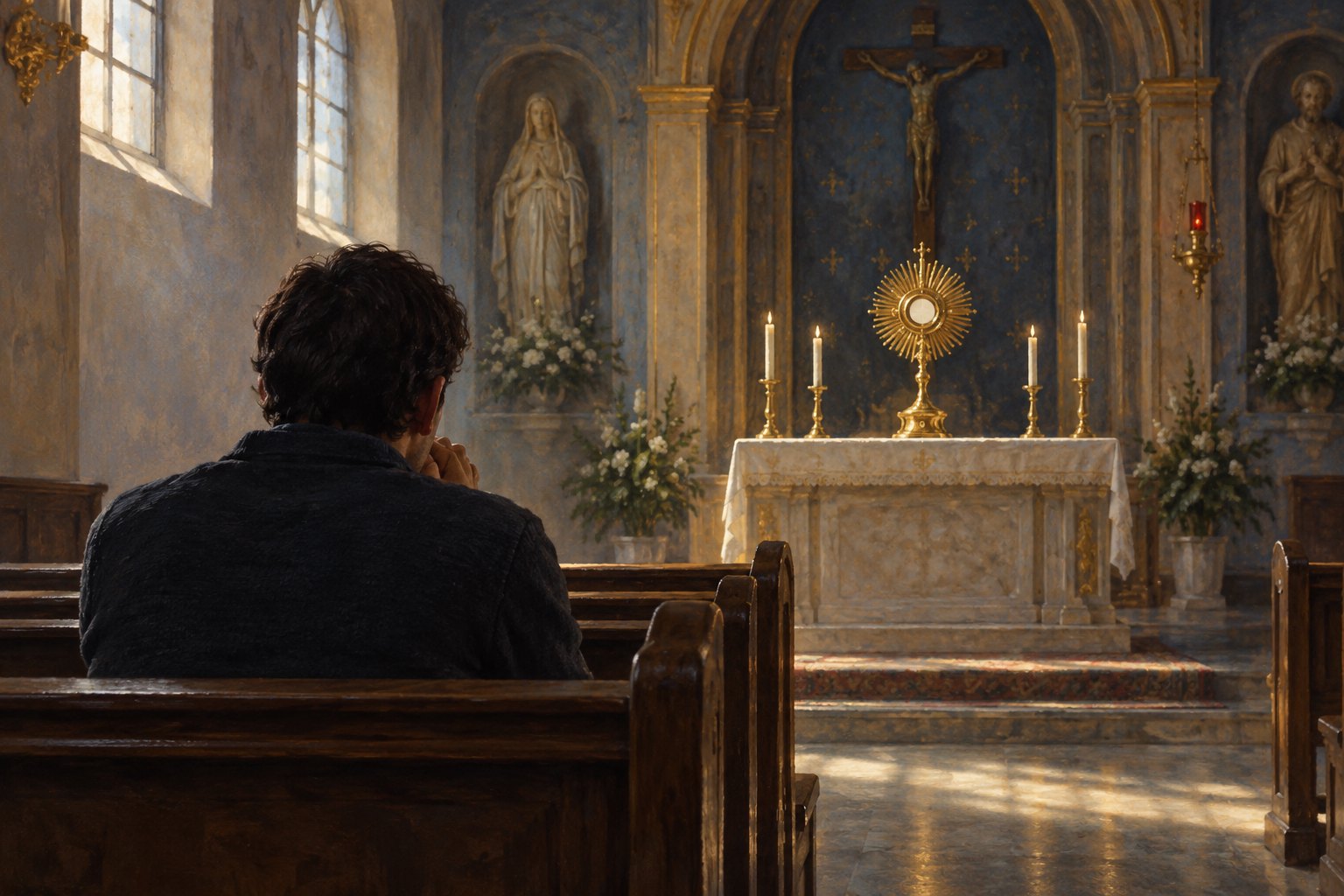
Adore Him: He Is Here approaches the transformative power of Eucharistic adoration through a compelling human question: what happens when an experience changes the story someone tells about their own life? Its accounts of religious encounter invite viewers to consider the distance between the person making plans and the person looking back, convinced those plans were incomplete.
EWTN News identifies the film as a docudrama combining personal testimony with dramatized salvation history. The project places Catholic belief in Christ’s Eucharistic presence at the center of its understanding of transformation. That is the religious conviction informing its stories. [EWTN News’ film coverage](https://www.ewtnnews.com/world/us/new-film-depicts-the-transformative-power-of-eucharistic-adoration).
Discussion includes reported testimony details. This article analyzes documented accounts and published film excerpts; it does not offer a firsthand assessment of the complete film’s performances, editing, or cinematography.
The person before the conversion matters
A conversion story contains an unusual imbalance. The person speaking knows where the journey leads. The earlier self being described does not. That difference can make testimony moving, but it also makes it easy to flatten a complicated life into a neat progression toward an inevitable conclusion.
For a film about spiritual transformation, preserving the earlier person’s perspective is essential. Ambition, curiosity, uncertainty, and resistance deserve attention on their own terms. Otherwise, the audience meets an illustration of a message instead of an individual whose understanding changed.
Our earlier discussion of Adore Him’s treatment of prayer and sustained attention examined the practice at the film’s center. Looking more closely at its participants raises another question: how does an encounter alter someone’s relationship with their own past?
Barbara Heil and the distance between curiosity and recognition
Joseph Pronechen’s National Catholic Register account describes Barbara Heil recalling that she “did not grow up Christian at all.” Her testimony moves through becoming Christian, developing an interest in Catholicism, and experiencing what she understood as Christ’s presence during a Eucharistic procession. The same coverage describes Father Chris Alar recalling material success before a car breakdown brought him unexpectedly to an adoration chapel. [The Register’s account of the film’s testimonies](https://www.ncregister.com/features/adore-him-he-is-here).
Heil’s reported progression offers a useful way to think about character development. A person can move through several understandings of the world without experiencing each one as a rehearsal for the next. Curiosity has its own emotional texture: it can include attraction, hesitation, embarrassment, and a willingness to listen without knowing what agreement would require.
Those possibilities should remain possibilities. There is no basis here for assigning Heil private thoughts beyond her testimony. What her account does establish is a sequence in which an unfamiliar religious practice eventually becomes personally significant.
From a storytelling perspective, the crucial change concerns recognition. Something previously approached from outside becomes something the speaker understands as addressing her. The physical event and its personal meaning become inseparable in her recollection.
That is also where a thoughtful viewer can participate without pretending to share the experience. Listening closely means understanding what Heil says happened to her and why she considers it decisive. Agreement with her interpretation is a separate response. A documentary gains depth when it allows room for both attentive listening and independent judgment.
Father Chris Alar and the failure of an ordinary plan
Alar’s reported account begins with an especially accessible disruption: a car stops working. Most viewers can recognize the frustration of having movement, appointments, and control suddenly taken away. The incident supplies a concrete point of entry into a story whose eventual meaning is religious.
What interests me about this premise is its reversal of value. An inconvenience can later become a treasured turning point. The underlying event stays the same; its place in a person’s autobiography changes.

That reversal deserves careful handling. Knowing that a narrator eventually became a priest can make an earlier interruption seem destined to happen. Yet the earlier person would have encountered an immediate practical problem. The dramatic interest lies in the gap between those perspectives.
A strong reading therefore keeps both versions of the event visible: the disruption as it was experienced and the significance later assigned to it. This approach respects the speaker’s faith while preserving the contingency that makes a life story recognizable.
It also avoids an easy assumption about material success. Professional achievement does not automatically establish spiritual emptiness. The more revealing question is what a participant came to believe success could and could not provide. Transformation becomes meaningful when it changes the person’s measure of a life.
How the film places individual lives inside a larger story
The production announcement credits Don Johnson as writer, producer, and director and describes a structure connecting the Ark of the Covenant, Christ’s earthly ministry, and contemporary Eucharistic devotion. Its historical dramatizations and modern testimonies establish a theological relationship across different periods. [The film’s production announcement](https://adorehimfilm.com/news/fathom-entertainment-adore-him).
My reading of that structure is that it offers participants a larger framework for understanding an intensely personal experience. An encounter becomes part of an inherited account of how God relates to humanity.
For viewers, the distinction between these storytelling forms remains useful. A reenactment embodies an interpretation through actors, settings, and dialogue. A testimony records someone describing an experience. Moving between them can create powerful associations, but their evidentiary functions differ.
The film’s title supplies the simplest expression of its organizing belief: presence in the present tense. Its human stories ask what accepting that belief might require of a particular person.
A changed life needs more than a decisive moment
Conversion narratives naturally emphasize turning points. Cinema also favors moments that can be isolated and remembered. A life, however, continues after its most memorable episode.
The useful critical question is what follows recognition: which priorities shift, which relationships change, and which responsibilities become harder to avoid? Those are standards for evaluating a transformation story, not claims about unverified scenes in this film.
We explored a related distinction between tenderness and consequential change in our analysis of selective compassion in Digger. Here, the question belongs to religious testimony: how does an inward conviction become legible through a person’s subsequent choices?
The deeper meaning of an interrupted life
The most productive way to approach these reported stories is to attend to the people’s changing definitions of themselves. Heil’s account concerns an unfamiliar practice becoming personally meaningful. Alar’s account gives an ordinary interruption an extraordinary place in memory.
Both invite a reading of transformation as a revision of identity. The past remains, but its meaning changes. What once appeared peripheral can become central; what once looked like progress can invite reconsideration.
That is the human interest at the heart of Adore Him: He Is Here. Its religious claim is specific, and its participants understand their experiences through that faith. The broader dramatic question is recognizable: when an encounter unsettles our account of who we are, what kind of life do we build afterward?
Original content by this site's editorial team. Published: October 4, 2026 at 14:28:34 PDT (Los Angeles time)