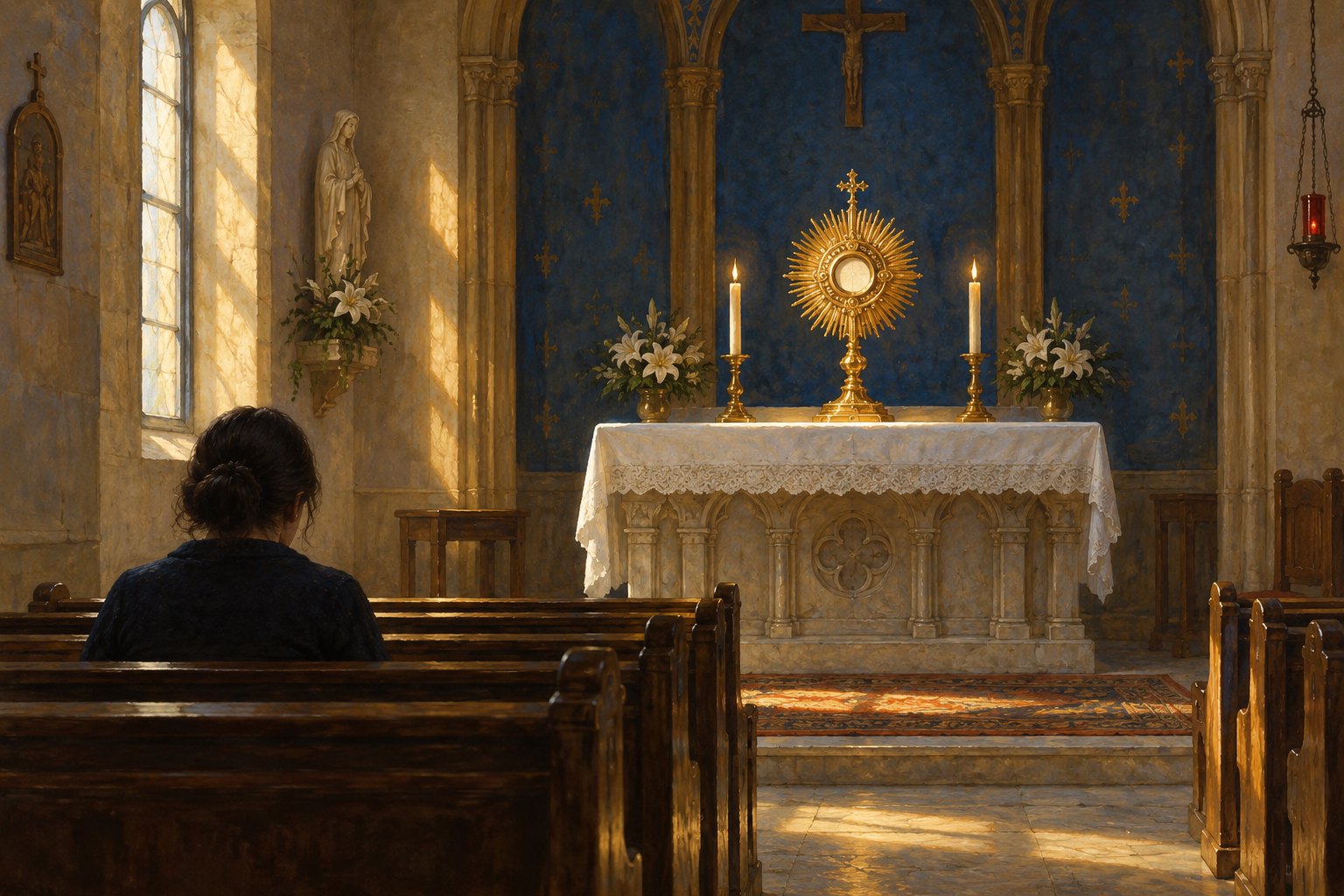
Adore Him: He Is Here approaches spiritual transformation through an activity that offers filmmakers an unusual challenge: remaining in someone’s presence. Its subject is Eucharistic adoration, the Catholic devotion centered on Christ’s presence in the Eucharist. The human question is how an encounter that may appear uneventful to an observer can become decisive for the person experiencing it.
Fathom Entertainment identifies the film as a docudrama written, produced, and directed by Don Johnson, with Deacon Steve Greco serving as executive producer, and lists its U.S. theatrical engagement for October 4–8, 2026. Its announced format combines personal accounts with biblical reenactments. [Fathom’s film announcement](https://www.fathomentertainment.com/news/fathom-entertainment-distribution-rights-to-adore-him/)
Scope and spoilers: This is an analysis of documented accounts of the film’s content, rather than a firsthand screening review. It discusses reported testimony and themes; judgments about performances, editing, and the complete viewing experience remain open.
The people behind the promise of transformation
A film about changed lives needs to preserve the people within those changes. The crucial dramatic distinction is between being told that someone became different and understanding what being different means to that person. Religious conviction can be the explanation a participant offers, but character emerges through particular fears, expectations, decisions, and relationships.
That is the most useful perspective to bring to Adore Him. Its participants deserve attention as individuals interpreting their experiences. Their accounts can communicate conviction without becoming interchangeable illustrations of a predetermined conclusion. For a viewer, the productive question is what each person believes happened—and how that belief alters the choices available afterward.
Our examination of how personal perspective shapes documentary meaning in They’re Here offers a related critical approach. The subjects are very different, but both invite attention to the distance between observing someone’s circumstances and understanding those circumstances from within.
A skeptical participant gives belief a personal stake
Joseph Pronechen’s National Catholic Register account describes a skeptical young woman recalling an encounter during adoration that she understood as an answer to a specific request. The important qualification is that this is her testimony: an experience narrated through the meaning she assigns to it. [National Catholic Register’s account of the film](https://www.ncregister.com/features/adore-him-he-is-here)
My reading is that skepticism gives such a story its dramatic stakes. A change of conviction matters because it revises an earlier understanding of the world. Yet an audience can respect a speaker’s sincerity while distinguishing personal certainty from independently established evidence.
Why the historical passages matter
In an interview with OC Catholic, Johnson describes connecting the Ark of the Covenant, Jesus’ birth, and contemporary devotion. The publication reports that live-action sequences supply the historical and scriptural context. That framework places the present-day testimonies within the film’s Catholic understanding of divine presence. [OC Catholic’s filmmaker interview](https://www.occatholic.com/adore-him/)
As a storytelling choice, this gives individual experience a larger frame. Someone describing a moment of recognition is also locating that moment within an inherited tradition. The film’s premise therefore involves two forms of belonging: a personal relationship with God and membership in a community that already has language for that relationship.
There is a critical distinction to retain here. A biblical dramatization gives visual form to a religious interpretation; it does not independently verify that interpretation. Recognizing the difference helps viewers engage the film on its own terms while remaining attentive to how reenactment, testimony, and teaching perform different jobs.
For believers, those connections may deepen a familiar practice. For viewers unfamiliar with Catholicism, they can explain why an apparently simple act carries considerable theological weight. The storytelling challenge is to make that meaning understandable without assuming that understanding and agreement must arrive together.
The simplest lines carry a demanding idea
Pronechen reports Father Chris Alar’s advice in the film: “Nothing. Just remain in silence. Just be in God’s presence.” Archbishop Paul Coakley describes a “heart-to-heart.” Together, the lines suggest that prayer need not become a performance of expertise. [Reported dialogue from the film](https://www.ncregister.com/features/adore-him-he-is-here)

For me, that invitation raises the richest cinematic question in the premise: how do you make attention visible? Speech can explain what a person believes, while stillness leaves more work to the viewer. A quiet face might suggest trust, discomfort, distraction, or uncertainty. Its meaning cannot responsibly be assigned from appearance alone.
This is also where restraint becomes an important standard for evaluating religious filmmaking. Music, reaction shots, and narration can help communicate feeling, but they can also narrow the emotional responses an audience is allowed to have. Without a screening, those choices cannot be assessed here. They remain useful things to notice when watching.
What happens after an extraordinary moment?
The Register also reports a discussion of Fulton Sheen’s daily Holy Hour. In my interpretation, this introduces a valuable counterweight to sudden conversion: a life can express conviction through repeatedly making time for it. [The Register’s discussion of Sheen](https://www.ncregister.com/features/adore-him-he-is-here)
Stories of transformation often concentrate on the moment everything changes. Daily conduct asks a harder question: what continues when the immediate feeling has passed? An extraordinary experience may explain a decision, but repetition reveals what that decision costs in time and competing priorities.
That is a useful standard for character analysis across genres. Our discussion of the personal choices behind Avengers: Endgame’s emotional impact similarly considers what convictions require people to give up. Here, the relevant sacrifice can be quieter: relinquishing another claim on one’s attention.
A deeper reading: presence changes the meaning of time
The title’s emphasis on presence supplies a compelling interpretive lens. To believe someone is here changes how waiting feels. Time that might otherwise seem empty becomes time shared. Within the film’s religious framework, adoration makes that distinction central.
My strongest interest in Adore Him is therefore the relationship between an exceptional encounter and an ordinary hour. The former offers a story someone can tell; the latter asks whether that story becomes a practice. The more fully a film allows both to matter, the more substantial its account of transformation can become.
Viewers need not bring identical convictions to take that question seriously. A thoughtful response can attend to the participants’ own explanations, examine the film’s means of persuasion, and ask what evidence of lasting change it presents. The deepest promise of this subject lies in showing how a person learns to spend a life differently, one act of attention at a time.
Original content by this site's editorial team. Published: October 4, 2026 at 12:06:41 PDT (Los Angeles time)