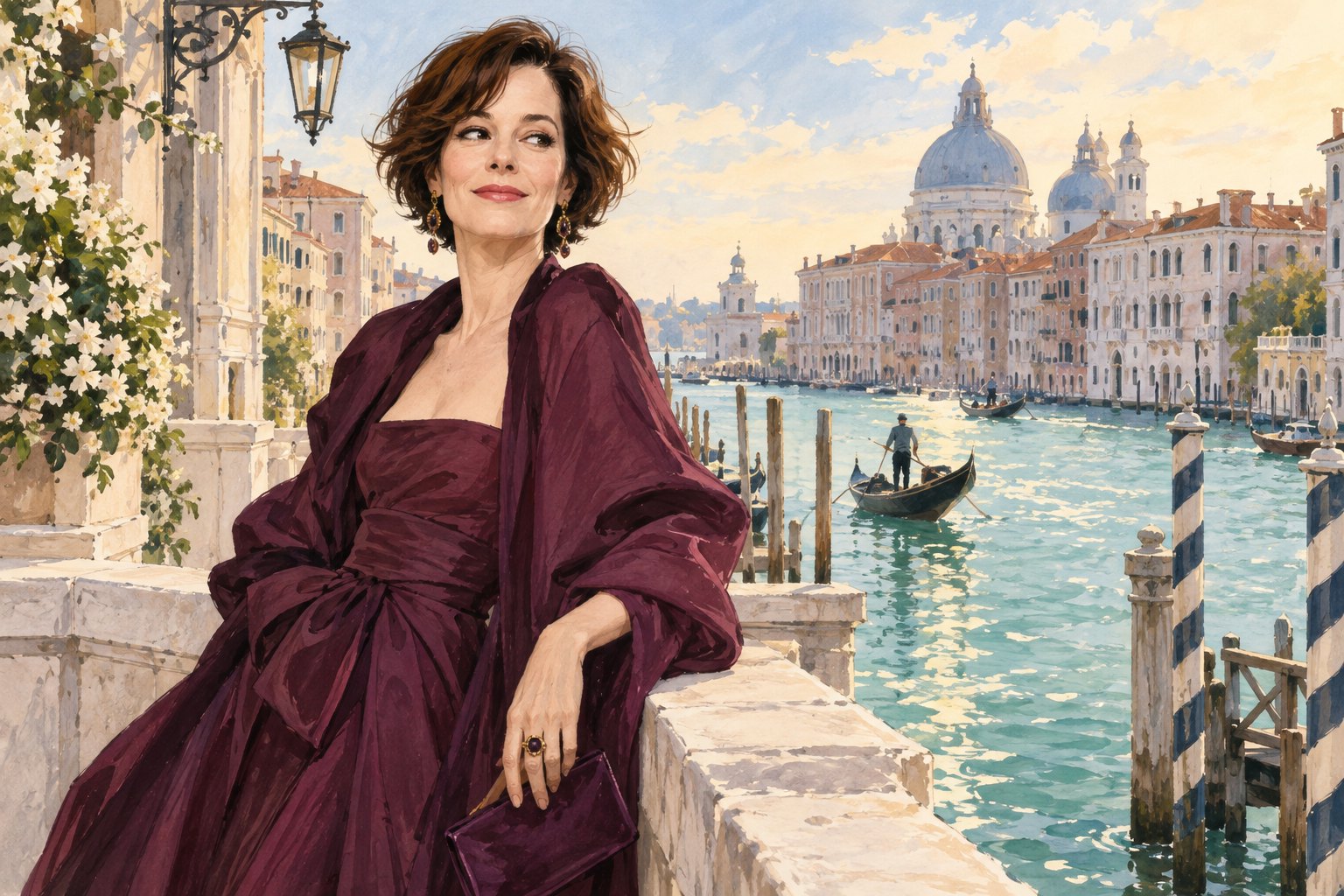
Parker Posey’s Venice Film Festival visit brings together two pleasures that celebrity coverage sometimes separates: exploring a place and dressing for an occasion. Vogue’s feature places sightseeing alongside festival fashion. The appeal is easy to understand. An actor moving through a city offers a different kind of interest from an actor arriving to be photographed, even when both experiences belong to the same trip.
For a film audience, that pairing raises a worthwhile question: what are we responding to when we enjoy watching an actor outside a movie? My reading is that the attraction lies in the movement between observer and observed. Posey is the subject of attention, but sightseeing also positions her as someone looking outward. That change in perspective gives this story more potential than a simple inventory of clothes.
This is spoiler-free commentary on festival imagery and public persona, rather than a review of a particular film. The accompanying illustrations are conceptual scenes, not documentary records of Posey’s outfits or itinerary.
The interest of seeing a star look outward
A formal celebrity portrait organizes attention around one person. We study the face, the outfit, the pose. Sightseeing introduces another center of interest: whatever has caught that person’s eye. It allows a festival story to ask what an actor notices, rather than only how an actor looks.
That distinction matters especially in coverage of performers. Audiences spend so much time watching them that it becomes easy to imagine their lives as a continuous series of entrances. The idea of Posey exploring Venice interrupts that expectation. A place can demand attention from a famous visitor just as readily as from anyone else.
There is a useful parallel with character analysis here. In a film, a character’s attention can reveal priorities before dialogue explains them. Someone who studies the room, watches a companion, or keeps checking an exit gives the audience different information. A travel portrait can awaken that same curiosity, although it cannot justify the same certainty about motivation. We can appreciate the act of looking without pretending to know the private thoughts behind it.
Sightseeing gives the fashion story a sense of time
Fashion coverage built entirely around a finished appearance can feel strangely timeless. The preparation has disappeared; the next obligation has not yet begun. The person seems to exist inside a single immaculate moment.
Pairing fashion with sightseeing introduces the possibility of a day unfolding. There is somewhere to go, something to notice, and an occasion that requires a different mode of presentation. That structure resembles a small narrative even without a dramatic incident. Its interest comes from transition.
For me, this is the most promising way to approach Posey’s Venice story. The clothes become part of an experience rather than the entire experience. The reader can remain interested in the person across changes in setting and degree of formality. A successful festival portrait should make us want to spend another paragraph in its subject’s company, even after the outfit has been described.
Clothes suggest a character, but they cannot explain a person
Moviegoers are trained to read clothing quickly. A tightly controlled silhouette might suggest discipline. An extravagant accessory might suggest confidence, playfulness, or a desire to command attention. Costume designers can encourage those readings, then let a performance complicate them.
Public appearances invite similar interpretations, but they offer fewer safeguards. A film supplies scenes, relationships, and consequences against which to test an initial impression. A photograph supplies a fragment. Calling someone imperious, carefree, or eccentric because of a look can turn a visual response into an unsupported personality judgment.
With Posey in Venice, the more interesting question is how fashion creates room for an audience’s imagination. Does a look invite a story? Does the relationship between expression and clothing leave something unresolved? Those are legitimate critical questions. They concern the image’s effect, without claiming that its wearer secretly inhabits a particular character.
Our discussion of what makes Venice red carpet style feel cinematic examines the visual construction of an appearance. Posey’s sightseeing-and-fashion premise invites a more personal extension: how does our interest in the wearer survive beyond the frame?
The viewer brings a history to the image
No familiar actor arrives before an audience entirely without context. Viewers bring memories of performances, interviews, publicity photographs, and their own reactions. Those memories can make a small gesture seem especially funny or a formal portrait unexpectedly warm.
This is part of the pleasure of following actors, but it also creates a critical trap. Recognition can masquerade as observation. We may think we are discovering something in a new picture when we are actually supplying an impression formed elsewhere.
A useful exercise when looking at Posey’s festival coverage is to separate three things: what is visible, what the accompanying reporting establishes, and what familiarity encourages us to imagine. None of those layers needs to cancel the others. Keeping them distinct makes admiration more precise. It also leaves room for an actor to surprise us instead of requiring every appearance to confirm an established persona.
What this coverage can add to watching movies
A festival portrait can renew interest in a performer. It can make the transition from everyday presence to screen character seem newly intriguing. That is a meaningful contribution to film culture, provided curiosity eventually leads back to the work.
The questions for a performance remain specific. What does the character want? How does the actor communicate a change of thought? Does a pause alter the balance of a scene? How do voice, posture, and timing develop within the film? A stylish appearance cannot answer those questions, however enjoyable it is on its own terms.
The distinction also helps readers navigate festival coverage more broadly. Our guide to reading Venice film reviews beyond the verdicts considers how to look for the reasoning behind a judgment. The same habit applies here: enjoy the portrait, then ask what kind of evidence supports any claim about the acting.
The pleasure is in the change of perspective
The strongest interpretation of Posey’s Venice story is that a movie star can be interesting both as a spectacle and as a spectator. Fashion invites us to look at her; sightseeing reminds us that she has things to look at, too. Holding those perspectives together makes celebrity coverage feel less sealed off from ordinary experience.
My preference is for festival stories that preserve that movement. The memorable element need not be the grandest outfit or the most polished image. It can be the sense that the person remains curious while becoming the object of everyone else’s curiosity. That is a satisfying reason to follow Parker Posey through Venice—and a good reason to return to her screen work with closer attention.
Original content by this site's editorial team. Published: September 10, 2026 at 08:26:35 PDT (Los Angeles time)