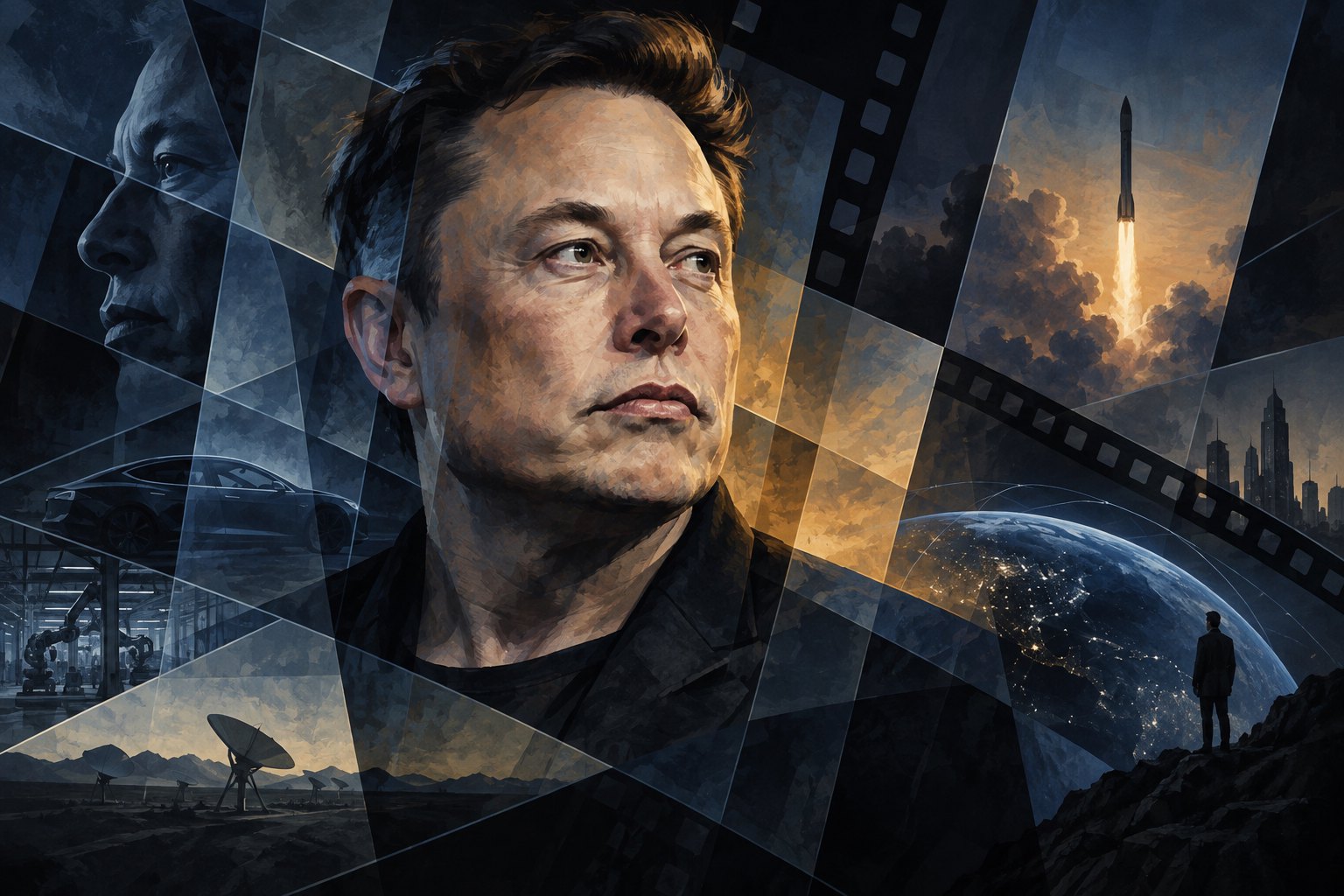
Alex Gibney’s Musk approaches Elon Musk as a biographical subject whose public identity demands examination alongside his business career. The central attraction is the possibility of understanding how the entrepreneur, celebrity, partner, and political actor connect. For viewers seeking more than another inventory of controversies, that is the question that makes this documentary worth examining.
Coverage note: This is an analysis of the film’s reported content and critical reception, based on published screening accounts, rather than a firsthand screening review. Spoilers follow for its structure, interview approach, and thematic development.
A Biography Built Around the Ownership of a Story
Variety’s review describes a documentary that follows Musk from early internet ventures through his automotive, space, and political pursuits. It also identifies interviews with Justine Wilson and Ashley St. Clair, attention to Tesla’s driver-assistance promises, and a reconstructed Musk interview using his existing words. Those elements establish several competing perspectives within the portrait. [Variety’s screening review](https://au.variety.com/2026/film/global/musk-review-elon-musk-alex-gibney-40069/)
My reading of that arrangement is that its strongest organizing idea concerns authorship. Who gets to explain what a successful enterprise means? The person associated with its public triumphs has one answer. A colleague, customer, or former partner may measure the same period against an entirely different set of experiences.
That distinction matters especially in a documentary centered on an exceptionally famous subject. Recognition can create the illusion of knowledge. We know a face, a speaking style, perhaps a handful of promises. Biography becomes useful when it makes those familiar pieces less comfortable: when it asks what the audience has accepted as explanation simply because it has encountered it repeatedly.
A chronological structure can help by restoring sequence. A promise made before an outcome is different from a promise remembered after success. Viewers should watch for whether the documentary preserves that uncertainty or makes every early event seem like an inevitable step toward the present.
Musk’s Perspective: The Future as a Source of Authority
Viewed as character analysis, the entrepreneur’s position raises an absorbing dramatic problem. Someone who asks others to believe in a future achievement also asks for patience with present limitations. That request can be reasonable. Difficult projects take time, and failure can contribute to progress. But the same request can become a way of postponing scrutiny indefinitely.
The useful critical distinction is between ambition and entitlement. Ambition proposes that something difficult can be accomplished. Entitlement assumes that the importance of the goal grants its pursuer special permission. A documentary must establish the passage between those positions through evidence, rather than treating confidence itself as proof of misconduct.
Variety’s account of the film’s attention to automotive promises makes that distinction particularly relevant. My interpretation is that this material poses a question about the audience’s role: when does enthusiasm for a technological possibility become trust in a particular person? The film’s argument deserves to be assessed at that point of transfer, where an attractive idea starts functioning as a character reference.
This also offers a better framework than deciding whether Musk should occupy the hero or villain slot. Both labels can simplify the relationship between achievement and responsibility. A meaningful accomplishment deserves recognition; it cannot settle every subsequent question about judgment.
The People Around Him Change the Measure of Success
The inclusion of Wilson and St. Clair gives the reported portrait a personal dimension. Their presence matters because a relationship supplies a different measure of behavior from a launch, presentation, or corporate milestone. Listening to a partner’s account requires attention to reciprocity, care, and the distribution of power.
These are real people giving testimony, not supporting characters whose only purpose is to explain a famous man. A strong reading of their participation should preserve that difference. The viewer can ask what each speaker knows firsthand, what remains interpretation, and whether the editing gives that person space to exist beyond the central subject’s biography.
That is also an ethical question explored in our discussion of how documentary testimony establishes knowledge and responsibility. The subjects differ, but the viewing discipline applies: proximity provides valuable evidence without making every inference equally secure.
For me, the deeper potential of this perspective is its resistance to scale. A grand mission may describe millions of hypothetical beneficiaries. A personal account concerns obligations to someone specific. Neither scale automatically cancels the other, and a film becomes more demanding when it makes the audience hold both in view.
The Reconstructed Interview Creates Its Own Tension
TheWrap reports that Gibney was denied a direct interview and uses an animated Musk avatar speaking publicly sourced soundbites, with AI assistance used for voice synchronization. Its account also quotes the filmmaker’s organizing questions: “How has Elon Musk assumed so much power” and “And why did we give it to him?” Later, St. Clair supplies a stark metaphor: “Elon is a nuke.” [TheWrap’s screening account](https://www.thewrap.com/creative-content/movies/musk-review-alex-gibney-punishing-elon-musk-documentary/)

The avatar presents a formal challenge. Existing words can be authentic while the encounter containing them is constructed. Selection, placement, and visual presentation all create meaning. My concern with the device is therefore less about whether reconstruction belongs in documentary than whether viewers can clearly distinguish a quotation from an answer elicited in an actual exchange.
Its possible advantage is equally interesting. A visibly constructed figure can make public identity appear assembled rather than natural. Its possible weakness is that caricature may deliver a verdict before the surrounding evidence has earned one. The device should be judged on how much it clarifies, not simply on how sharply it mocks.
That tension connects with our analysis of spectacle and scrutiny in Primetime: a work examining someone’s command of attention must also examine its own methods of commanding ours.
The Deeper Question Is What Admiration Authorizes
Gibney’s reported question about why power was granted is more revealing than a demand to diagnose one personality. It directs attention toward the decisions through which admiration becomes permission. Audiences, institutions, and collaborators can participate in that process for different reasons; a persuasive explanation needs to leave room for those differences.
St. Clair’s nuclear metaphor expresses danger with enormous economy, but a memorable line cannot carry the evidentiary burden of an entire film. Its value lies in prompting a more exact question: which relationships or institutions can impose limits, and what happens when those limits fail?
The most productive interpretation of Musk, based on its reported construction, is a study of conditional trust. Achievement can justify interest, investment, or admiration. Each new claim still deserves its own examination. A documentary about a man who wants to shape the future becomes most useful when it restores the viewer’s ability to judge what is happening in the present.
Original content by this site's editorial team. Published: September 10, 2026 at 10:08:26 PDT (Los Angeles time)