
The Uprising deliberately invites a Robin Hood interpretation of Andrew Garfield’s character, but describing it simply as another Robin Hood adventure misses its central conflict. Paul Greengrass’s film places a fictional farmer, identified as the Ploughman, within the Peasants’ Revolt of 1381. Its connection to the legendary outlaw concerns what that ordinary man becomes—and what happens when a collective struggle is remembered through a single hero.
The distinction matters because published reviews disagree about the ending’s meaning. The Associated Press reads it as a Robin Hood origin reveal; other accounts treat it as a more suggestive move into folklore. The useful answer is therefore qualified: yes, Robin Hood is part of the film’s framing and interpretation, but the principal story concerns rebellion against Richard II.
Spoilers follow for the character trajectory and ending. This analysis draws on published plot accounts and reported dialogue; it is not a firsthand screening review. The accompanying illustrations are conceptual artwork, not images from the film.
The Ploughman begins with a livelihood, not a legend
Garfield’s character is introduced as a farmer whose wife and children have died. George Simpson’s account describes him being drawn into revolt as taxation makes ordinary survival increasingly difficult. His identity begins with work, bereavement, and material pressure rather than a famous name.
That starting point changes how his resistance can be understood. A legendary outlaw arrives with an audience’s affection already secured. A farmer has to reach the point where continued obedience becomes intolerable. Through the Ploughman’s perspective, rebellion begins as a question of what a person can endure.
“We’ve given you enough!” is one of the film’s lines reproduced in the Associated Press review. Its force lies in the word “enough.” The speaker is establishing a limit after a history of compliance. He is demanding that those collecting from him recognize that his capacity to surrender more has ended.
My reading is that this makes the character’s occupational name particularly effective. Calling him the Ploughman keeps labor visible whenever he is identified. It also creates a dramatic risk: someone meant to represent ordinary people can become so representative that his individual contradictions disappear.
Wat Tyler and John Ball complicate the lone-hero story
The Ploughman shares the rebellion with Wat Tyler, played by Cosmo Jarvis, and John Ball, played by Jamie Bell. Both are historical figures, while Garfield’s central character is fictional. That arrangement gives the film a personal viewpoint through which to approach a larger movement.
It also raises a question of dramatic emphasis. In his review for That Hollywood Show, George Edelman argues that giving the fictional protagonist such prominence diminishes Tyler’s importance. That is a useful criticism to consider without treating it as a settled verdict: when the invented character becomes the audience’s main point of access, the historical participants can start to look like supporting players in their own struggle.
From the characters’ perspective, however, sharing an enemy does not mean sharing a purpose. Edelman describes the film’s Ball as increasingly driven by vengeance. The distinction between reform and retribution gives the rebellion an internal argument. Removing an injustice and punishing the people responsible may overlap, but they do not necessarily produce the same decisions.
This is where a familiar hero framework becomes restrictive. A lone champion can embody an uncomplicated moral position. A movement has to accommodate people whose grievances, methods, and limits differ. The most revealing question is which differences the Ploughman can accept before solidarity becomes complicity.
Believing the king will listen is its own kind of vulnerability
Simpson’s account describes the rebels marching toward London to petition a king they believe is controlled by his council. Their initial hope depends on a distinction between the sovereign and the people governing around him.
That belief makes emotional sense. If injustice comes from corrupt intermediaries, reaching the ruler promises a solution. The person at the top can remain an imagined source of fairness even while the institutions acting in his name cause suffering.
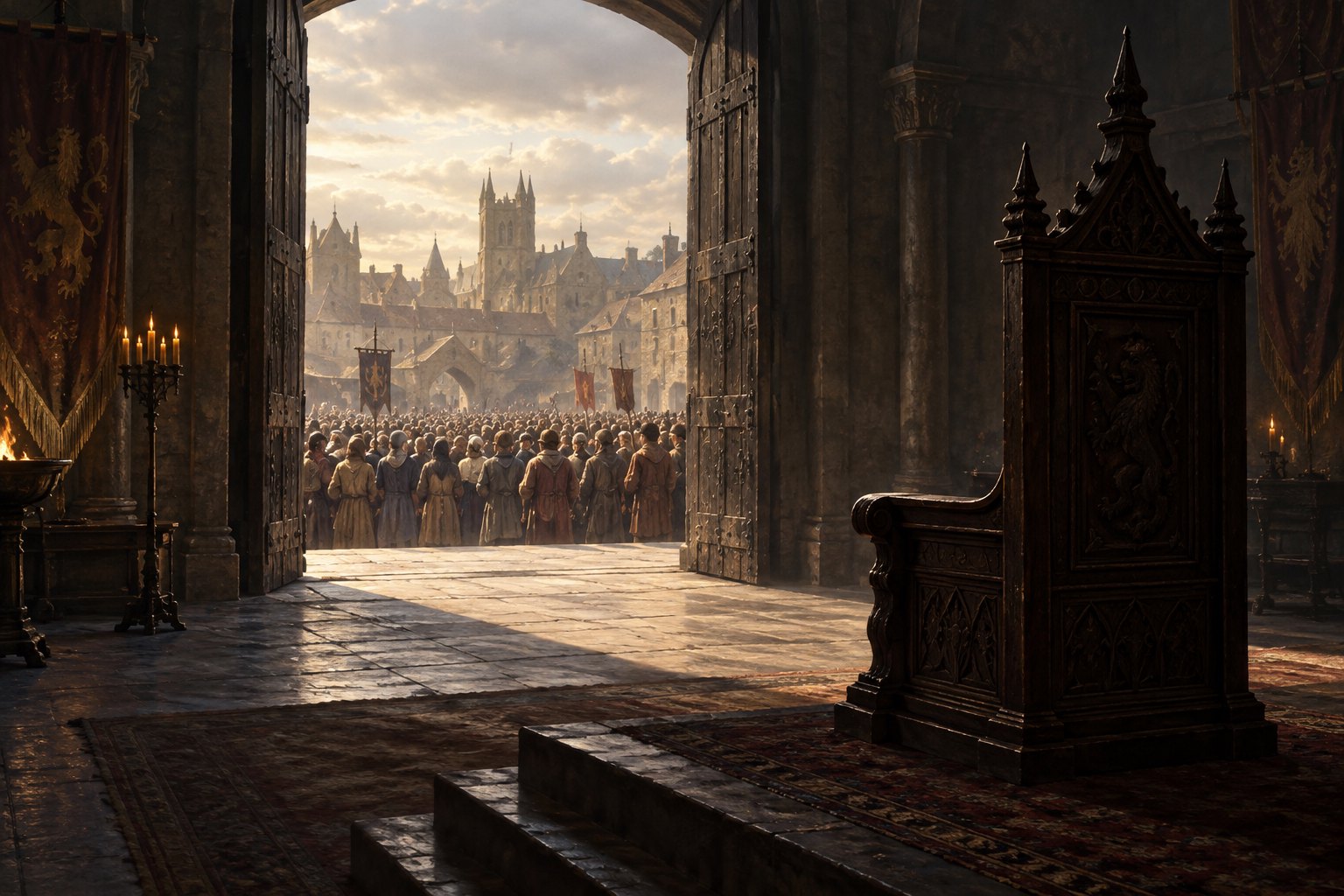
For the Ploughman, the deeper challenge is therefore more than securing an audience. It is discovering whether being heard creates any obligation to answer. A ruler may understand a grievance perfectly and still choose to preserve the arrangement that produces it.
That is my interpretation of the premise’s strongest political tension. The rebels seek recognition from an authority whose position depends on their submission. Their hope is moving precisely because it exposes them. They have made a moral appeal within a structure that need not operate morally.
When justified anger escapes its original purpose
The Associated Press describes the Ploughman recoiling as the rebellion descends into looting and reports his response: “I did not come for this.” The sentence marks a division between the cause he joined and the conduct he encounters.
It is also an uncomfortable claim. Good intentions cannot automatically absolve someone of responsibility for what follows their actions. Yet holding a rebel responsible does not make the original oppression disappear. The character’s dilemma becomes meaningful only if both truths remain in view.
My judgment is that this moral complication offers more analytical substance than the question of whether Garfield eventually resembles a familiar outlaw. The Ploughman must decide how to continue opposing injustice after discovering that opposition itself can become cruel.
That problem connects with our discussion of how costly choices expose character in Everybody Knows. In either kind of drama, a person’s principles become legible through what those principles require them to risk.
The Robin Hood ending: survival or consolation?
Edelman describes the coda as a transformation toward Robin Hood. Read that way, the movement into legend suggests that resistance can survive beyond the immediate fortunes of a rebellion. A recognizable outlaw becomes a way of carrying an unfinished demand forward.
There is another possible reading. Elevating one survivor into folklore can offer emotional reassurance without resolving the collective suffering that made the story urgent. The audience gets a hero to remember, while the people around him risk becoming the background to his emergence.
This is related to the question explored in what an ending owes the story already told. An invitation to imagine future adventures can deepen a conclusion, but it can also draw attention away from consequences that deserve their own weight.
The strongest interpretation of The Uprising holds those possibilities together. Robin Hood can preserve a memory of resistance while simplifying the people and disagreements behind it. Garfield’s Ploughman matters because he stands at that transition: a worker becomes a rebel, and a rebel becomes available for myth. The final question is whose hopes survive that transformation—and whose lives the legend leaves out.
Original content by this site's editorial team. Published: September 9, 2026 at 10:51:26 PDT (Los Angeles time)