
Andrew Garfield’s The Uprising has an explicit Robin Hood connection in its American publicity. That does not make every expectation attached to a conventional Robin Hood adventure a reliable guide to the movie. Paul Greengrass’s film centers on rebellion against King Richard II; the disagreement concerns how that story should be understood before audiences encounter it.
The distinction matters because publicity can quietly rewrite a character’s purpose. Introduce someone as a ploughman, and viewers look for the circumstances that turn a worker into a rebel. Introduce him as a future legendary outlaw, and those same viewers may start searching for clues to an identity they already know.
Light spoilers for the premise and one reported line of dialogue follow. This is a critical examination of the rollout and published descriptions of the film, rather than a firsthand screening review.
What the Robin Hood publicity actually establishes
Focus Features identifies Greengrass as the film’s writer and director. Its official synopsis describes Garfield leading a popular rebellion and explicitly connects the events behind the story to the Robin Hood legend. That establishes the connection as part of the distributor’s presentation, rather than an audience theory. It does not independently establish a historical origin for the legend. [Focus Features’ official film description](https://www.focusfeatures.com/the-uprising).
The sharper contradiction appeared in the competing campaigns. TheWrap reported that American promotional material used the phrase “Witness the Rise of Robin Hood,” while British distributor Entertainment Film Distributors characterized the movie as a historical epic about the Peasants’ Revolt of 1381 and rejected the Robin Hood description. Those are materially different invitations to an audience. [TheWrap’s reporting on the conflicting campaigns](https://www.thewrap.com/creative-content/movies/is-andrew-garfield-playing-robin-hood-in-the-uprising-paul-greengrass/).
Neither statement, by itself, proves that the movie was rewritten, that an ending was added, or that separate countries received different cuts. A disagreement over positioning is evidence of a disagreement over positioning. Claims about changes to the film require additional evidence.
My objection to the rollout is therefore specific: it makes the audience do interpretive work that a clear synopsis should handle. A campaign can protect surprises while still explaining whether familiar mythology is the main attraction, a thematic reference, or an eventual destination.
The Ploughman becomes a different proposition under each pitch
Garfield’s character is identified as the Ploughman. The Daily Beast’s account describes him working the land and mourning a family lost to plague. That reported starting point gives the character a personal burden before the larger rebellion supplies a public role. [The Daily Beast’s account of the film](https://www.thedailybeast.com/obsessed/the-uprising-the-truth-behind-andrew-garfields-secret-robin-hood-movie/).
Consider how the two campaigns affect our reading of that setup. In a political drama, grief can make participation in collective action difficult: a person accustomed to loss must decide whether other people are worth risking further pain for. The dramatic interest lies in an uncertain decision.
Under an origin-story pitch, grief can instead appear to be preparation for a predetermined heroic identity. Viewers may treat the farmer’s life as a preliminary stage, something the movie needs to move beyond before its advertised subject arrives. This is an interpretation of the publicity’s effect, not a claim about a particular scene’s intention.
That difference also changes the pressure placed on Garfield’s performance. An ordinary person becoming a leader invites attention to hesitation, persuasion, and dependence on others. An emerging icon invites attention to stature and recognition. Neither approach is inherently superior, but they ask an actor to hold our interest in different ways.
Our earlier examination of the Ploughman and the film’s relationship to Robin Hood mythology addresses the narrative connection more directly. Here, the important question is what the campaign teaches viewers to value before that narrative unfolds.
A king’s question points toward the collective story
One line quoted in the Associated Press review gives the political premise a useful focus: “Can you not hear their rage?” The king’s question locates the immediate pressure in the people confronting power. My reading of the wording is that its force comes from the plural: the threat exceeds any single rebel. [Associated Press review](https://apnews.com/article/6fd3791e81e501c82a3e66ecf66d8e41).
For a viewer, that suggests a productive shift in attention. Rather than asking only whether the protagonist looks like the hero promised by an advertisement, ask whose needs he is being asked to represent. Leadership becomes dramatically meaningful when the people being led have interests that cannot simply be reduced to admiration for their leader.
This is where the Robin Hood label can help or hinder. It can make resistance to unequal power immediately legible. But it can also encourage audiences to place the emotional weight on a recognizable individual before the film has established the importance of everyone around him.
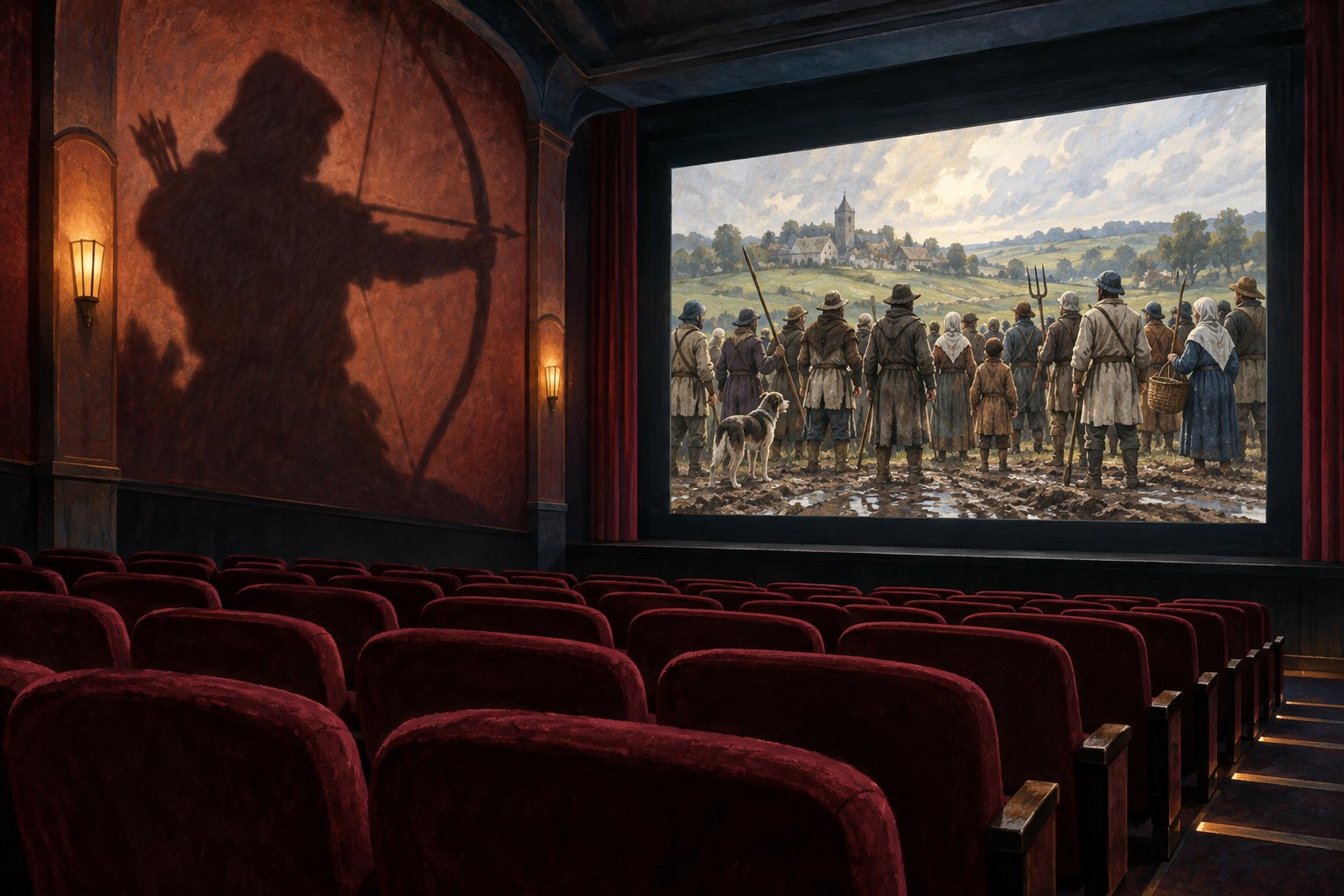
A misleading expectation is not automatically a bad movie
The publicity dispute should not become a substitute for evaluating the filmmaking. Confusing advertising does not establish weak characterization, and an elegant explanation of the Robin Hood connection would not establish strong drama.
The more useful critical standard is causality. Do developments follow from what the characters want, fear, and decide? Does the central figure’s growing importance emerge through relationships and consequences? If a film asks us to revise our understanding of its protagonist, has it supplied the emotional groundwork for that revision?
These questions also prevent recognition from being mistaken for resolution. Learning how a story connects to a familiar name can be satisfying, but familiarity alone cannot settle its human conflicts. That distinction connects with our discussion of why movies still need satisfying endings when a larger story beckons. A recognizable destination has value only when the journey has dramatic substance.
What to keep in mind before watching
- Expect a rebellion-centered premise. The official description emphasizes resistance to royal power and the formation of a popular army.
- Keep the Robin Hood association in proportion. Its presence in the American campaign is confirmed; it should not be treated as a checklist of familiar characters, settings, or adventures.
- Separate historical claims from dramatic interpretation. A distributor’s connection between an uprising and a legend is part of its framing, not sufficient historical evidence on its own.
- Judge character development through consequences. A revealing choice tells us more about a protagonist than resemblance to an established icon.
The deeper issue is who gets to define the protagonist
The most revealing aspect of this rollout is the competition between two ways of assigning significance. One begins with a person’s circumstances and asks how his actions acquire meaning. The other begins with a famous identity and asks how the person reaches it.
My preference is to let the first question lead. It leaves room for uncertainty, other characters, and choices whose value is not guaranteed by a recognizable name. The Robin Hood association may enrich that process, but it should earn its importance through the drama.
For The Uprising, the decisive achievement would be making the Ploughman worth following before any legendary association becomes relevant. Audiences can recognize Robin Hood almost instantly. Caring about the person placed beneath that name takes a story.
Original content by this site's editorial team. Published: September 9, 2026 at 12:18:14 PDT (Los Angeles time)