
Woman Unknown has won the Golden Lion at the 2026 Venice Film Festival, bringing May el-Toukhy’s postwar Danish drama to the center of the film conversation. Mathilde Arcel also received the best actress award. The recognition invites a closer look at Marie, the housemaid she plays: a woman whose opportunity to build a secure future depends on keeping a dangerous past concealed. The awards were reported by [Reuters](https://wsau.com/2026/09/12/woman-unknown-wins-venice-top-prize-as-lone-female-contender-triumphs/).
El-Toukhy was the competition’s only solo female director, a distinction that gives the victory institutional significance. But Marie’s predicament deserves its own attention. What does advancement mean when a person’s new security can disappear the moment someone else tells her story?
Spoiler note: This critical analysis discusses the official premise and selected situations described in published festival coverage, without revealing the ending. It does not offer a firsthand assessment of the complete film. Dialogue is paraphrased where exact English subtitle wording cannot be verified.
Marie’s marriage promises a place in the world
The official synopsis identifies Marie as a young nanny and housemaid preparing to marry Christian, her wealthy, older employer, who is a widower. Her wartime relationship with a German soldier threatens that transition. These are the central circumstances established by [the Venice festival’s film entry](https://www.labiennale.org/en/cinema/2026/venezia-83-competition/kvinde-ukendt-woman-unknown).
Viewed through Marie’s position, the engagement carries several meanings at once. It can offer affection, shelter, status, and an escape from dependence on wages. Those possibilities need not cancel one another. Reading her primarily as an opportunist would make the social arrangement appear simpler than it is: the person offering intimacy already possesses the resources that shape her choices.
My reading of this premise is that marriage creates an unstable kind of promotion. Marie can move upward inside the household without necessarily gaining the freedom to define herself. Becoming its mistress may change how others address her while leaving her vulnerable to their approval.
That distinction gives the story a sharper question than whether she will successfully conceal a secret. Can she belong somewhere without continually proving that she deserves to remain?
Christian’s home makes affection inseparable from power
Christian’s dual position as employer and future husband matters even before any judgment about his intentions. A disagreement between romantic partners takes on different stakes when one partner controls the other’s livelihood and domestic security. From Marie’s perspective, honesty therefore has a material cost as well as an emotional one.
From Christian’s position, the household can appear orderly and reassuring. The person who works within it may experience that same order as a series of conditions. This is an interpretation of their unequal circumstances, rather than a claim about his private motives: comfort looks different depending on who has the power to withdraw it.
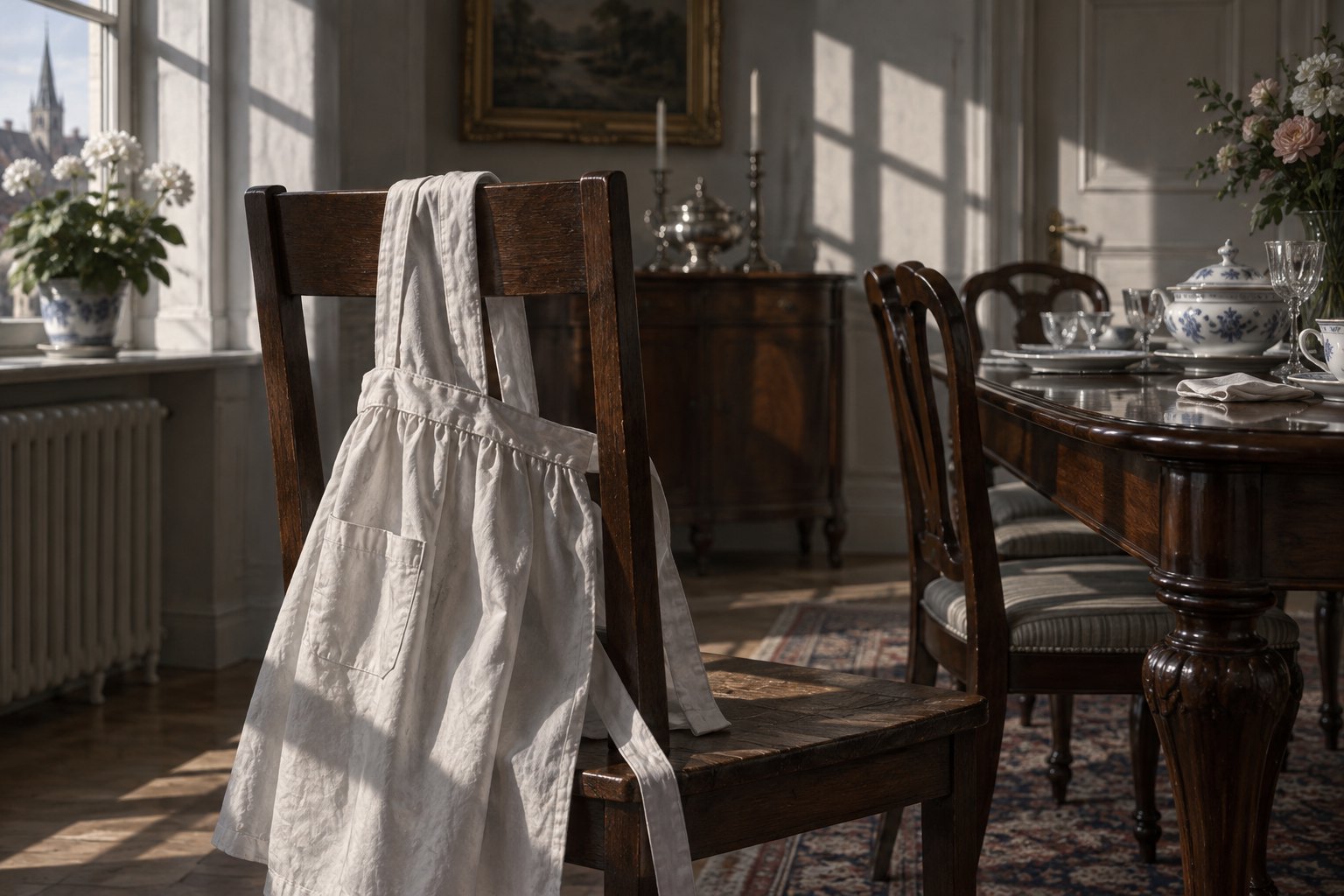
The illustration’s apron and dining table suggest that divide between maintaining a home and possessing a secure place within it. They are symbolic editorial imagery. The useful question for viewers is how Marie’s obligations change as her formal status changes—and which expectations survive untouched.
A related concern appears in our character analysis of The Surgeon: professional usefulness can give a woman influence while leaving others convinced that they are entitled to control her.
A liberated country can remain dangerous to women
El-Toukhy’s festival statement places the story amid punishment directed at women who had relationships with occupying soldiers. She describes a society in which women’s sexual behavior became entangled with national identity. In her acceptance speech, she called the film an examination of “the female body as a battleground and a public matter.” That is the director’s description, not a line spoken by Marie.
The distinction between political liberation and personal safety is essential to this interpretation. A nation can celebrate the departure of an occupying force while allowing new forms of coercion to operate in streets and homes. Marie’s fear belongs to that gap between a public declaration of freedom and the private experience of living without protection.
There is also an ethical difference between investigating wartime conduct and treating an intimate relationship as sufficient grounds for humiliation. The latter makes the woman’s body carry a public verdict. Individual circumstances become inconvenient because punishment has already supplied a collective story.
For a viewer, resisting that simplification means considering Marie’s decisions without assuming that fear proves guilt. It also means allowing her to be complicated. A character does not have to be perfectly candid, generous, or admirable to deserve protection from violence.
The child’s grief reveals what survival can teach
One revealing exchange described in festival coverage concerns Christian’s grieving daughter. The child asks Marie whether the pain of missing her mother will ease. Marie’s response, paraphrased, advises learning to make herself stop being sad. [In Review Online’s account](https://inreviewonline.com/2026/09/12/woman-unknown-review/) describes this encounter; the precise subtitle wording is not reproduced here.
Read from the child’s perspective, this is a request for reassurance. Read from Marie’s, it can sound like instruction in a technique she needs herself. The distance between those needs is painful: an adult may sincerely try to help while passing along the habits that have made her own life bearable.
That is a more troubling idea than simple emotional coldness. Suppression can become a form of practical knowledge, taught by someone who has had little opportunity to discover a safer alternative. Care and damage can travel through the same conversation.
This exchange also widens the story beyond Marie’s secret. It asks what children inherit from adults whose first priority must always be getting through the day. An apparently small domestic answer can carry the pressure of an entire social order.
What the Venice victory establishes—and what remains open
The Golden Lion and acting award establish the jury’s recognition of the film and Arcel’s work. They do not settle every question about pacing, characterization, or the handling of suffering. Those require engagement with the finished film. A useful response to the victory is curiosity about Marie’s contradictions, rather than an assumption that prestige supplies a complete critical verdict.
Readers looking for the wider awards context can turn to our Venice winners coverage and analysis of Wild Horse Nine. Here, the more revealing focus is the relationship between recognition and visibility within Marie’s story.
The deeper question behind Woman Unknown
The title invites an interpretation in which being unknown can mean both exclusion and protection. Marie risks being reduced to her past if it becomes public; concealing it may help preserve her future while preventing others from fully understanding her.
That tension is the strongest reason to approach the film through its protagonist. Security purchased through silence can leave a person housed, accepted, and profoundly alone. The promise of a new life remains incomplete if it requires living as someone whose history cannot be spoken.
Venice has made Woman Unknown highly visible. Its central predicament asks us to consider something more intimate: whether a woman can be known without becoming someone else’s property, evidence, or accusation.
Original content by this site's editorial team. Published: September 13, 2026 at 08:04:35 PDT (Los Angeles time)