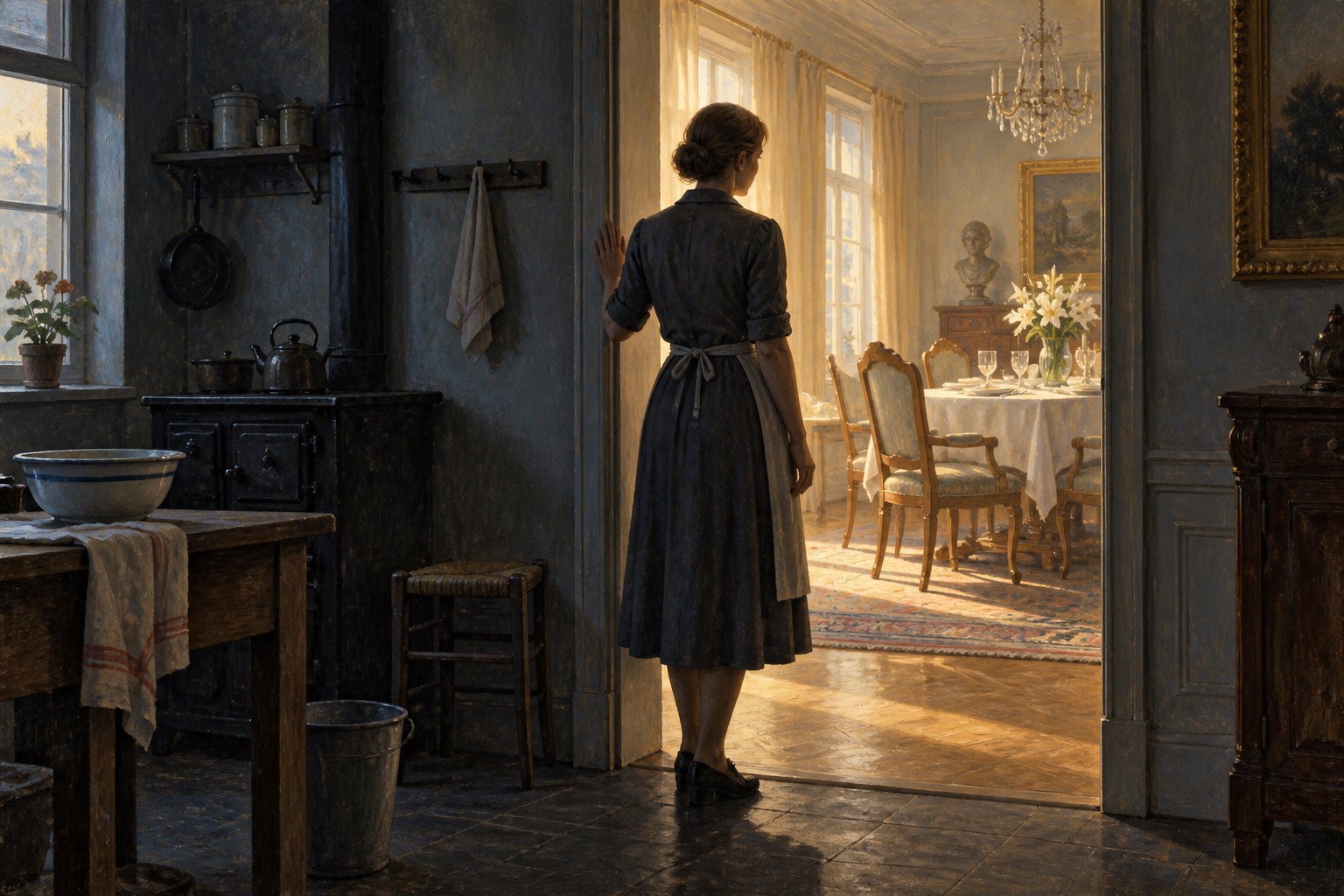
Woman Unknown, directed by May el-Toukhy, has won the Golden Lion for best film at the 2026 Venice Film Festival. Behind that achievement lies a domestic premise with an uncomfortable question: when a woman who already cares for a household marries its owner, how much power actually changes hands? The award was also confirmed by [the Associated Press](https://apnews.com/article/a6018c587044350c0503e1c199d5077f).
Marie’s prospective marriage offers an obvious transformation in status. Her position within a family is harder to describe. She is an employee preparing to become a wife, a caregiver preparing to become a stepmother, and a person whose history threatens the future she wants. Those overlapping roles make the household worth examining beyond the threat of exposure.
Spoiler note: This critical companion discusses the established premise and selected early character details documented in festival materials and published coverage. It does not reveal the ending or offer a firsthand assessment of the complete film.
A caregiver before she becomes a bride
The official Venice synopsis identifies Marie as a nanny and housemaid preparing to marry Christian, her wealthy, older, widowed employer. She has concealed an intimate relationship with a German soldier during the occupation, and its possible discovery threatens her position in postwar society. Those are the story’s documented starting conditions. [Venice’s film entry](https://www.labiennale.org/en/cinema/2026/venezia-83-competition/kvinde-ukendt-woman-unknown) also identifies Mathilde Arcel and Carsten Bjørnlund among the principal cast.
Consider the arrangement from Marie’s position. She is already useful inside this home. Its routines depend, at least in part, on work she performs. Yet usefulness gives her no automatic claim to the security that marriage promises. The uncomfortable distinction is between being needed and having needs that other people recognize.
That makes the marriage plot more complicated than a fantasy of upward mobility. A new title can change how someone is introduced without changing the habits through which others understand her. If a relationship begins with one person giving instructions and another accommodating them, equality requires more than a ceremony.
Our earlier examination of the stakes of Marie’s impending marriage considers its promises of protection and respectability. The family perspective adds another question: will the people who accept her care make room for her independent emotional life?
Leonora’s memory complicates the new beginning
Christian’s daughter Leonora provides a different way into that question. Published scene coverage describes her keeping a photograph of her deceased mother beneath her pillow despite her father’s wish to remove reminders of his late wife. This small act gives the child a private relationship with a past the household’s authority would prefer to put away. [The published scene account](https://wdcnews6.com/woman-unknown-review-may-el-toukhys-paranoid-period-thriller/) supplies that detail.
My reading is that the photograph matters because remembering becomes something Leonora must protect. An adult can announce that a family is moving forward; a child may experience the same announcement as a demand to abandon someone. Her attachment deserves consideration on its own terms, without assuming that it amounts to hostility toward Marie.
This also complicates the position Marie is entering. Becoming a stepmother cannot mean completing an administrative vacancy. A child’s previous attachments remain part of the family. The photograph offers a precise lens for thinking about belonging: a home becomes more generous when it can accommodate relationships that do not revolve around the person currently exercising authority.
Care does not erase competing needs
A reading centered on caregiving must resist turning Leonora into evidence of Marie’s goodness. Looking after a child is meaningful work, but a child also has interests that exist independently of the adult’s struggle. Likewise, Marie’s capacity to provide care cannot be the sole measure of whether she deserves understanding.
This is where the family structure becomes especially useful for criticism. Three different desires can coexist: an adult’s wish for a stable partnership, another adult’s wish for safety, and a child’s wish to maintain a connection with a lost parent. None automatically settles the others. Calling the household a family should begin a conversation about those obligations, rather than conclude it.
From this perspective, the most revealing distinction is between incorporation and acceptance. Incorporation assigns someone a place in an existing arrangement. Acceptance allows that person’s presence to alter the arrangement itself. Marie’s transition invites us to ask which kind of welcome a marriage can offer when its terms have largely been established before she arrives.
The difference between intimacy and management
Christian’s roles as employer, father, and prospective husband concentrate several kinds of authority in one person. The resulting imbalance does not require us to invent motives for him. It is already present in the relationships described by the film’s premise.
Viewed from his position, maintaining continuity might appear responsible. A household has obligations; a child needs care; a marriage promises companionship. Yet responsibility becomes incomplete when the person organizing everyone else’s future does not recognize their ability to define it differently.
For Marie, the corresponding danger is that accommodation can become habitual. Being attentive to someone’s expectations may help a domestic employee navigate daily work. Within a partnership, the same habit can make disagreement feel like a failure of duty. The distinction matters because intimacy requires space for an inconvenient answer.
These questions also explain why attention to cinema’s collaborative craft remains valuable after an awards announcement. In assessing the finished film, performance, framing, and editing need to establish whose response receives attention during an exchange. A premise can identify unequal power; its dramatic execution must make that inequality perceptible.
A deeper reading: belonging must include a past
The family angle brings two different relationships with memory into view. Marie’s concealed history threatens her hoped-for future. Leonora’s attachment to her mother preserves something she does not want that future to erase. Their circumstances are distinct, but together they challenge the idea that starting over means becoming free of everything that came before.
My interpretation is that this is the most productive question to carry into Woman Unknown: what kind of family requires someone to become easier to accommodate before allowing them to belong? It directs attention toward the ordinary conditions of acceptance, including who may remember, who may disagree, and whose discomfort receives a response.
Venice’s Golden Lion brings attention to el-Toukhy’s film. Its domestic premise gives that attention somewhere specific to go. Marie’s possible arrival as a wife matters, but the deeper test is whether she can arrive as a whole person—and whether the household can offer its child the same freedom.
Original content by this site's editorial team. Published: September 12, 2026 at 16:36:57 PDT (Los Angeles time)