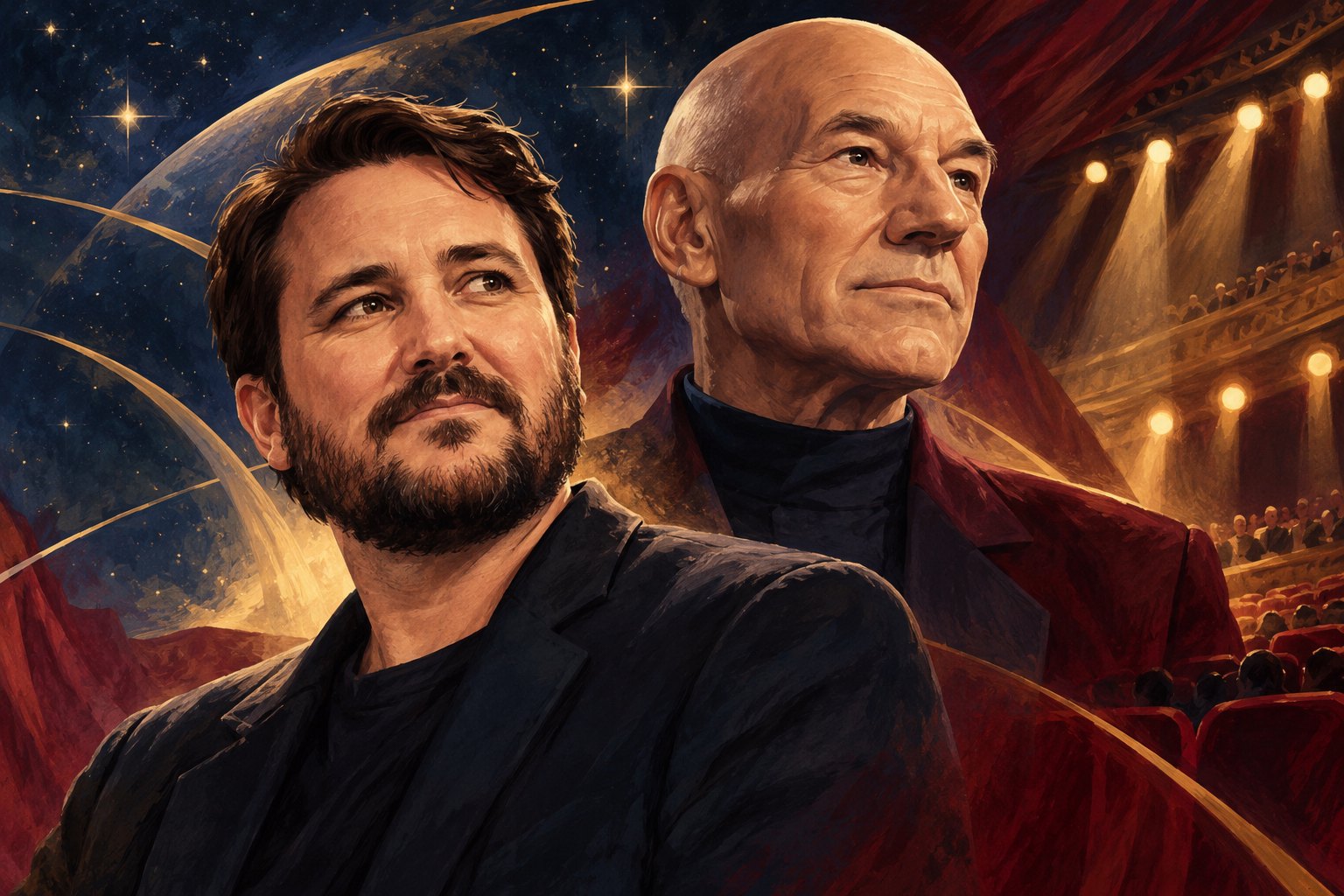
Wil Wheaton’s rebuke of Stephen Miller puts a familiar question in unusually blunt terms: what does it mean to admire Patrick Stewart while disputing the values associated with his work? Yahoo’s report describes Wheaton telling Miller to keep Stewart’s name out of his “Nazi mouth.” That phrase is Wheaton’s denunciation, not an independently established characterization adopted here.
The confrontation invites an argument about who gets to invoke a beloved actor. For viewers, however, there is a more illuminating question underneath it: what did Stewart make compelling about Captain Jean-Luc Picard? His authority was certainly part of the appeal. But his finest moments also exposed the limitations of authority—including his own.
Critical perspective: The following discussion contains major spoilers for Star Trek: First Contact.
What Wheaton’s statement can—and cannot—tell us
The reported remark establishes the vehemence of Wheaton’s objection to Miller invoking Stewart. It does not, by itself, establish every detail of Stewart’s private opinions, nor does it make Wheaton the final interpreter of an entire franchise. Those distinctions matter even when readers sympathize with his anger.
Actors acquire meanings beyond their performances. Audiences remember a voice, a gesture, or a character’s decision, then attach those memories to their understanding of the person. With Stewart, that process is especially powerful: Picard’s measured delivery can make intelligence and moral seriousness feel almost physically present.
Yet a performance is richer than a badge of affiliation. Admiring an actor does not automatically demonstrate agreement with the actor’s convictions. Equally, admiring a character does not prove that someone has understood the story’s criticism of that character. This tension belongs to the larger question of who has authority over a public portrayal: personal attachment carries emotional weight, but interpretation still needs evidence.
First Contact makes Picard’s authority a problem
The 1996 film Star Trek: First Contact offers a particularly useful test. Picard and the Enterprise pursue the Borg into Earth’s past to prevent them from destroying the Phoenix, humanity’s first warp-speed vessel. The mission concerns the survival of a future built around exploration and contact. For Picard, however, the enemy also brings his own history of assimilation painfully close.
That gives the film two kinds of stakes. There is the external emergency, which demands decisive leadership. Then there is the personal wound, which can make decisiveness difficult to distinguish from compulsion. Stewart’s performance draws its force from allowing both to occupy the same man.
My reading is that the film works best when viewers cannot simply relax into trusting him. We understand why Picard hates the Borg. Understanding that hatred does not make every decision it produces defensible. The captain’s experience gives him knowledge, but it also gives him a reason to misread himself.
This is a valuable complication for any discussion of Stewart’s legacy. The impressive voice is not a guarantee of moral accuracy. Sometimes the performance asks us to hear what authority sounds like when it is protecting an unresolved grievance.
Picard’s famous declaration needs its context
“The line must be drawn here” is an irresistible expression of resolve when detached from its scene. Within the film, its force is more troubling. Picard’s determination to keep fighting the Borg has become entangled with revenge, while Lily Sloane challenges his refusal to abandon the Enterprise.
The scene does not make resistance itself foolish. The Borg remain a threat. What it questions is Picard’s ability to assess the cost of his particular response. A legitimate enemy does not make every act of defiance wise, and a justified fear does not erase a leader’s responsibility to other people.
Stewart makes the outburst compelling enough that the audience can feel its appeal before confronting its danger. That is the dramatic achievement. A weaker performance would either make Picard transparently unreasonable or turn his anger into uncomplicated triumph. Here, the audience must reconsider the very charisma that helped win its allegiance.
Applied to the Wheaton–Miller dispute, the useful lesson is interpretive rather than predictive. The film cannot tell us what Stewart would say about every political confrontation. It can remind us that quoting a commanding character is different from following the argument of his story.
Lily supplies the perspective Picard lacks
Lily has no reason to treat the captain’s reputation as an answer. Her immediate concern is what his decisions mean for the people trapped aboard the ship. Where he sees a struggle charged with historical and personal significance, she sees lives endangered by his inability to stop.
Her comparison to Captain Ahab cuts through his self-description. “See you around, Ahab” works because it places Picard inside a story he recognizes. His literary knowledge becomes useful only when he accepts that the warning might apply to him.
For me, this is the film’s strongest exchange. Lily does more than provide a moral lesson for its central figure. She changes the terms on which he must explain himself. Rank, eloquence, and experience cannot substitute for an honest account of his motives.

The shattered display of miniature ships makes that failure tangible. Lily’s observation, “You broke your little ships,” brings the confrontation down from grand declarations to visible damage. The objects reveal something Picard’s rhetoric conceals. As in our discussion of what movie objects reveal about character, a prop becomes meaningful through the behavior surrounding it.
Where the film earns its optimism
First Contact’s great strength is that its faith in humanity survives this humiliation of its hero. Picard does not need to remain correct at every moment for the future he represents to remain worth protecting. He needs to become capable of hearing a correction.
There is a limitation here, too. The confrontation gives a deeply rooted injury a relatively concentrated dramatic resolution. Viewers who want a more sustained account of Picard’s trauma may find the movement from rage to recognition unusually swift. As an action film, however, it turns an internal struggle into a clear, consequential choice without making the struggle meaningless.
Its optimism becomes persuasive because it includes fallibility. The advanced society Picard describes has not magically removed every destructive impulse from its citizens. Its ideals still require practice, especially when fear and pain make them difficult to uphold.
Honoring Stewart means keeping the complexity
Wheaton’s response to Miller is an argument about the meaning attached to Stewart’s name. Readers can judge its language separately from the broader concern it raises: whether public admiration engages with a person’s values or merely borrows their prestige.
Stewart’s work offers a demanding way to approach that concern. Picard matters because he can be principled, persuasive, wounded, and wrong—and because recognizing the last possibility does not destroy the first. His dignity survives being challenged.
The deeper achievement of First Contact is its insistence that a humane future depends on relationships in which correction remains possible. Lily does not diminish Picard by refusing to flatter him. She helps him recover the judgment his anger has displaced. Any account of Stewart’s legacy that remembers only the commanding speeches misses the quieter courage of listening afterward.
Original content by this site's editorial team. Published: October 31, 2026 at 07:53:32 PDT (Los Angeles time)