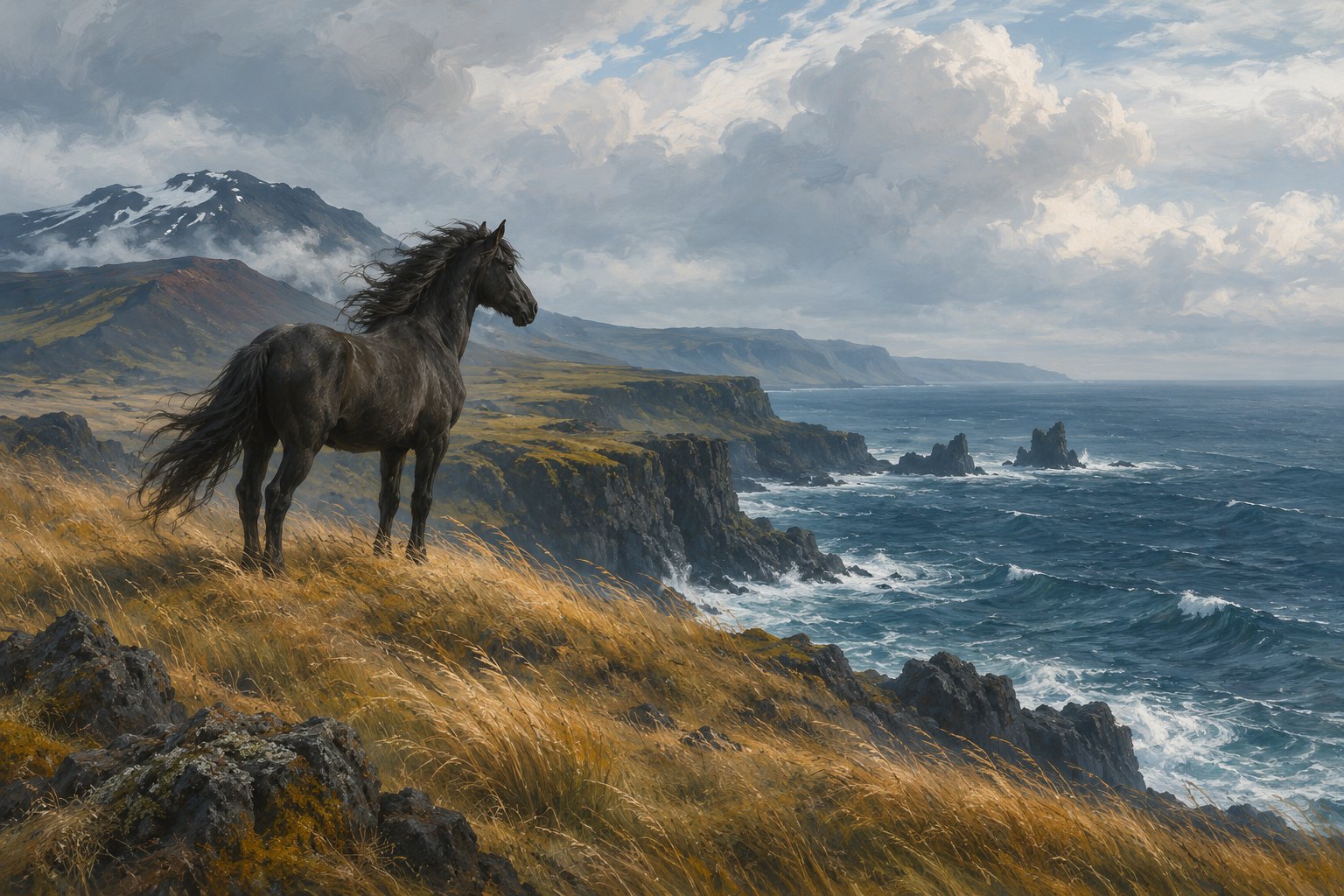
Wild Horse Nine has a partly straightforward explanation and a deliberately elusive one. The horses connect to the animals roaming Easter Island, where much of Martin McDonagh’s film takes place. The precise significance of “Nine” is less settled: McDonagh has publicly resisted supplying a definitive answer. That distinction matters. A plausible interpretation is not necessarily the filmmaker’s confirmed explanation.
The unexpected part is that the title may work better as an invitation to consider John Malkovich’s character than as a puzzle with a single solution. What does freedom look like to someone who has spent his working life controlling other people’s futures?
Spoiler note: This analysis discusses the premise, illness, character relationships, and selected dialogue. It does not reveal the ending. It draws on published interviews and documented scenes rather than claiming a firsthand screening.
What McDonagh Has Actually Said About the Title
In his conversation with David Marchese for The Interview, McDonagh was asked directly about the number. He playfully suggested that an audience might find an answer on a third viewing, while also allowing that he might not know its meaning himself. He additionally recalled an earlier title, Wild Horse 9: Easter Island. Those remarks establish ambiguity, not a secret code that critics have conclusively cracked. [McDonagh’s interview transcript](https://podcasts.happyscribe.com/the-daily/martin-mcdonagh-has-a-vision-for-hope-it-s-not-for-the-faint-of-heart)
The useful distinction is between identifying a motif and explaining every word of a title. Horses can carry emotional significance without the number becoming a mathematical key. Counting animals, identifying religious associations, or proposing an intelligence designation might produce interesting theories; none should be presented as the official answer without supporting evidence.
My reading is that the title establishes a productive imbalance. “Wild Horse” suggests movement and independence. “Nine” sounds precise, as though something has been classified. That friction between freedom and classification suits a story about men whose professional identities depend on institutions, orders, and secrets. This is a linguistic interpretation, not a confirmed account of McDonagh’s intention.
Chris: A Man Who Can No Longer Control His Future
The verified setup places CIA agents Chris, played by Malkovich, and Lee, played by Sam Rockwell, in Chile shortly before the 1973 coup. Their superior, MJ, played by Steve Buscemi, sends them from Santiago to Easter Island. There, their shared history and Chris’s connection with two students complicate the trip. Searchlight identifies McDonagh as both writer and director and lists the American theatrical release for November 6, 2026. [Searchlight’s film information](https://press.searchlightpictures.com/wild-horse-nine)
Chris’s approaching death makes the question of freedom especially uncomfortable. According to the Associated Press’s account, he has cancer and increasingly wanders through thoughts about his life and its consequences. He also imagines a Western from a horse’s perspective, calling it a “downbeat Western.” Lee answers, “There’s no way I’m seeing that Western.” [Associated Press review](https://apnews.com/article/0b906f9c404fb6da854bc9d4675b72a2)
That exchange offers a particularly useful route into the title. A Western usually asks us to follow the person holding the reins. Chris’s proposed version shifts attention to the creature being directed. Read alongside his profession, the joke raises an uncomfortable possibility: someone accustomed to exercising power is finally considering a perspective outside it.
Yet an imaginative shift is not the same as a moral transformation. Recognizing another point of view does not undo what a person has done. The more compelling question is whether Chris wants to understand the lives around him or simply wants a comforting story about his own departure.
This is where character analysis needs to remain demanding. Illness can explain vulnerability without proving innocence. A film can ask us to care about a frightened man while leaving our judgment of his actions intact.
Lee: When Friendship Becomes a Moral Problem
Lee gives that tension a second human perspective. In the Marchese interview, McDonagh described the central relationship as a deeply loving friendship expressed through bickering, with the familiarity of a long marriage. The affection is part of the dramatic design, not an assumption audiences must make because two recognizable actors share the screen.
That familiarity changes how we can read Lee’s response to the imagined Western. On the surface, it is a funny rejection of a miserable movie pitch. Within a friendship shaped by approaching loss, the refusal can also suggest resistance to Chris’s increasingly bleak perspective. Humor allows the conversation to continue without requiring either man to speak plainly about fear.
From Lee’s position, loyalty contains competing obligations. Listening can be an act of care. Challenging a friend can be another. Shared experience makes understanding possible, but it can also make excuses feel natural. The critical question is where companionship stops helping someone face reality and starts protecting him from it.
Our discussion of how an ensemble gains substance through distinct character perspectives provides a useful comparison. The value of this pairing lies in the pressure each character places on the other’s account of himself.
The Horses and the Life Chris Cannot Keep
Another documented line brings the emotional stakes into sharper focus. Speaking about the young student Monica, Chris says, “She’s life, and I’m leaving it.” Sean Burns’s review identifies the line within Chris’s attachment to her. [WBUR’s discussion of Chris and Monica](https://www.wbur.org/news/2026/11/04/martin-mcdonagh-wild-horse-nine-john-malkovich-film-review)
The sentence is affecting because its second half revises its first. Chris begins by identifying vitality in another person, then immediately describes his own absence from it. Even his admiration is filtered through mortality. That makes the feeling understandable while leaving room to question its self-centeredness.
For me, the horses invite a related reading. They suggest life continuing beyond Chris’s authority and beyond his ability to explain it. Their significance need not depend on a supernatural message or a numerical solution. The essential contrast is between a man preoccupied with the meaning of his life and a living world that owes him no answer.
Monica, however, must remain more than an emblem of youth in that interpretation. Reducing her to what Chris needs would repeat his limited perspective. As with our examination of why character choices need their own dramatic justification, the strongest reading leaves space for people to exist beyond the central character’s emotional requirements.
A Title About the Limits of Explanation
The most persuasive interpretation of Wild Horse Nine does not require pretending that its final word has been solved. The horses provide an image through which to consider freedom; Chris and Lee supply the human complications. Affection, fear, regret, and responsibility can coexist without resolving into a clean verdict.
That is also the standard by which this kind of drama deserves to be judged. Does sympathy deepen our understanding, or does it quietly become absolution? Does a beautiful image challenge the characters’ worldview, or merely decorate their sadness?
My reading favors the harder possibility: Chris can recognize something precious without possessing it, and he can fear death without having settled his moral debts. The title’s uncertainty becomes meaningful when it preserves that discomfort. Its power lies less in delivering a hidden answer than in leaving a man who once acted with institutional authority confronting something he cannot command.
Original content by this site's editorial team. Published: November 5, 2026 at 01:40:31 PST (Los Angeles time)