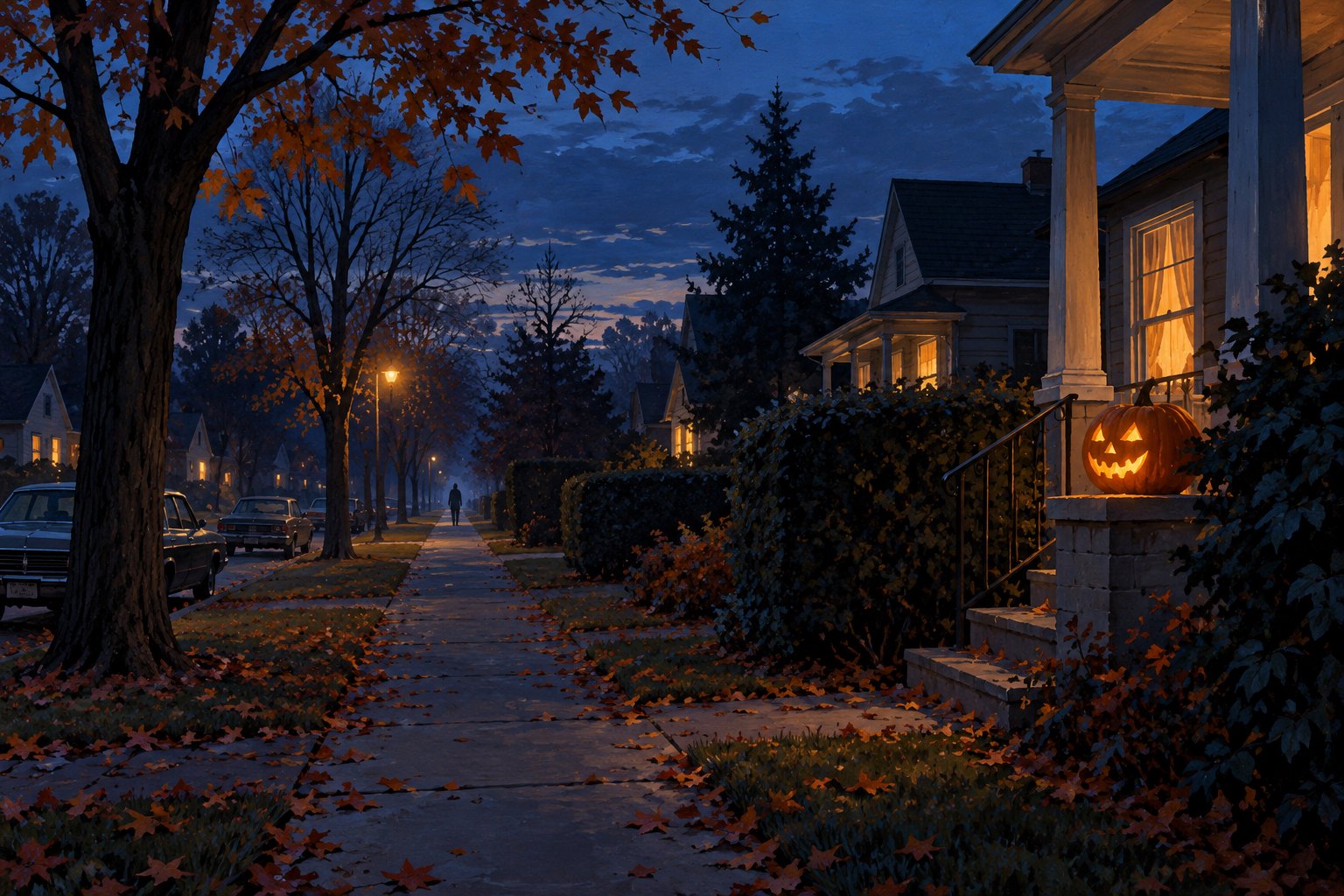
John Carpenter’s Halloween (1978) is my pick for the best Halloween horror movie because the holiday shapes how its characters misunderstand danger. Masks look ordinary. Frightened children sound imaginative. A stranger glimpsed outside might be someone playing a joke. The film turns the night’s permission to scare people into a reason genuine fear goes unanswered.
Directed and scored by Carpenter, and written by Carpenter and producer Debra Hill, the original film builds its strongest suspense around Jamie Lee Curtis’s Laurie Strode. She has homework, friends, insecurities, and a babysitting job. Watching those manageable concerns give way to something she cannot explain remains more frightening than an elaborate account of why a killer kills.
Viewing guide: Choose this for patient stalking sequences, autumn atmosphere, and sustained tension. Its violence is less graphically displayed than its reputation might suggest, but it includes killings, sexual content, and nudity. Viewers seeking constant action or a cheerful party movie may find its long stretches of watching and waiting a poor fit.
Spoilers follow for the entire 1978 film, including its ending.
Laurie Strode makes an ordinary evening matter
After an opening that reveals Michael Myers murdered his sister as a child, the story moves forward fifteen years. Michael escapes confinement and returns to Haddonfield. Laurie encounters his presence while moving through familiar places, but she has no access to the history that would make those encounters intelligible.
That gap is crucial. We know she has reason to worry; she knows how embarrassing it might be to insist. Her friends turn her uneasiness into teasing, and Curtis makes Laurie’s uncertainty feel socially recognizable. She is trying to judge both what she saw and whether other people will think she is ridiculous for mentioning it.
Laurie’s reserve also gives her relationship with Tommy Doyle warmth. Babysitting allows her to be competent without having to perform the confidence her friends expect. She can organize an evening, reassure a child, and make herself useful. The film establishes those abilities before it tests them.
Once she must protect both Tommy and Lindsey Wallace, survival becomes more than a private contest between victim and attacker. She has to manage someone else’s panic while barely containing her own. Curtis makes that divided attention the emotional center of the final act.
Michael Myers turns looking into a source of dread
Michael’s most disturbing quality is how little response he offers. His mask withholds the expressions through which people normally negotiate an encounter. There is no visible embarrassment at being noticed, no apology, and no invitation to understand him.
Carpenter and cinematographer Dean Cundey repeatedly make the surrounding space worth inspecting. A hedge, a window, or the far side of a street can become more important than the person speaking in the foreground. The viewer starts searching the picture instead of simply following the dialogue.
This makes the suspense participatory. You may spot a figure before Laurie does, yet seeing him gives you no way to help her. At other times, an empty space becomes uncomfortable because the film has trained you to expect a presence there. Its patience is doing practical work.
My main reservation is that this rhythm can become repetitive for viewers who already know the film’s methods. Several passages depend on anticipation rather than new information. But on a quiet Halloween evening, that repetition feels purposeful: the neighborhood gradually becomes a place where looking away seems irresponsible.
The holiday gives everyone a plausible excuse
Sheriff Brackett’s remark, “Everyone’s entitled to one good scare,” captures the town’s assumptions. Fear belongs to the occasion, so it does not automatically require investigation. The line is friendly in context and increasingly uncomfortable in retrospect.
Annie and Lynda inhabit that same ordinary social world. Their teasing, romantic plans, and impatience help establish what the evening should have been. Reducing them to people who break horror-movie rules misses the more unsettling point: they behave as though other people share basic limits.
Michael exploits those expectations when he approaches Lynda beneath a sheet, wearing Bob’s glasses. She interprets the disguise through someone she knows. The audience understands that familiar signs have become unreliable.
This is where Halloween imagery gains dramatic weight. A costume changes what a character believes and how she responds. Our commentary on how horror imagery becomes character storytelling explores a related distinction: recognition alone is less affecting than a frightening image attached to a human vulnerability.
Laurie fights with the home she has available
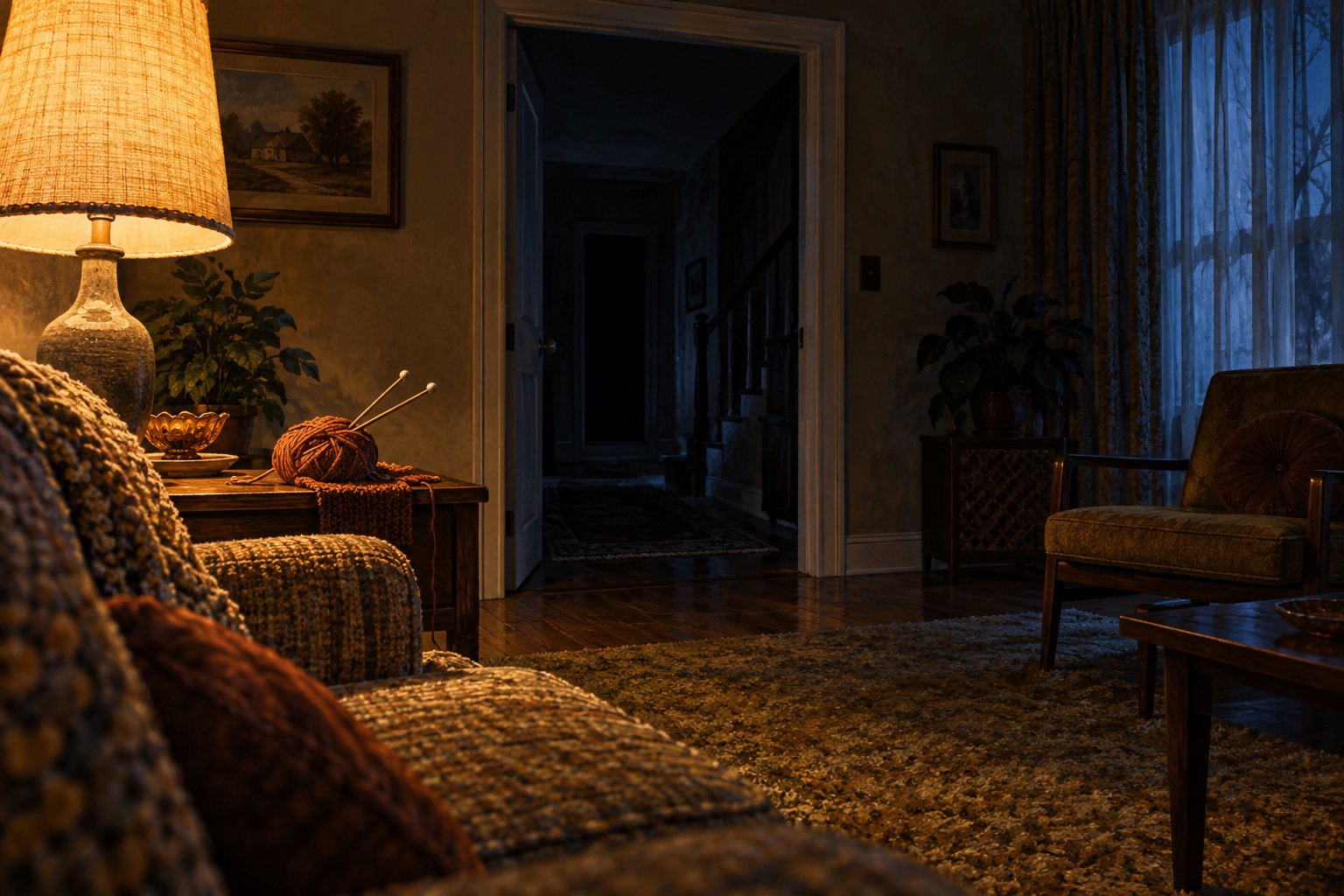
During the attacks, Laurie uses a knitting needle and later a wire hanger to defend herself. These objects matter because they belong to the domestic environment the film has already made familiar. She does not suddenly acquire a new set of abilities; she improvises under pressure.
The closet sequence makes the limits of shelter painfully clear. A hiding place can conceal Laurie, but it also restricts her movement. Each barrier buys time without delivering the security she needs. The house becomes a series of temporary solutions.
There is room to criticize how often she assumes Michael has stopped moving for good. Repeated apparent defeats can feel like a mechanism for extending the climax. Curtis nevertheless gives those pauses an understandable emotional basis: Laurie desperately wants the emergency to be over, and she still has children to check on.
The relationship between restricted space and fear also connects with our analysis of how enclosed environments make helplessness personal. Here, the force comes from knowing where Laurie can move and watching those options disappear.
Loomis’s certainty cannot restore order
Donald Pleasence’s Dr. Loomis offers a striking contrast to Laurie. She struggles to trust her perception; he speaks with absolute conviction about Michael’s danger. His urgency suggests that understanding the threat should make it containable.
Yet Loomis spends much of the film searching. Knowledge does not place him wherever protection is needed. Pleasence’s intensity is effective partly because it contains that frustration: he can communicate catastrophe more readily than he can prevent it.
Tommy’s warning, “You can’t kill the boogeyman,” supplies the simpler explanation. To Laurie, it initially belongs to childhood fear. By the conclusion, after Loomis shoots Michael and his body disappears, that childish category seems harder to dismiss.
Loomis’s answer to Laurie—“As a matter of fact, it was”—is chilling because reassurance has been replaced by acknowledgment. An adult authority finally validates the fear without being able to remove it.
The ending makes survival different from safety
My reading of Halloween is that its deepest horror concerns the loss of reliable reassurance. Friends can misunderstand you. A house can fail to shelter you. An expert can recognize danger and still arrive late. Laurie survives, but survival does not return her to the world she believed she occupied that morning.
The final views of emptied spaces, accompanied by Michael’s breathing, extend that uncertainty beyond a single attacker’s location. The film leaves us examining ordinary rooms as though their apparent emptiness proves nothing.
That is why it remains my seasonal choice. Halloween ends when the calendar changes; the habit of checking the doorway can last longer.
A television detail worth noticing
The children’s television viewing includes The Thing from Another World (1951), a film Carpenter would later revisit with The Thing (1982). Within Halloween, the older movie also creates a pointed contrast: a monster on television offers a contained evening’s entertainment while an actual threat approaches outside.
That small detail expresses the pleasure and danger of the whole film. Laurie expects to help the children enjoy being frightened. By the end, she needs someone to tell her where pretend fear stops—and nobody can.
Original content by this site's editorial team. Published: October 28, 2026 at 02:49:51 PDT (Los Angeles time)