If you are choosing between Ramayana’s Hindi and English theatrical cuts, the Hindi version with English subtitles is the stronger first-viewing choice on the available reporting. The reason is character development: the longer version reportedly preserves family encounters that help explain what Rama knows, whom he loves, and what his obligations cost him.
That recommendation needs a clear boundary. This is an analysis of reported differences between the cuts and publicly released promotional material, rather than a claim to have independently screened both versions. The distinction matters when evaluating a film whose editing can change the apparent meaning of a performance.
Spoiler warning: The discussion below covers reported wedding material, a family death, and Bharat’s encounter with Rama. Quoted dialogue comes from the trailers; its presence in every theatrical version is not assumed.
Two cuts change more than the viewing time
Nitesh Tiwari’s adaptation stars Ranbir Kapoor as Rama, Sai Pallavi as Sita, and Yash as Ravana. Reporting by Mint and NDTV Profit, drawing on IndieWire’s comparison, places the Hindi cut at approximately 195 minutes and the English cut at 166 minutes. Those figures suggest a substantial editorial difference, although viewers should check their own theater’s listing.
A shorter running time can be an advantage. It can remove repetition, sharpen transitions, and help a complicated story move. But the useful question is what the audience loses along with those minutes. Removing an explanation that viewers already understand is different from removing the encounter through which a character understands his own circumstances.
For an epic, scale includes the number of relationships a decision affects. A prince’s marriage belongs to a household as well as a couple. A death changes both private feeling and public responsibility. Scenes that establish those connections may look expendable in a plot summary while doing essential work on screen.
Rama’s family relationships give duty a personal cost
Mint’s account identifies wedding-related material missing from the English version: interactions involving Rama’s brothers and the inclusion of their marriages alongside his wedding to Sita. The reported difference gives the version debate a concrete focus. The issue is how much of the family exists as an active presence around the central couple.
My reading is that this context matters because responsibility becomes dramatically interesting when it attaches to particular people. Viewers can understand that a hero values family after a single line of dialogue. Seeing affection, shared anticipation, or social awkwardness gives that value an emotional texture that exposition cannot easily replace.
For Rama, the distinction is especially useful. An idealized hero can become remote if the film presents him only through declarations and ceremonial images. Everyday relationships offer another route into his character: how he includes others in his happiness, how he listens, and how his choices extend beyond himself.
The reported wedding material also deserves consideration from Sita’s perspective. Marriage changes the social world around her. Preserving that surrounding world can help viewers approach her as a participant in an interconnected family rather than allowing later danger to define her entire significance. This is an argument for the material’s dramatic potential, not an unsupported verdict on Pallavi’s performance.
Bharat’s visit is the most consequential reported omission
NDTV Profit reports that the English cut omits Bharat’s meeting with Rama in which he brings news of their father’s death. That is a particularly important kind of scene to remove because it establishes the passage of knowledge between characters.
A viewer knowing something and a protagonist knowing it are separate dramatic conditions. When the moment connecting them disappears, subsequent dialogue can become harder to interpret. Is Rama responding to fresh grief, remembering an earlier conversation, or acting without information the audience possesses? An omitted encounter can leave an emotional gap even when the broad storyline remains understandable.
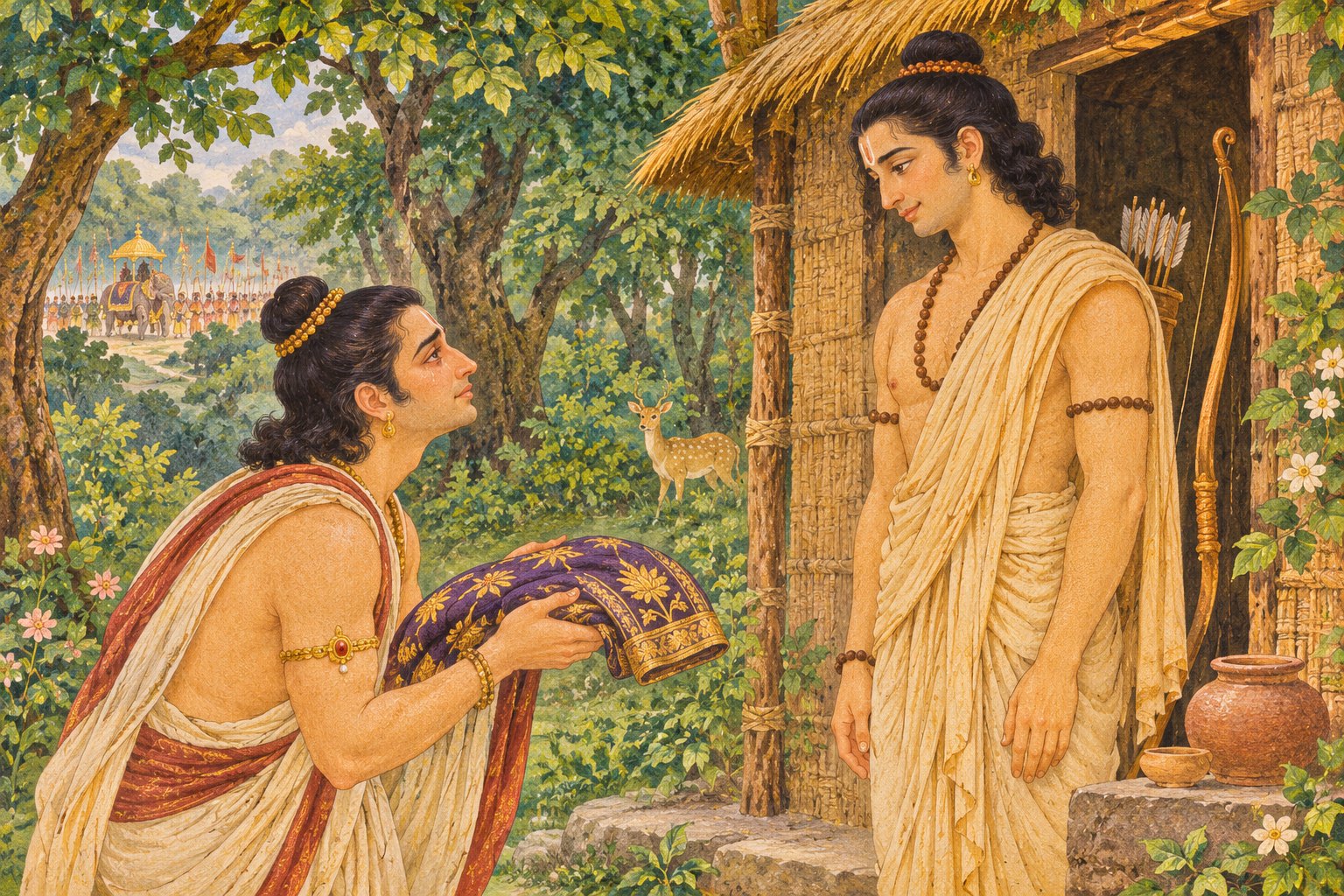
From Bharat’s perspective, the meeting also creates room for a relationship that cannot be reduced to succession. A brother arriving with devastating news has a personal burden. Giving him time to deliver it allows the audience to consider grief as something shared between people with different responsibilities.
This is where the case for the Hindi cut becomes most persuasive. The value lies in keeping a consequential human exchange available to the viewer. An epic earns emotional scale when the consequences of public events reach individual lives.
The trailers frame Rama and Ravana differently
The Indian Express’s comparison of the trailers records Ravana’s English-language declaration, “Before me, every head will bow.” It is a compact expression of domination: other people become an audience for his authority.
Rama’s English trailer line, “If I don’t stop him, the world will fall,” frames action as an obligation to others. Together, the lines establish an accessible opposition between power sought for oneself and power exercised under responsibility. They are promotional dialogue, however, and cannot establish the full complexity of either finished characterization.
The same trailer comparison describes differing emphasis on Rama’s divine identity. That distinction warrants attention because translation can change a story’s conceptual frame as well as its vocabulary. Religious context shapes how an audience understands destiny, choice, and moral obligation.
A viewer unfamiliar with the epic may benefit from that context being articulated. Familiar action-movie language makes a conflict immediately legible, but specificity gives the conflict its particular meaning. The challenge is to welcome newcomers while preserving the ideas that make this story distinctive.
How to choose your screening
- Check the audio language. A shared title or poster does not establish which version a theater is showing.
- Confirm English subtitles. If you do not understand Hindi, verify subtitle availability for the specific performance you intend to attend.
- Compare the listed running times. A substantial difference can indicate more than an alternative dub.
- Consider your access needs. The English version may be the practical choice for viewers who find sustained subtitle reading difficult.
No audience member needs to treat a screening choice as a test of cultural seriousness. The recommendation for the Hindi version concerns the reported preservation of dramatic context. Accessibility remains a legitimate reason to choose another presentation.
Viewers interested in how theatrical presentation influences attention may also appreciate our discussion of what a second cinema viewing can reveal in an epic. Our character-focused comparison of the Hunger Games adaptations similarly considers how screen storytelling preserves the relationships behind a larger conflict.
The deeper issue: who gets time to matter?
The most revealing way to consider these two cuts is through the distribution of attention. Battles establish the reach of power. Family encounters establish what power interrupts, protects, or fails to repair. Both belong to an epic’s account of human consequence.
Rama’s responsibility becomes more tangible when the people affected by it have room to exist. Sita’s importance grows when her relationships receive attention beyond their usefulness to a crisis. Bharat’s grief matters when he can bring it into the story himself.
That is the strongest reason to favor the Hindi cut on the reported evidence. The additional material offers viewers more opportunities to understand the people inside the spectacle. For a first encounter with Ramayana, that context is worth making time for.
Original content by this site's editorial team. Published: November 6, 2026 at 03:04:08 PST (Los Angeles time)