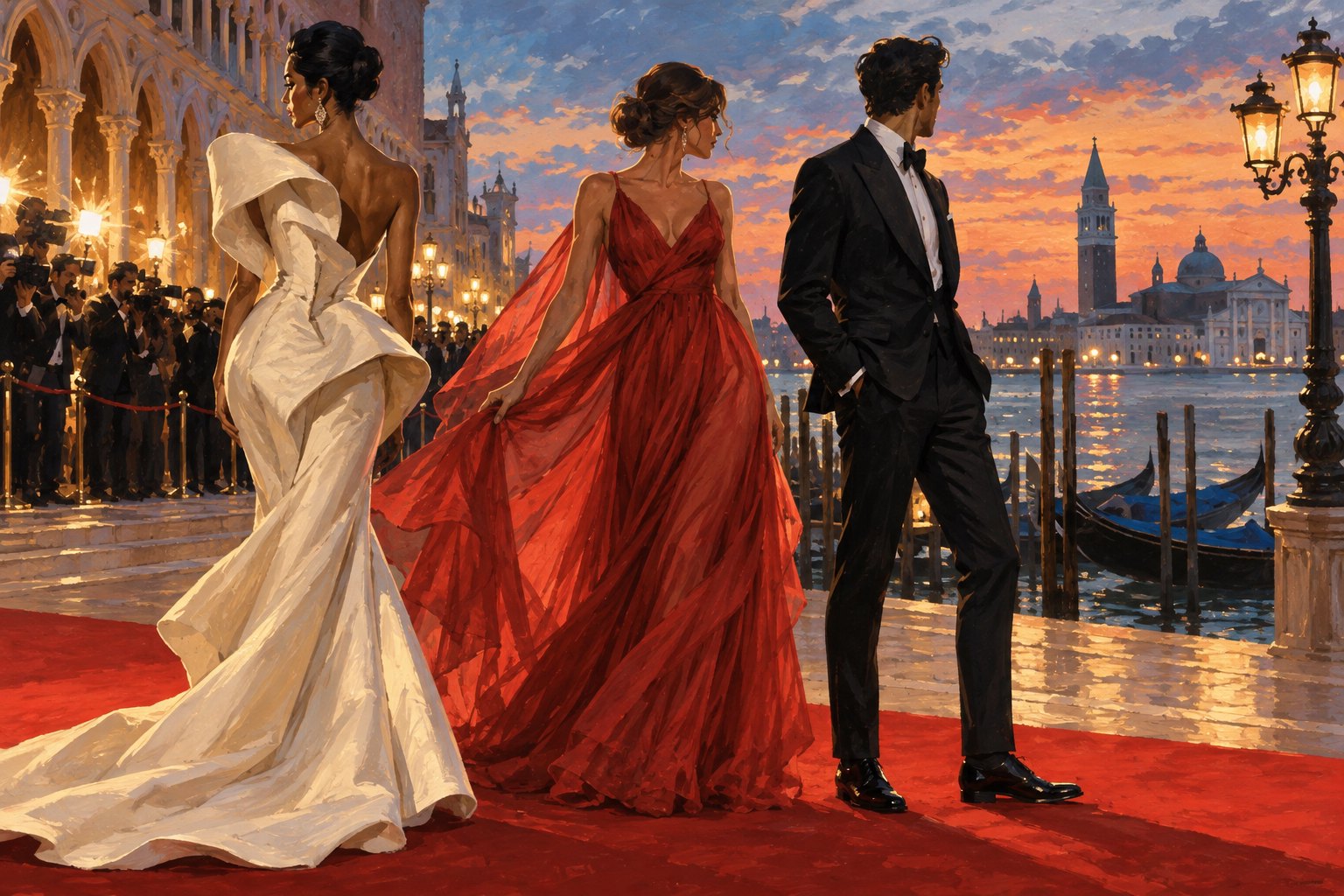
The best-dressed stars at the 2026 Venice Film Festival invite two different questions: who attracted attention, and what makes an outfit worth remembering? Pamela Anderson, Alba Rohrwacher, Robert Pattinson, and Suki Waterhouse are among the names featured in ELLE’s festival fashion coverage. Its credits identify Anderson in Carolina Herrera, Rohrwacher in Prada, Pattinson in Dior, and Waterhouse in Saint Laurent. Those are useful starting points, but a designer credit is the beginning of a fashion assessment, not its conclusion. [ELLE’s Venice red-carpet coverage](https://www.elle.com/fashion/celebrity-style/a73571699/all-the-looks-photos-venice-film-festival-2026/)
For a film audience, the more interesting question is how an entrance creates an impression of character before anyone speaks. My standard for a best-dressed appearance is coherence: silhouette, styling, movement, and the wearer’s presence should create an image that holds together. That is an editorial preference, not an official festival distinction. It also leaves room for both quiet tailoring and spectacular evening wear.
A Famous Label Does Not Explain Why a Look Works
Putting a brand beside a celebrity’s name answers a factual question about clothing. It does not tell us whether the proportions are persuasive, whether the accessories contribute anything, or whether the outfit remains interesting beyond its first photograph. A useful best-dressed discussion has to make that second step.
Consider the difference between identifying a gown and describing its effect. Saying that a dress has a dramatic skirt gives the reader an observable feature. Explaining how that volume balances a narrow bodice gives the reader a reason to look again. Calling the whole thing iconic supplies neither. Fashion criticism becomes more useful when its adjectives point toward something visible.
The same scrutiny should apply to suits. A familiar formal silhouette still contains decisions about shoulder width, jacket length, trouser shape, shirt contrast, and footwear. Understated dressing deserves close attention rather than automatic praise for restraint. Equally, an adventurous outfit should not win solely because it contains more elements.
Read the Silhouette Before the Accessories
A practical first step when browsing Venice photographs is to look at the full figure before enlarging the jewelry. Where does the eye travel? Is there one dominant shape, or several competing ones? Does the outfit create a clear relationship between the shoulders, waist, and hem?
This resembles looking at a film composition. A frame can contain beautiful objects and still lack a focal point. An outfit can contain exquisite pieces and still feel unresolved. In both cases, the problem is the relationship among the elements rather than the quality of any individual element.
My preference is for a look with a readable central idea and at least one detail that rewards closer inspection. That detail might be an unexpected fold, a change in texture, or a deliberate interruption of symmetry. It need not announce itself immediately. The most satisfying second look often reveals something the first glance missed.
Movement Changes the Verdict
A still photograph captures an arrangement. Moving footage shows what happens when that arrangement has to accommodate a person. Fabric may fall beautifully during a turn, a jacket may regain its shape after an embrace, or a carefully balanced silhouette may become difficult to read outside a single pose.
That is why I would hesitate to declare any Venice appearance a personal favorite from one cropped image. A full-length photograph and a short sequence can answer different questions. The photograph clarifies proportion; the sequence reveals how those proportions behave.
Movement also matters because clothing and presence are inseparable in the finished image. A garment can create an impression of ease, formality, exuberance, or theatricality. Those impressions are fair subjects for criticism. Claims about the wearer’s actual confidence, discomfort, or emotional state require more evidence than a photograph provides. Describing what an image communicates is different from claiming access to someone’s private experience.
The Star Is Not the Character
Movie viewers bring memories to a red carpet. We may associate a performer with vulnerability, menace, romantic charm, or comic awkwardness because of roles we have watched. An evening look can harmonize with those associations or disrupt them. That tension helps explain why festival fashion can feel narratively interesting even when it tells no literal story.
But an actor’s public appearance is not an extension of a fictional character by default. A severe suit does not establish a film’s darkness. A romantic dress does not reveal a character’s desires. Without a documented connection, matching an outfit to a movie’s themes is an interpretation, and sometimes a very speculative one.
For readers who want to move from star images to the stories themselves, our guide to Venice films exploring power and identity offers a separate starting point. The questions change once a screening begins: what does the character want, what choices become available, and what does the performance reveal over time?
Three Questions for Choosing Your Own Favorites
There is no need to borrow someone else’s taste to enjoy the Venice fashion conversation. A stronger personal judgment comes from stating the reason behind it. These three questions make the exercise more precise:
- What holds the look together? Identify the shape, color relationship, or contrast that organizes the outfit. If your answer is only the celebrity’s name, look again.
- What does each detail contribute? Hair, jewelry, shoes, and accessories can reinforce the main idea or productively complicate it. More is not automatically better; neither is less.
- Does the impression survive another view? Compare a close-up with a full-length image, and movement with a pose when footage is available. A favorite can become more interesting when its strengths are specific.
These questions also make disagreement enjoyable. One viewer may value architectural precision while another prefers softness or deliberate excess. Neither needs to pretend that taste is a measurable fact. The useful part is explaining how the clothes produce the response.
Let the Entrance Lead Back to the Film
The deeper appeal of festival dressing is that it makes public identity visible as a creative construction. Clothing offers a brief, concentrated impression; acting develops meaning through duration, interaction, and change. Both involve choices about what an audience sees, but they operate on different terms.
That distinction should sharpen our enjoyment of Venice’s best-dressed stars. Appreciate an entrance for its visual intelligence, then give the film room to establish its own identity. Our character-focused fall movie watchlist continues that shift from appearances to dramatic possibilities.
For me, a memorable festival look earns attention through a clear idea carried into the details. The best conversation about it does the same: it looks carefully, explains its preferences, and leaves the person wearing the clothes larger than the image.
Original content by this site's editorial team. Published: September 11, 2026 at 18:00:39 PDT (Los Angeles time)