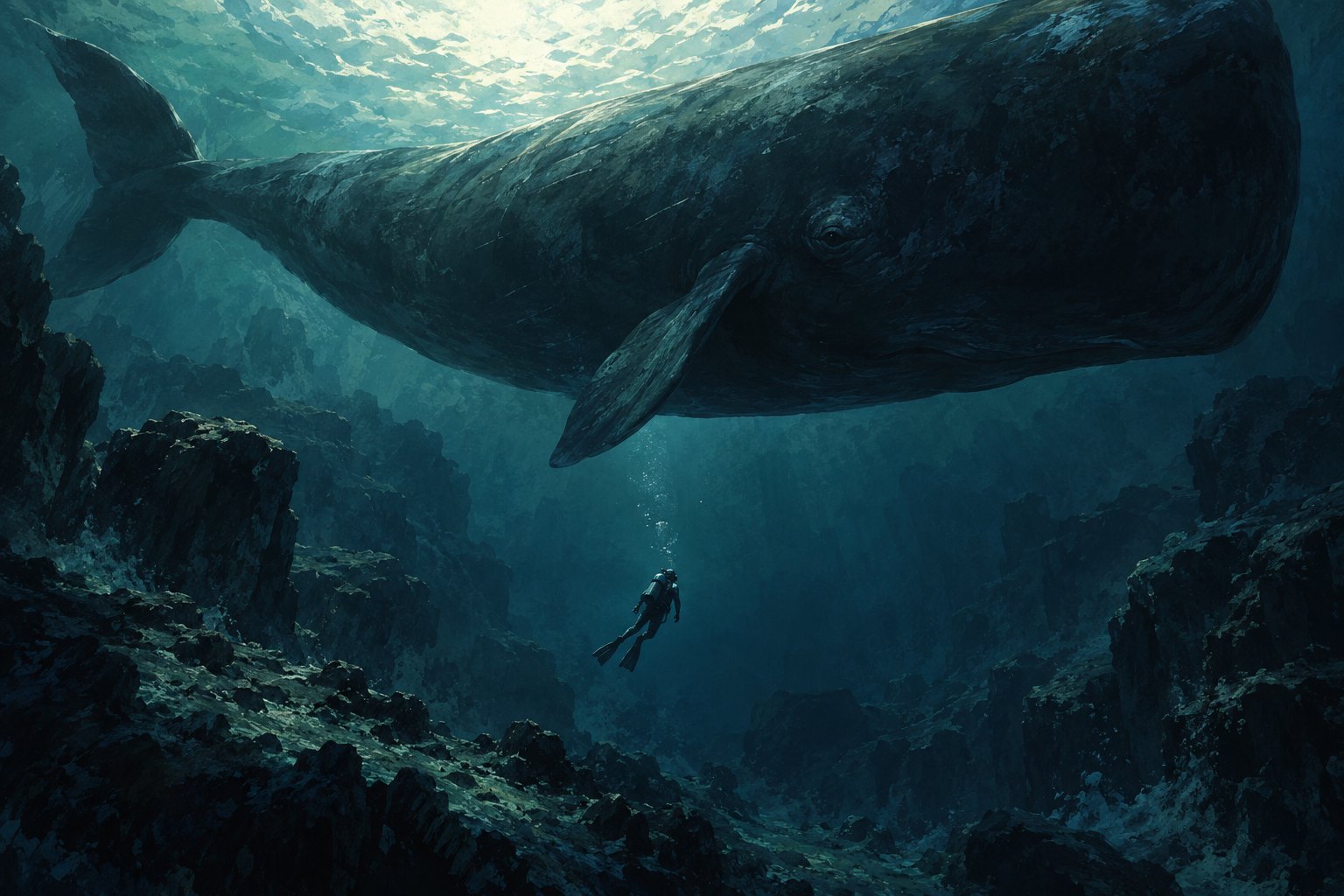
Whalefall gives inherited masculine expectations a brutally physical shape: a young man struggles to survive inside something overwhelmingly larger than himself while his father’s lessons remain lodged in his head. The compelling question is whether Jay Gardiner can draw strength from that inheritance without accepting the cruelty attached to it. Knowing how to survive and knowing how to treat your child are different accomplishments. This story puts dangerous pressure on the distinction.
Spoilers: This character analysis discusses the premise, family conflict, flashback structure, and a late narrative development. It draws on official film information and published accounts rather than a firsthand screening.
Jay’s search begins with an unfinished relationship
Directed by Brian Duffield, with a screenplay by Duffield and novelist Daniel Kraus, Whalefall stars Austin Abrams as Jay and Josh Brolin as his father, Mitt. The studio’s synopsis establishes the essential action: after his father’s death, Jay dives off California’s central coast to recover his remains, is swallowed by a sperm whale, and faces a dwindling supply of breathing air. His father’s teaching becomes a potential means of escape.
That starting point matters because Jay enters the water pursuing someone else. His immediate objective is recovery, a task organized around the dead. The encounter with the whale forces his own continued existence to become urgent. Read through character rather than spectacle, the premise moves from what a son believes he owes his father toward what he owes himself.
Disney’s production coverage describes Jay as experiencing both sorrow and relief after Mitt’s death. That combination gives the relationship its emotional specificity. Relief does not cancel grief, and grief does not prove that the relationship was healthy. Jay can miss his father while also missing the possibility of a gentler father he never had.
The whale makes paternal authority feel inescapable
The toxic masculinity interpretation works because enclosure gives an internal problem external dimensions. Jay’s relationship with Mitt already shapes how he understands danger, competence, and failure. Inside the whale, he cannot simply walk away from the crisis that activates those memories. The physical trap makes the persistence of paternal authority visible.
Here, toxic masculinity means a damaging expectation that a man must suppress vulnerability and demonstrate worth through toughness. Diving skill itself is not the problem. Discipline, attention, and practical knowledge can preserve life. Trouble begins when those skills become evidence that the person teaching them is entitled to intimidate or belittle the learner.
The whale should also retain its identity as an animal. Treating every movement as an expression of Mitt’s personality would flatten the survival story into an illustrated argument. Nature’s indifference gives the metaphor friction: Jay experiences a deeply personal crisis inside a creature that knows nothing about his family.
Our examination of the biological limits of Whalefall’s survival premise approaches that setting from another direction. The character question here concerns the meaning Jay brings into it.
A father’s useful advice does not justify his methods
In the trailer, Mitt’s voice delivers the terse instruction, “Remember, survivors survive.” The line, documented in CinemaBlend’s trailer coverage, sounds like encouragement stripped down to its hardest edge. It offers certainty when circumstances are terrifying. It also leaves very little room for anyone who cannot meet its demand.
As a survival cue, the phrase can help Jay focus on another action rather than surrender. As a philosophy of parenting, it is inadequate. It tells a frightened child what successful people supposedly do without explaining how to manage fear—or acknowledging that fear deserves a compassionate response.
The film’s use of remembered lessons therefore creates an interpretive hazard. If Mitt’s instructions help Jay, a viewer might conclude that Mitt’s harshness was necessary preparation. That conclusion does not follow. A lesson can be valuable even when its delivery caused lasting damage. The same knowledge could have been passed on with patience.
For me, that distinction is the most productive way to read the father–son conflict. Jay’s competence belongs to Jay, even when some of its foundations came from Mitt. Remembering an instruction, recognizing when it applies, and acting under pressure all require the son’s judgment. Inheritance does not erase agency.

The flashbacks put Jay’s independence under pressure
Published accounts describe a structure that moves between Jay’s immediate predicament and memories of Mitt. This creates two competing sources of suspense. One concerns what Jay can physically do next. The other concerns whether he can understand his father differently without allowing that revised understanding to consume his own perspective.
There is a real dramatic tradeoff here. A flashback can give a practical action emotional weight: what looks like improvisation also carries a history of instruction and conflict. But when memory repeatedly supplies the answer to a present obstacle, the father risks becoming the author of every success. Jay needs room to interpret his training, make decisions, and become more than its delivery system.
That is also why vulnerability matters to the character. Panic, uncertainty, and the need for reassurance do not automatically negate courage. A survival narrative becomes more interesting when its protagonist acts while frightened. Requiring Jay to become emotionally invulnerable would reproduce the very standard that makes his relationship with Mitt painful.
Hearing Mitt again raises the stakes of reconciliation
Accounts of the later passages describe Jay hearing his father’s voice through the whale. The development brings the metaphor unusually close to the surface: the surrounding physical presence becomes a medium for the relationship he cannot finish in ordinary life.
My reading is that this device is most persuasive as an expression of Jay’s need. A conversation imagined under extreme conditions can give shape to feelings that had no safe outlet before. It cannot establish that the father Jay remembers has objectively changed, or that every grievance between them has been settled.
The emotional distinction is crucial. Understanding a parent’s fear can explain behavior without excusing it. Accepting that love existed can coexist with recognizing harm. Reconciliation becomes less convincing when the injured person must abandon those distinctions to receive comfort.
Readers interested in how adaptations determine whose experience carries authority can also explore our analysis of character perspective in The Shining and Trainspotting. In Whalefall, the corresponding test is whether the son remains the center of his own emotional story.
Survival should give Jay a life beyond proving himself
“Survivors survive” becomes more revealing when considered beside Jay’s initial mission. Before the whale, his actions are organized around finding his father. Inside it, continuing to live must become a sufficient purpose. He should not need to turn survival into one final demonstration that he deserves Mitt’s approval.
That gives Whalefall a richer possible meaning than a simple endorsement or rejection of paternal influence. Growing beyond a damaging relationship rarely requires pretending that nothing useful came from it. It requires deciding what to retain, what to question, and what to stop passing on.
The strongest interpretation of Jay’s struggle is therefore selective inheritance. He can keep knowledge, persistence, and even affection while rejecting humiliation as a teaching method. The whale makes escape an immediate physical necessity. The deeper freedom lies in no longer treating a father’s judgment as the final measure of a son’s worth.
Original content by this site's editorial team. Published: October 17, 2026 at 07:07:51 PDT (Los Angeles time)