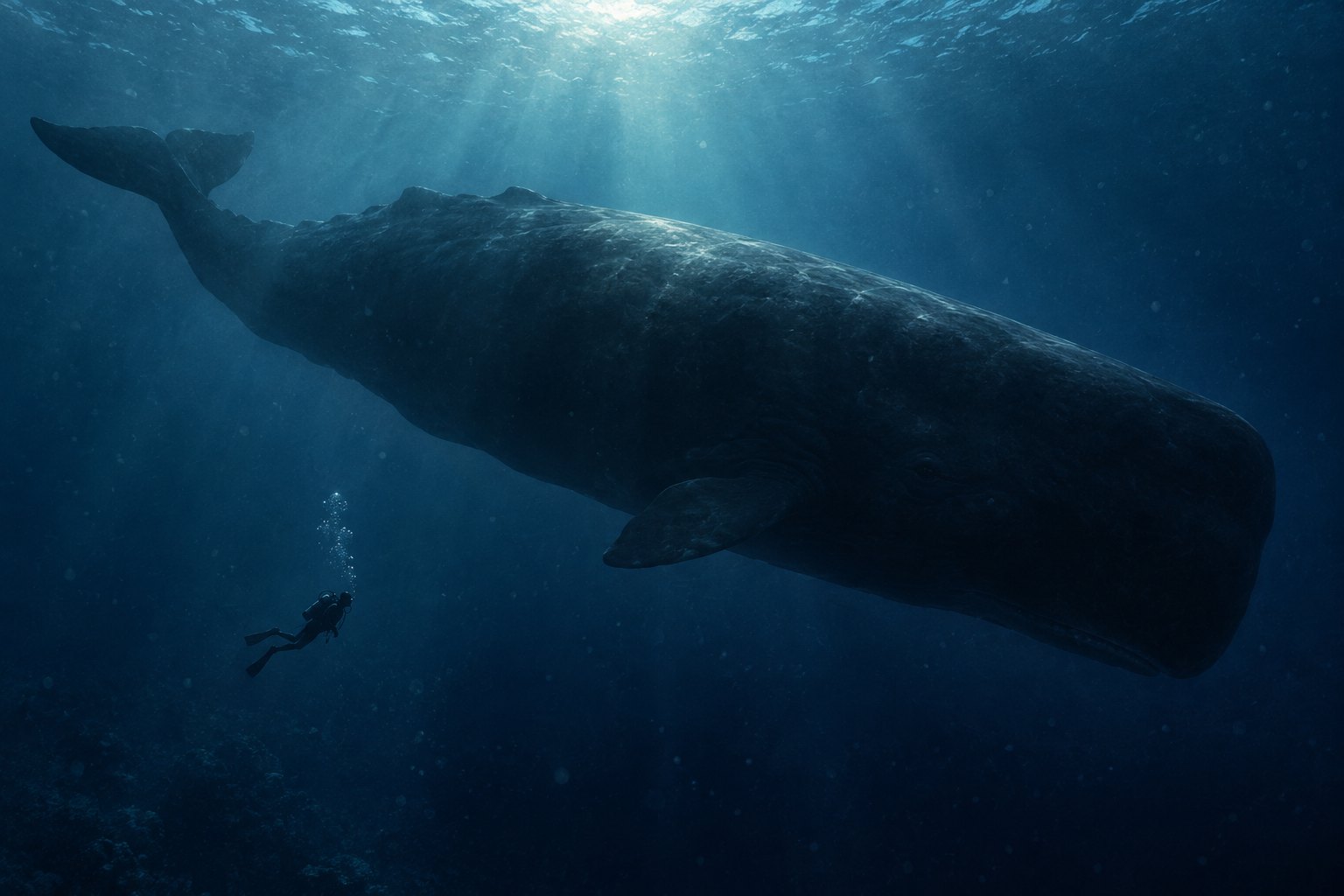
Whalefall makes good on its extraordinary premise: a young diver gets swallowed by a sperm whale and must find a way out before his breathing supply runs out. Austin Abrams plays Jay Gardiner, while Josh Brolin plays Mitt, the father whose death sends Jay into the water. The survival problem is immediate. The emotional problem has been developing for years.
The most interesting question is what Jay can keep from a painful relationship without remaining trapped inside it. That makes this an unusually pointed story about inheritance: practical knowledge can save someone even when the person who taught it also caused lasting hurt.
Spoiler warning: This character analysis discusses reported events through the ending. It draws on published story coverage and production information rather than a firsthand screening assessment.
What is Whalefall, and who made it?
Brian Duffield directs the adaptation of Daniel Kraus’s novel, with Duffield and Kraus sharing screenplay credit. Alongside Abrams and Brolin, the cast includes Elisabeth Shue, John Ortiz, Jane Levy, and Emily Rudd. The studio lists a U.S. theatrical release of October 16, 2026, and a PG-13 rating. Those details are confirmed by the [official film listing](https://www.20thcenturystudios.com/movies/whalefall).
Knowing the setup is enough to understand the basic viewing proposition: confinement, bodily danger, and family conflict. A rating alone cannot tell viewers how they will respond to prolonged underwater peril. Anyone especially sensitive to suffocation scenarios should weigh the premise itself when deciding whether this is their kind of thriller.
Why does Jay go diving?
Disney’s production account places Jay back in Monterey a year after his father’s death. He dives to recover Mitt’s remains. A whale feeding on a giant squid inadvertently swallows him, leaving roughly an hour of breathing air. The same account describes Mitt as a respected diver and a controlling parent, with Jay experiencing both grief and relief after losing him. These details establish the conflict in [Disney’s production feature](https://thewaltdisneycompany.com/news/whalefall-austin-abrams-josh-brolin/).
That mixture of grief and relief matters more than a simple declaration that the two had a difficult relationship. Someone can miss a parent and also feel freer in that parent’s absence. Neither feeling cancels the other. Reading Jay’s expedition through that contradiction makes it more troubling than an uncomplicated act of devotion.
Searching for remains also gives an emotional problem a physical task. There is something to locate, retrieve, and bring home. My reading is that this offers Jay the promise of a manageable ending to an unmanageable relationship. The whale destroys that promise by making his own continued existence the urgent question.
Why is Mitt central to the survival story?
Mitt’s diving knowledge becomes relevant to Jay’s predicament. That creates a productive distinction between accepting useful instruction and accepting the authority of the instructor. Jay can draw on what his father knew without conceding that his father was right about everything.
This is where the story’s emotional argument deserves scrutiny. A parent’s competence does not erase cruelty. Teaching a child how to survive does not automatically justify making that child feel small. The richest interpretation allows both truths to remain visible: Mitt gave Jay something valuable, and Jay has reasons to resist his influence.

Family stories often turn understanding into absolution too quickly. Here, the more compelling possibility is selective inheritance. Jay can decide what deserves to accompany him into adulthood. That question also runs through our examination of family memory in Coco and Ghostbusters: Afterlife: recovering the past changes the living person who must carry it.
Is the whale a villain?
The feeding accident establishes a useful difference between danger and malice. Jay experiences the whale as a lethal enclosure; that does not make the animal morally responsible for his suffering. From his perspective, escape is everything. From the animal’s perspective, human family drama has no special standing.
That imbalance gives the premise its unsettling force. There is no captor to persuade and no grievance to answer. Jay must respond to conditions that cannot care about his intentions. The ocean makes his vulnerability visible without arranging itself around his needs.
As a dramatic idea, this is stronger than treating every threatening creature as a monster. It also resists an overly tidy metaphor. The whale can suggest emotional engulfment while remaining an animal with an existence beyond what it means to Jay.
Which lines capture the movie’s competing tones?
Vanity Fair reports Jay’s desperate cry, “Help! I’m in the fucking whale!” It also quotes Mitt describing boats as “making the whales go crazy.” Its [spoiler discussion](https://www.vanityfair.com/story/whalefall-movie-questions-answered) confirms an explosive escape and explains the title through the life sustained by a dead whale’s remains.
Jay’s cry expresses the absurdity of needing to explain an impossible situation while experiencing it. On the page, it sounds funny. Within the predicament, it is an attempt to be heard. That collision is potentially the film’s sharpest tonal resource: panic does not always produce dignified language.
Mitt’s observation points outward. It introduces human interference into a story that could otherwise treat the sea as an empty arena for one man’s ordeal. The interesting tension is that Jay needs sympathy urgently, while the surrounding world does not exist solely to provide it.
What does the ending mean for Jay?
Physical escape answers whether Jay can get out. It cannot, by itself, answer how he should remember Mitt. Treating those as separate questions preserves the emotional difficulty that makes the premise worth discussing.
My interpretation is that survival represents permission to have a future that is not organized entirely around the father. Jay need not forget him, imitate him, or settle every unresolved argument. He can use what helps and refuse what harms. That is a more demanding form of independence than simply declaring the past finished.
It is also why changing behavior matters more than announcing a revelation. Our discussion of Bruce Wayne’s evolving sense of responsibility explores a related distinction: insight becomes meaningful when it changes what a character chooses to do.
Why the title carries the deeper interpretation
The title offers an image of death becoming nourishment. Applied to Jay’s relationship with Mitt, that is both hopeful and uncomfortable. Something useful can grow from a loss without making the loss desirable or the earlier suffering necessary.
For me, that qualification is essential. Jay should not have to prove that every wound was secretly a gift. The more humane reading allows him to transform an inheritance he did not choose. His father’s influence can change shape rather than disappear.
Whalefall therefore invites a question more lasting than how anyone escapes a whale: how do you keep living when the person who helped shape you also made living harder? Its strongest thematic answer is the possibility of carrying knowledge forward while leaving domination behind.
Original content by this site's editorial team. Published: October 16, 2026 at 06:52:47 PDT (Los Angeles time)