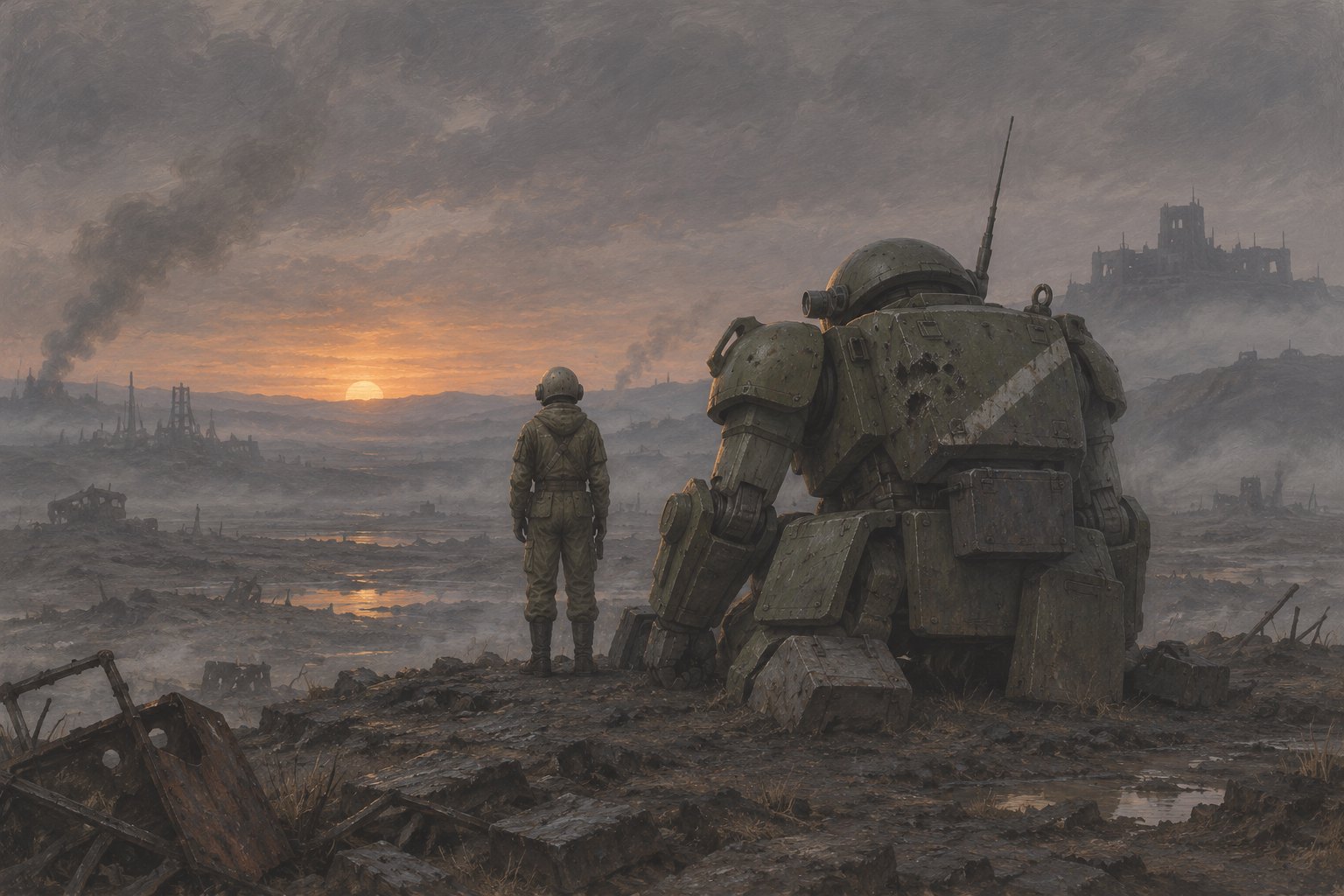
VOTOMS: Die Graue Hexe has an unsettling question at its center: what happens when surviving a war makes you an object of suspicion? Mamoru Oshii’s film builds its central relationship around Ash Vamps, whose repeated returns from deadly assignments attract military attention, and Maki Stauffenberg, the officer assigned to investigate her. That relationship offers a compelling way into the film’s familiar territory: the distance between keeping a soldier alive and valuing her life.
Ollie Barder’s Forbes review describes a restrained film whose narrative resembles earlier VOTOMS stories, while praising its mechanical detail and questioning the clarity of its action. Those are reported viewing judgments. The analysis here concentrates on the confirmed character setup and its implications, rather than claiming an independent assessment of every scene.
Spoiler notice: The following discusses the central investigation and mission premise, without revealing an explanation for Ash’s survival.
A soldier whose survival becomes evidence
The official synopsis places the story near the end of the Hundred Year War between Gilgamesh and Balarant. Maki arrives at a frontline base with a concealed assignment: investigate Ash, a member of a penal unit feared as a witch because she survives exceptionally dangerous operations. Maki eventually joins the unit’s hazardous assault as an armored trooper pilot.
That premise creates a disturbing imbalance. Survival should be the minimum outcome a military institution wants for its personnel. Here, extraordinary survival becomes something requiring investigation. The institution’s curiosity gives Ash significance, but significance is not the same as protection.
My reading is that this makes Ash most interesting as a person trapped inside other people’s explanations. A soldier may describe her as lucky, another as frightening, and a superior as useful. Each interpretation threatens to replace the individual with a category. Her continuing existence becomes a problem everyone else believes they have a right to solve.
The witch designation sharpens that effect. It places a supernatural explanation over a practical horror: some soldiers return while others do not. Calling the survivor uncanny offers a way to discuss the discrepancy without immediately confronting the decisions that sent everyone into danger.
Maki’s investigation carries its own moral problem
Maki’s role gives the story a second source of tension. An investigator needs information, but a relationship needs trust. Those demands do not comfortably coexist when the investigation itself is concealed.
From Maki’s position, Ash can initially be approached as a question with an answer. Why does this particular soldier survive? What distinguishes her from the others? Yet those apparently reasonable questions carry an assumption: that Ash’s life is available for examination because a superior has authorized it.
This is where the character pairing becomes more interesting than a simple mystery. The investigator’s understanding can deepen while her conduct remains ethically compromised. Learning someone’s secret does not necessarily mean learning how to treat that person well.
A related distinction runs through our analysis of observation and possession in A Talent for Murder: close attention can become a way of turning another person into material. In Maki’s case, the institutional purpose behind that attention makes the question especially uncomfortable.
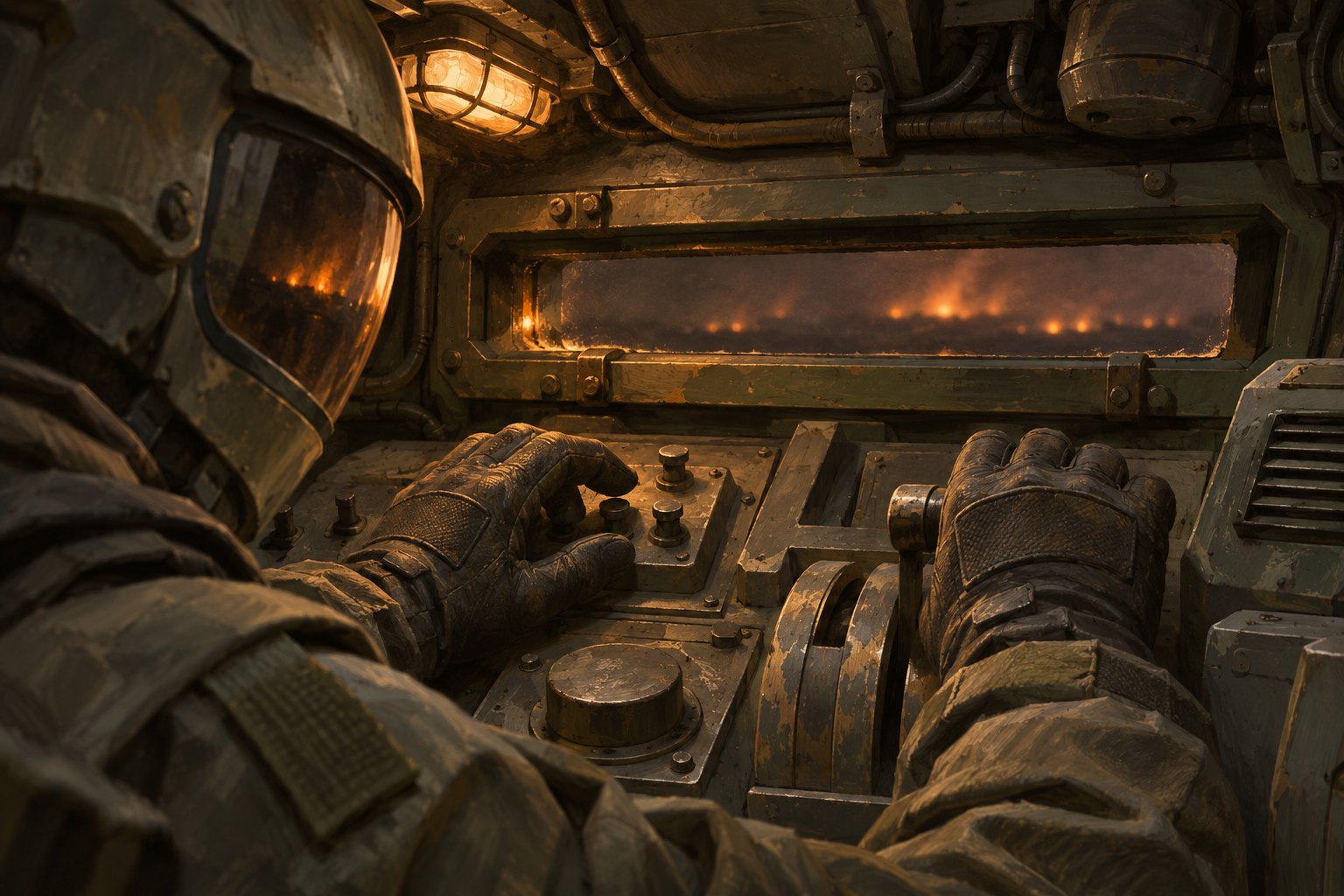
Entering the cockpit changes the investigator’s position
Maki’s participation in the assault matters because it changes the conditions under which she seeks knowledge. She enters the same dangerous operational space as the person she is studying. Information gathered under shared threat has a different emotional weight from information extracted at a safe distance.
That does not automatically erase the unequal relationship. An investigator can share danger and still possess authority that the subject lacks. But it creates the possibility that Maki’s assignment and her immediate human obligations will pull in different directions.
For character drama, that is a productive conflict. A mission can be completed according to its official terms while failing everyone involved on a personal level. Conversely, protecting another person can require abandoning the institutional definition of success.
The useful question is therefore not merely whether Maki discovers the truth. It is what discovering it would entitle her to do. Understanding Ash could become the basis of solidarity, or it could make her easier to exploit. The premise leaves room for both possibilities.
When familiarity supports a film—and when it limits one
Barder’s comparison with the earlier relationship between Chirico Cuvie and his investigator identifies a legitimate concern: a returning franchise can introduce new protagonists while retaining an old dramatic structure. Recognition alone cannot establish whether that repetition is rewarding.
For me, the decisive test is whether the new characters change the meaning of the familiar situation. An investigation into exceptional survival can support many different stories. Its originality depends on the investigator’s loyalties, the survivor’s agency, and the consequences of their relationship.
That is also why changing the protagonists’ identities should neither guarantee praise nor invite automatic dismissal. The meaningful question concerns what the characters can choose, what they misunderstand, and whose perspective organizes the drama.
Our discussion of why familiar characters need new emotional stakes raises a comparable issue. Repetition becomes expressive when an old situation reveals a changed person. Without that development, recognition can substitute for discovery.
Mechanical weight is only part of the action
The Forbes review’s combination of enthusiasm for the armored machines and reservations about battle readability points to another useful distinction. Convincing machinery and convincing action storytelling are separate achievements.
A vehicle can seem heavy, vulnerable, and functional while the surrounding sequence remains difficult to follow. For character-centered criticism, the essential issue is whether viewers understand the decisions being made inside that machinery.
Battlefield confusion can be purposeful. It can communicate limited visibility, fear, or a soldier’s incomplete knowledge. But confusion becomes dramatically costly when viewers cannot connect a choice to its consequence. The audience need not possess a complete tactical map; it does need enough orientation to understand why a person’s action matters.
The deeper question: who owns a survivor’s future?
The strongest interpretation of Die Graue Hexe begins with a distinction between surviving and becoming free. Escaping death does not necessarily release a soldier from command, scrutiny, or the expectation of another deployment.
Seen this way, Ash’s mystery has significance beyond its eventual explanation. A system can treat an exceptional survivor as evidence that more risk is acceptable. Her continued existence may become an argument for sending her back.
Maki’s presence makes that possibility personal. She stands between the desire to understand an unusual soldier and the obligation to recognize a human being. The film’s central relationship deserves attention because those goals can diverge.
That is the premise’s most troubling implication: the ability to survive could make someone less likely to be allowed to stop fighting. Whether this new VOTOMS story ultimately escapes its familiar structure depends on what it does with that contradiction—and whether Ash gains a future beyond being the person who returns.
Original content by this site's editorial team. Published: November 25, 2026 at 04:01:21 PST (Los Angeles time)