
Nick Nolte and Milo Gibson are starring in Vested, an independent horror film for which Deadline has reported a first look. For readers looking for the essential news, that is the central development: a named project, two announced stars, and an initial glimpse accompanying the announcement. The casting offers a reason to pay attention, while the film’s effectiveness as horror remains an open question.
This is a spoiler-free preview, not a review of the finished film. No assessment of its ending, individual scenes, or performances follows here. Instead, the announcement invites a specific critical question: what would make these actors’ characters worth following when fear begins to shape their decisions?
The casting is the starting point, not the character story
Putting Nolte and Gibson at the center of the announcement directs attention toward performance. That matters in horror because the audience’s relationship with a threatened person often determines whether a frightening situation has any staying power. A startling image can produce a reflex. A character whose choices we understand can make that feeling persist after the image disappears.
It would be premature to assign either actor a dramatic function. The announcement alone does not establish who holds authority, whose perspective organizes the story, or whether the characters’ interests align. Recognizable names can encourage viewers to fill those gaps with familiar roles. Doing so would tell us more about our expectations than about Vested.
The more useful question is whether each performance will have an independent emotional purpose. Does a character want something beyond surviving the next encounter? Is there a belief that danger forces them to reconsider? Those are criteria for a future review, rather than claims about what this film contains.
Our discussion of how an ensemble gives a star-centered movie dramatic friction explores a related issue. Casting becomes storytelling when the people on screen change what others can do, conceal, or believe. For Vested, that transformation will matter more than the names on the announcement.
What a first look can actually tell viewers
A first look is an invitation to form an impression. Depending on the material released, it may introduce a visual mood, a setting, or an actor’s appearance. It cannot, by itself, demonstrate the rhythm of a performance or the construction of a sustained sequence. Those distinctions are especially important for horror, where timing frequently supplies the meaning.
Consider the difference between a face held in close-up for a moment and the same face held for several uncomfortable seconds. In the first case, the shot might simply register a reaction. In the second, viewers may begin searching the expression for withheld information. The still image could be identical; the experience would be different.
Sound changes the equation again. Silence, an ordinary background noise, or something approaching from beyond the frame can make the same composition reassuring or threatening. A promotional image leaves those relationships unresolved. This preview therefore makes no claims about the released image’s specific contents or the film’s visual execution.
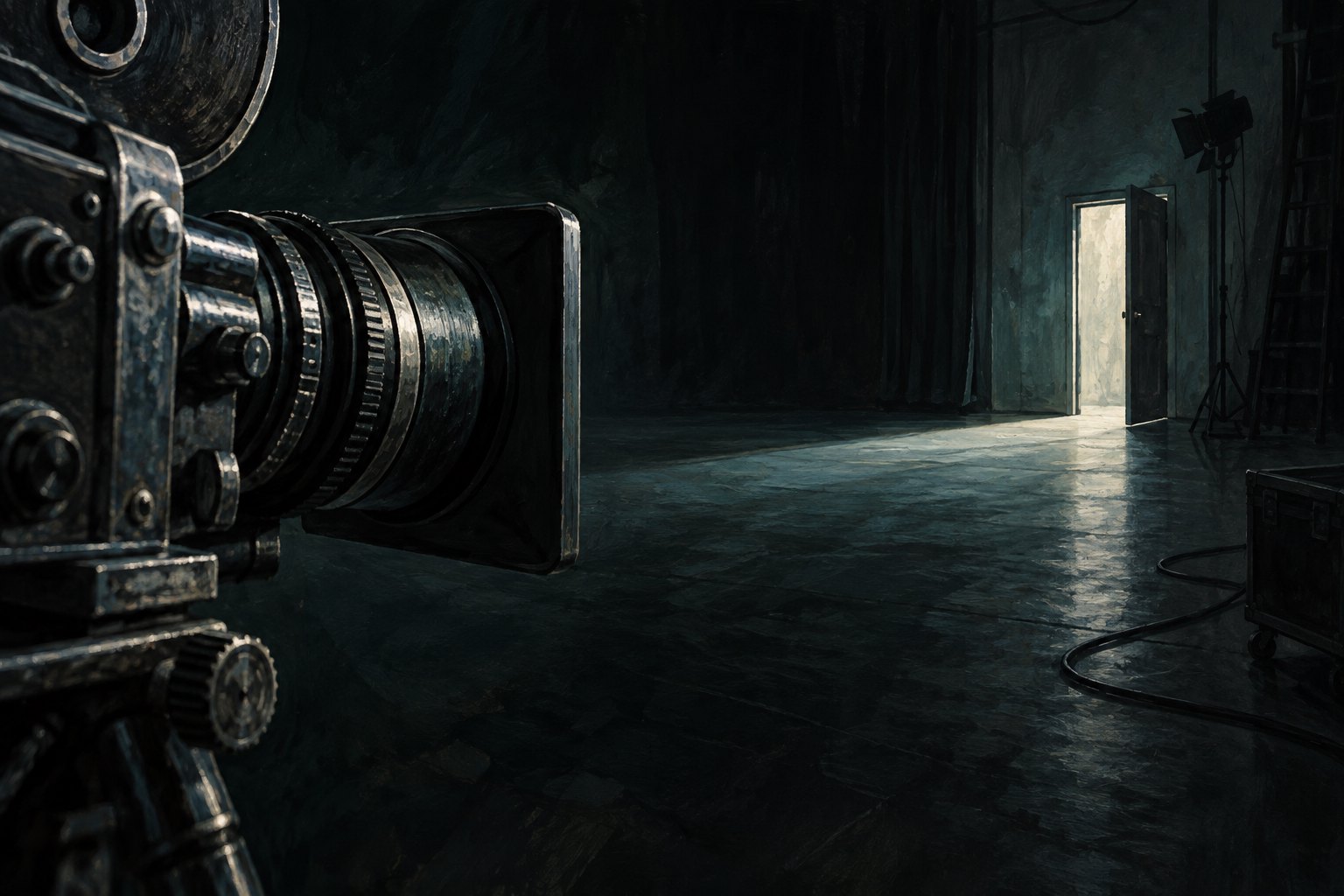
The illustrations accompanying this article are conceptual editorial artwork, not production stills from Vested. Their emphasis on performance space and framing reflects the questions raised here, rather than depicting events from the movie.
Fear becomes interesting when characters interpret it differently
The character-centered approach most worth applying to Vested is to ask how fear alters judgment. A horror character does not need to make the safest possible choice every time. The choice does need to arise from something the film has made legible: attachment, shame, stubbornness, incomplete knowledge, or a competing responsibility.
That distinction separates a flawed person from a convenient device. When viewers understand why someone stays, hesitates, or refuses to accept a warning, suspense can coexist with frustration. When the motivation exists only to deliver the next scare, the character becomes difficult to believe.
For Nolte’s and Gibson’s eventual performances, listening may prove as revealing as speaking. A pause can suggest that information has landed differently than expected. A change in posture can indicate that confidence was a performance within the performance. These are possibilities inherent in screen acting, not descriptions of scenes already observed in Vested.
A full review should also distinguish what a character knows from what the audience knows. Viewers can mistake privileged information for common sense, criticizing a decision that is reasonable from inside the story. Following the characters’ perspectives carefully is essential to judging whether suspense has been earned.
Independent horror is a category, not a quality verdict
The independent label establishes part of how Vested is being presented. It does not establish its budget, creative freedom, production scale, or artistic success. There is no reason to assume either resourcefulness or limitation before seeing what the filmmakers have achieved.
My preference in horror is for specificity: a space whose geography matters, a relationship with recognizable pressure points, and consequences that survive beyond the immediate scare. None requires a particular production model. All require decisions that connect the film’s atmosphere to the people experiencing it.
The relationship between place and character is explored further in our analysis of how filming locations become convincing fictional spaces. The relevant test for Vested will be whether its surroundings shape behavior, rather than merely providing an ominous background.
What remains to be established
This preview does not confirm a release date, viewing platform, character breakdown, or detailed plot synopsis. It also includes no dialogue quotations: memorable lines require reliable access to the dialogue and its context. An announcement cannot support an interpretation of an ending or an inventory of Easter eggs.
The most useful next material would clarify the story’s central conflict and show enough sustained acting to suggest how its characters respond to one another. A release announcement would answer the practical question of where and when audiences can watch. Until then, the casting and first-look news support interest, not a recommendation to buy a ticket.
The deeper question for Vested
The interpretive question I would bring to Vested is whether fear exposes its characters or changes them. Those are different dramatic possibilities. One reveals values that were present all along; the other forces people to become someone they could not previously imagine being.
Neither can be assigned to this film yet. But that distinction offers a meaningful way to approach the Nolte–Gibson announcement: look beyond who appears in the horror and toward whose understanding of themselves is at risk. If Vested gives that question a compelling answer, its characters could remain unsettling long after the immediate shocks have passed.
Original content by this site's editorial team. Published: September 17, 2026 at 13:01:41 PDT (Los Angeles time)