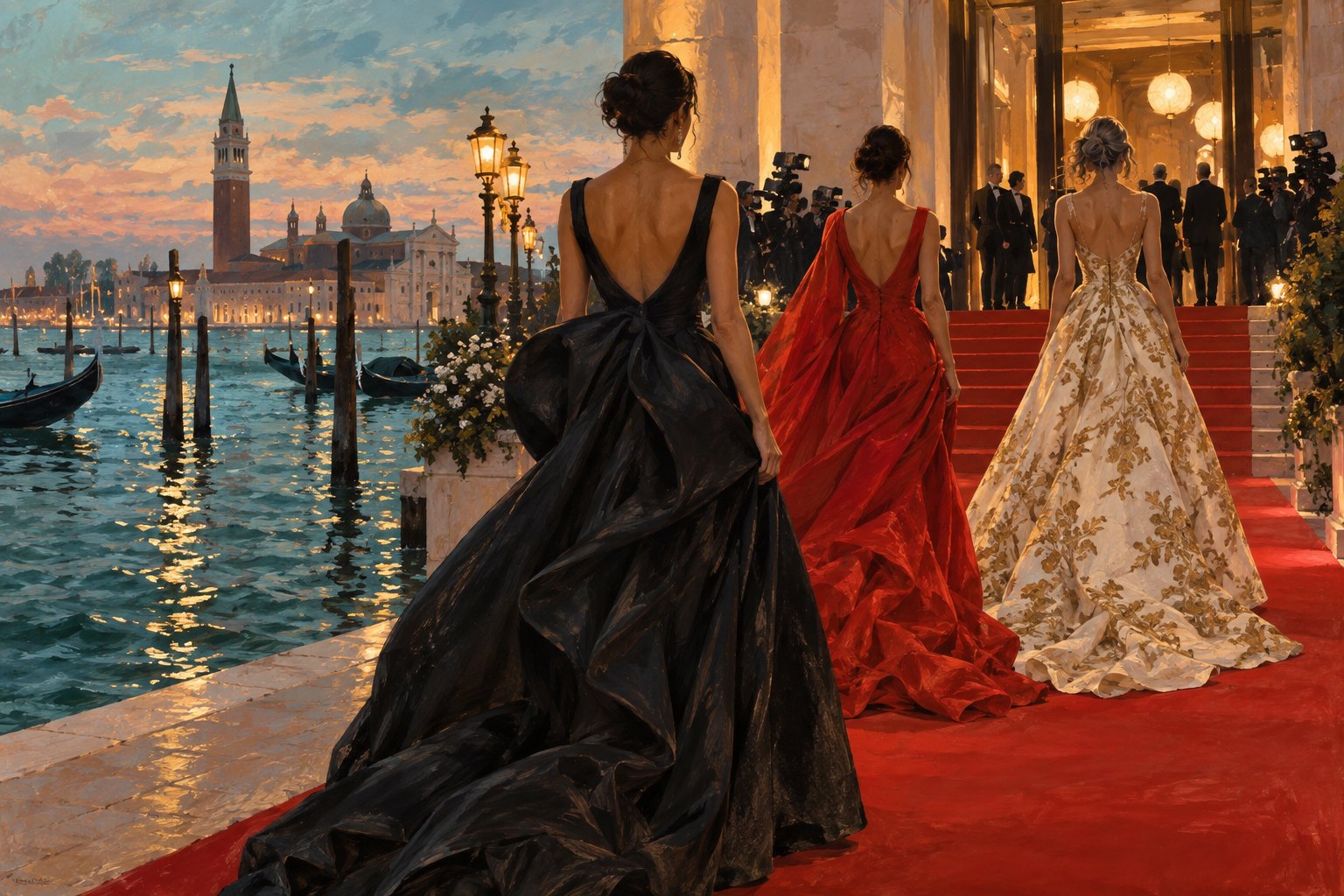
The best-dressed conversation at the 2026 Venice Film Festival offers several competing ideas of glamour. Kendall Jenner wore vintage Giorgio Armani; Penélope Cruz appeared in red Chanel; Pamela Anderson chose yellow Carolina Herrera. Amal Clooney’s Tom Ford bandage dress and Rooney Mara’s black Louis Vuitton dress with a bubble hem supplied different approaches to dark eveningwear. Those details, reported by ELLE, provide a starting point for a more useful question: what makes an outfit worth remembering after its first photograph?
Our critical preference is for clothes that reward a second look. Immediate impact matters, but the most interesting fashion also gives the eye somewhere to travel: an unexpected proportion, a change in texture, a relationship between the garment and the person wearing it. This is fashion commentary through a film lover’s lens, with no judgment of the movies attached to these appearances.
Start with silhouette, before the designer’s name
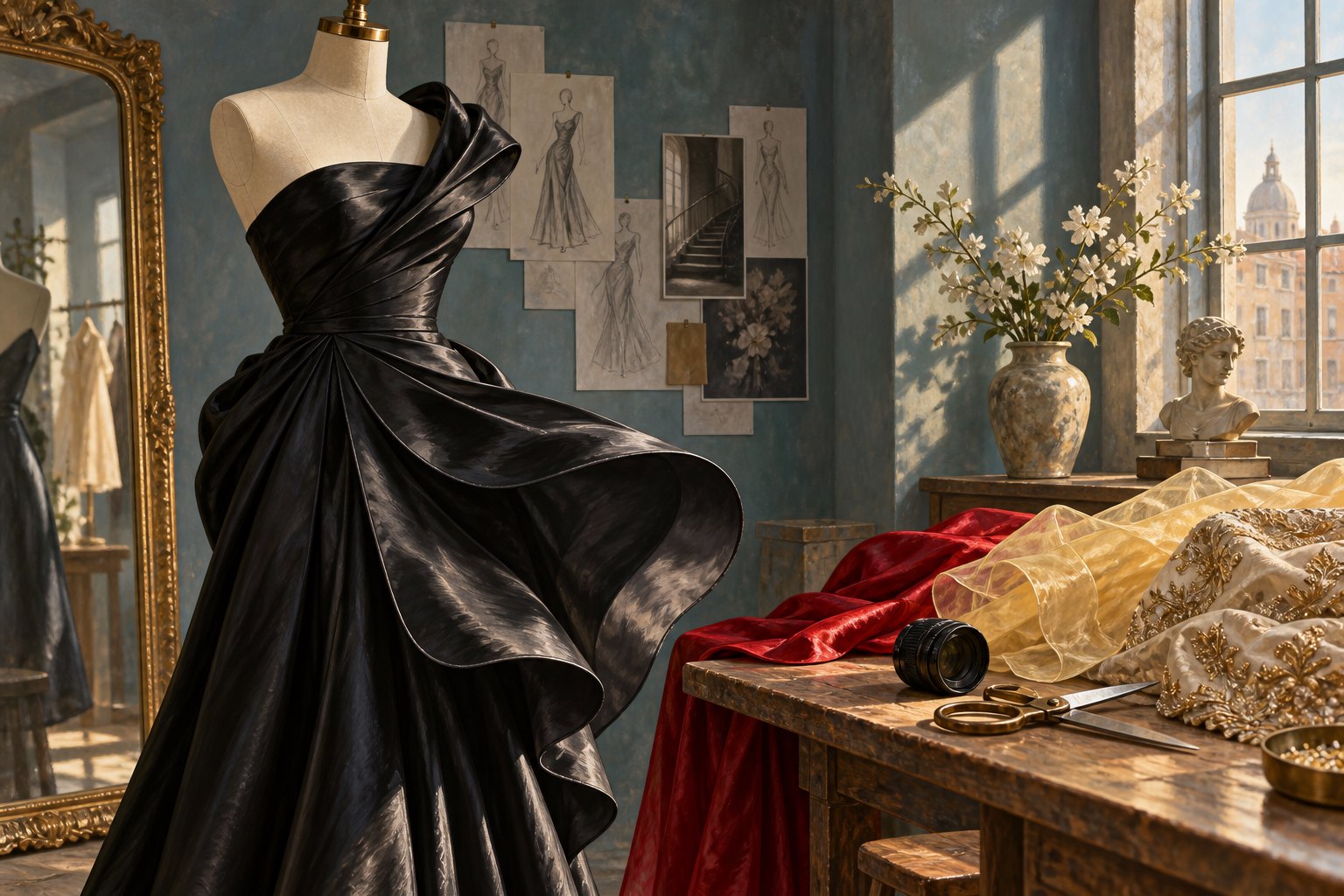
A useful first exercise is to imagine the photograph reduced to a silhouette. Can you still describe the outfit? Does its outline have a clear structure, or does its appeal depend entirely on decoration that disappears at a distance?
Neither simplicity nor complexity automatically wins. A narrow column can establish a strong vertical line. A wider skirt can create tension between the body and the space around it. An asymmetric shoulder can pull attention toward the face. The question is whether those decisions cooperate.
This is where film viewers already have useful instincts. In a well-composed shot, the arrangement of shapes helps establish what deserves attention. Red-carpet dressing presents a related visual problem: the viewer needs an entry point. If every accessory, seam, and surface demands equal attention, the overall image can become difficult to read.
My test is straightforward: describe the look without naming its wearer or label. If the description remains specific, there is probably an actual design idea to discuss.
Color creates emphasis, not a personality diagnosis
Bright eveningwear offers an obvious visual attraction, but color criticism becomes lazy when every red dress means confidence and every yellow dress means happiness. Those associations are possible readings, not access to the wearer’s state of mind.
A more precise approach asks what the color does within the image. Does it distinguish the garment from its surroundings? Does it make the outline easier to follow? Does it allow intricate construction to recede, leaving a single strong impression?
Black deserves the same attention. It can emphasize a contour, absorb distracting detail, or make the difference between matte and reflective surfaces especially noticeable. Calling it a safe choice tells us very little about whether the dress itself succeeds.
For readers comparing Venice looks, try separating two reactions: liking a color and liking what the design accomplishes with it. You may love a shade while finding the proportions unresolved. You may dislike a shade in your own wardrobe while recognizing its effectiveness in a photograph.
Vintage should earn its place in the present
An archival garment introduces another dimension: the relationship between an earlier design and a contemporary public image. Yet age alone cannot make an outfit compelling. A date supplies context; it does not supply a verdict.
The stronger question is what the new styling brings into focus. Hair, jewelry, footwear, and posture can direct attention toward features that might otherwise seem secondary. A restrained presentation may reveal construction. A more assertive one may expose an unexpected tension in a familiar shape.
There is a useful parallel with revisiting an older film. Historical significance can explain why something deserves consideration, but the experience still needs to be examined. What remains expressive? What feels newly legible? What requires context to appreciate?
For red-carpet criticism, that means resisting the temptation to treat access to a rare garment as the achievement itself. The achievement is making a persuasive image with it.
The photograph is only one part of the performance
A still image freezes a garment at a favorable—or unfavorable—instant. Movement poses different questions. Can the wearer turn comfortably? Does the fabric settle with intention? Does a striking volume remain expressive when the body changes direction?
Without footage, those questions should remain questions. A photograph cannot establish that someone struggled to walk, felt uncomfortable, or spent the evening adjusting an outfit. Visible posture gives us something to describe, but motives and sensations require evidence.
This distinction improves criticism. Rather than declaring that a dress overwhelms its wearer, explain the visible relationship: perhaps the neckline competes with the face, or the volume occupies most of the frame. Specific observations give readers something they can assess themselves.
The relationship between clothing and performance also runs through our commentary on Charli xcx’s Music, Fashion, Film tour. Across these settings, a costume becomes interesting through its interaction with a person and a camera.
A public persona is not a fictional character
Film fans bring memories of performances to celebrity photographs. That can enrich an image, but it can also make interpretation too easy. An actor associated with restrained characters does not necessarily dress to express restraint. A dramatic outfit does not prove a personal reinvention.
Instead, consider the distance between familiarity and surprise. Does the appearance sharpen an established image? Does it introduce a different visual register? Both can work. Consistency may create precision, while a departure can reveal possibilities that habitual styling leaves unexplored.
Keep that assessment separate from the screen performance. Our discussion of Robert Pattinson’s Primetime role addresses the different questions involved in examining a portrayed identity. Clothes outside a screening cannot answer questions about characterization inside the film.
What deserves to last
For us, a lasting best-dressed moment combines a readable shape, purposeful detail, and a persuasive relationship with its wearer. Expense, novelty, and immediate visibility can accompany those qualities, but none replaces them.
The deeper pleasure of Venice fashion is the invitation to look carefully. A red-carpet image asks for attention before the theater lights go down. Good criticism makes that attention more exact: noticing how an outline directs the eye, how a fabric changes the impression, and where interpretation reaches its limits. The most rewarding look is the one that leaves you with something specific to say.
Original content by this site's editorial team. Published: September 12, 2026 at 06:34:49 PDT (Los Angeles time)