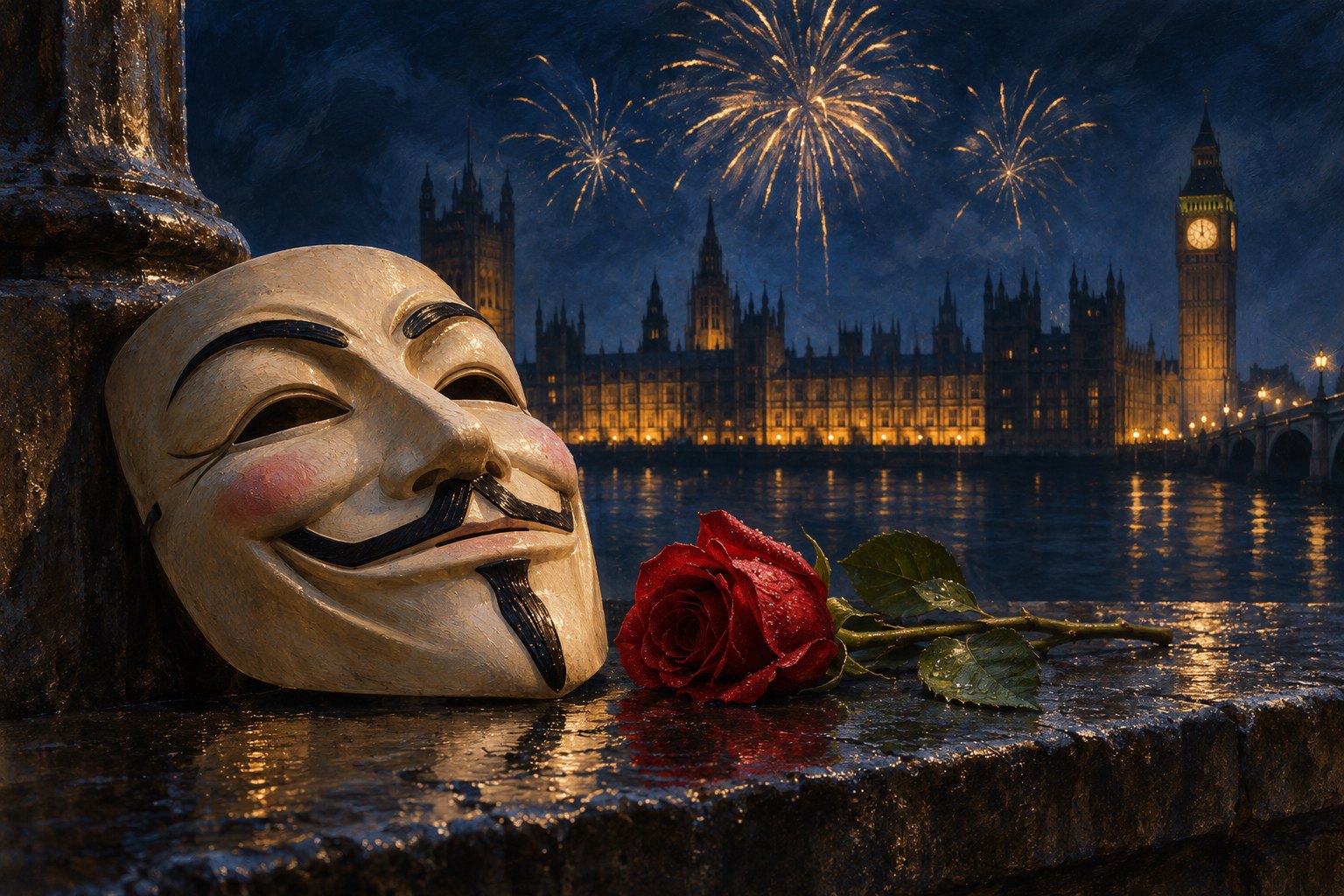
V for Vendetta makes “Remember, remember the fifth of November” unforgettable because the date becomes a promise. First it summons a historical conspiracy; then it gives a frightened population an appointment with its own courage. The rhyme supplies the rhythm, but Evey Hammond supplies the emotional stakes: what does remembering require of someone who has learned that surviving means staying quiet?
Major spoilers follow, including Evey’s imprisonment and the ending. My reading of the film is that its most compelling argument lies in the tension between V’s dazzling public gestures and the private lives those gestures claim to defend. Its revolution is thrilling. Its revolutionary deserves harder questions.
What the November 5 quote actually means
The rhyme predates the movie. November 5 recalls the failed Gunpowder Plot of 1605, in which Guy Fawkes participated in a conspiracy to blow up Parliament. That history matters because the film repurposes an existing memory rather than inventing a date. The historical conspiracy should not be mistaken for a straightforward campaign for modern democratic freedom. [UK Parliament’s historical account](https://www.parliament.uk/about/living-heritage/evolutionofparliament/parliamentaryauthority/the-gunpowder-plot-of-1605/) provides the essential distinction.
Inside the movie, remembering becomes a challenge to official storytelling. V rescues Evey from the secret police and brings her to witness the destruction of the Old Bailey. He subsequently calls on the public to gather outside Parliament one year later. The interval gives the story its structure: a spectacular interruption becomes a sustained test of whether people will act.
That is why the line works beyond its catchy repetition. A date is something people can share without meeting. V turns the calendar into a means of organizing collective attention. Yet the command also reveals his controlling streak. He decides what must be remembered, when it must be remembered, and what shape the commemoration should take.
V: a brilliant performer with a dangerous certainty
Directed by James McTeigue and written by the Wachowskis, the film makes V’s theatricality central to his appeal. Hugo Weaving gives an unmoving mask surprising expressive range through vocal rhythm, posture, and pauses. V can sound amused, wounded, or frightening without the reassurance of a visible facial reaction. The principal credits are confirmed in [DC’s film listing](https://www.dc.com/movies/v-for-vendetta-2006).
My favorite aspect of that performance is its instability. His elegance invites trust while his certainty discourages disagreement. The cultivated voice and elaborate presentation make violence feel choreographed, almost inevitable. Watching him, it becomes easy to confuse command of a scene with moral authority.
The film’s revenge narrative gains force whenever that confusion becomes uncomfortable. V’s experience of persecution explains his rage, but explanation cannot settle every question about his behavior. This distinction also animates our look at the grief beneath John Wick’s lethal reputation: the person behind an action icon matters because sympathy and approval are different responses.
V is most interesting when his love of freedom collides with his desire to direct everyone else’s part in the drama. The film sometimes makes that collision exhilarating. Elsewhere, it seems too eager to let his charisma resolve it.
Evey’s ordeal exposes the film’s deepest contradiction
Evey’s apparent imprisonment ends with the revelation that V has staged her captivity and torture. He believes the ordeal has freed her from fear. The revelation is a crucial plot turn, confirmed in the film’s [detailed synopsis](https://en.wikipedia.org/wiki/V_for_Vendetta_(film)). It is also where the movie’s emotional persuasion deserves the closest scrutiny.
From Evey’s perspective, the immediate truth is betrayal. A man who rescued her has assumed the powers of her persecutors. His intended lesson cannot erase the fact that she did not consent to it. Natalie Portman’s performance gives that discovery a physical force that no abstract speech about liberation can comfortably absorb.
The sequence asks viewers to accept a troubling proposition: someone may destroy another person’s sense of safety in order to deliver freedom. I find the film more persuasive when it allows Evey’s anger to stand than when its imagery encourages us to interpret suffering as a necessary passage toward enlightenment.
Her subsequent strength is real within the story. That does not make V’s method morally sound. A survivor’s capacity to find meaning in an ordeal should never become automatic vindication of the person who imposed it. Keeping those judgments separate makes Evey a richer character and the film a more demanding experience.
Valerie gives remembering a human purpose
Valerie’s letter interrupts the struggle for power with the record of a life. Her memories of love, acting, and roses insist that a persecuted person existed before the state reduced her to a category. Her relationship with Ruth gives the political horror an intimate scale: what disappears is a shared home and a future, not merely an abstract right.

In my view, this is the film’s strongest answer to its opening command. Remembering means preserving the texture of someone’s existence. The letter offers solidarity without demanding that its reader become a weapon. Its tenderness exposes what V’s grand performance can obscure: freedom should make ordinary happiness possible.
Evey’s later words, “God is in the rain,” connect her experience to Valerie’s remembered world. The phrase is recorded in the film’s [dialogue collection](https://en.wikiquote.org/wiki/V_for_Vendetta_(film)). It matters less as a declaration of doctrine than as a moment of sensation: after confinement, weather itself becomes something she can receive freely.
The contrast between V and Valerie is especially revealing. He tries to transform Evey by controlling her surroundings. Valerie reaches her through an account of herself. One demands an outcome; the other makes recognition possible.
Finch and the ending: refusing to keep the machinery running
Inspector Finch offers a quieter route through the story. His investigation undermines the legitimacy of the regime he serves. Where V performs conviction, Finch must endure doubt. Stephen Rea makes that uncertainty valuable: a conscience awakening inside an institution is rarely as photogenic as a masked rebel, but it can be just as consequential.
At the climax, Evey sends the explosives-filled train carrying V’s body toward Parliament, while Finch allows her decision to stand. The spectacle is enormous, yet the essential dramatic movement is a withdrawal of control. V cannot personally complete the future he has imagined; Finch declines to enforce the order he has come to distrust.
That emphasis on choices made within coercive systems connects with our analysis of rules, debts, and limited freedom in John Wick: Chapter 2. Here, however, the question expands from one person’s escape to a population’s willingness to stop obeying.
The ending delivers emotional release more confidently than it imagines political reconstruction. Destroying a monument cannot establish accountability or guarantee a fair society. I see that gap as the film’s principal limitation: its images communicate the exhilaration of a beginning while leaving the difficult work afterward outside the frame.
Details worth watching—and what survives the fireworks
The recurring V carries a compact visual joke: it is also the Roman numeral for five, tying identity to the commemorative date. The letter’s aggressive repetition in V’s introductory speech makes language another costume. He announces himself as someone who has deliberately turned a person into a pattern.
Valerie’s roses provide a more intimate recurring motif. Their significance comes from a remembered relationship, giving beauty a history that spectacle alone cannot supply. On a rewatch, following those small objects can be more revealing than following the explosions.
My verdict is that V for Vendetta remains a forceful, uneven political thriller whose emotional intelligence sometimes exceeds its answers. November 5 endures because the film attaches a public symbol to private grief. Its deepest invitation is to remember the people a regime tried to erase—and to question anyone who claims that their suffering grants him unlimited authority.
Original content by this site's editorial team. Published: November 5, 2026 at 21:26:04 PST (Los Angeles time)