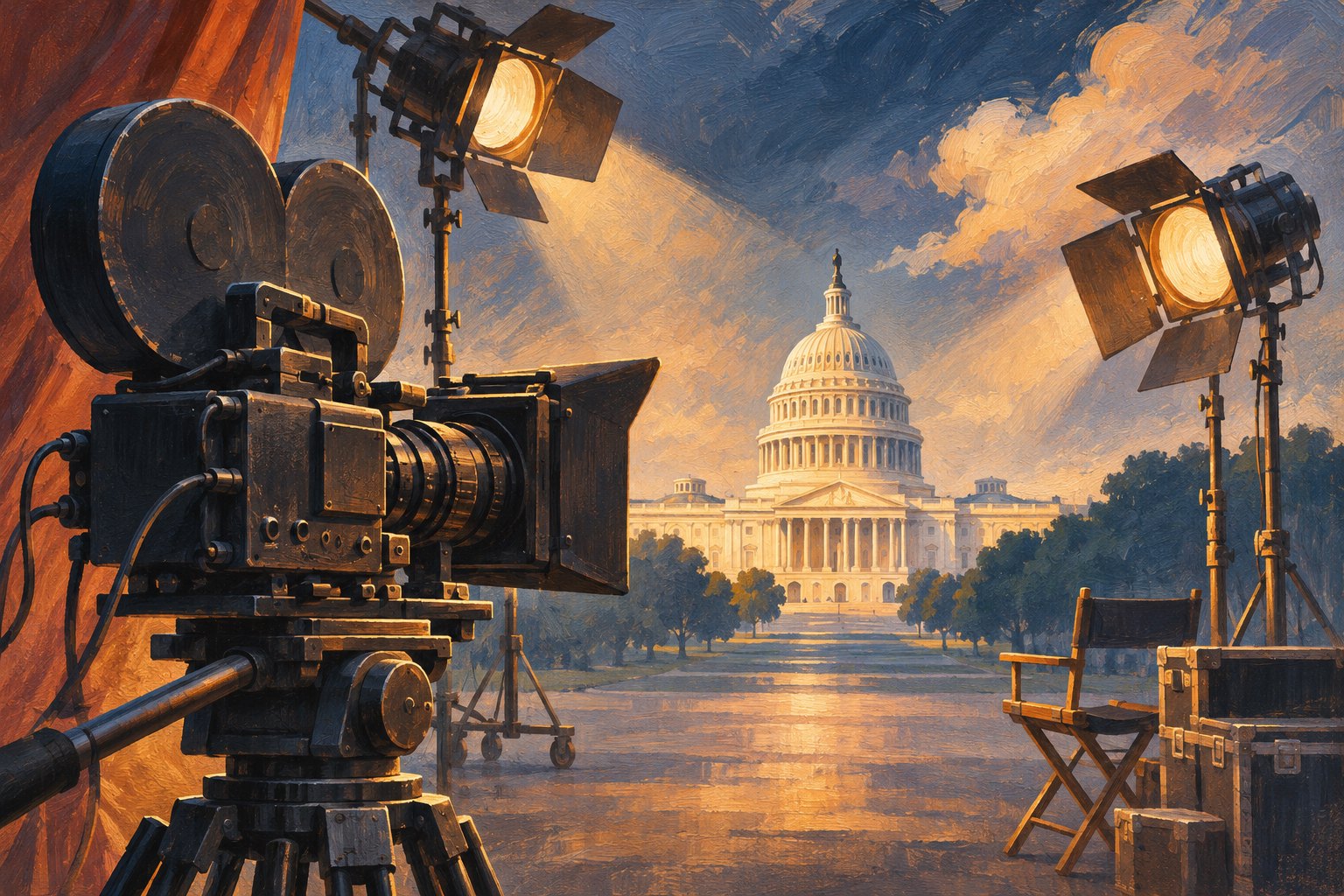
Donald Trump’s meeting with Jon Voight about a U.S. film incentive brings a practical question into a highly visible political setting: what would meaningful support for American filmmaking actually accomplish? Variety reports that the meeting took place amid a flight halt, with its headline highlighting the exhortation, “Get This Done!” The encounter puts attention on the issue. It does not, by itself, establish what an incentive would deliver.
For movie lovers, the stakes reach beyond the two recognizable names. Production support can be judged through the work it makes possible: the crews hired, the projects that secure financing, and the creative choices filmmakers can afford. Our view is that any proposal deserves scrutiny at that level. A political endorsement starts a conversation; the terms and results determine its value.
What the Trump–Voight Meeting Establishes
The central reported event is straightforward: Trump and Voight met to discuss a U.S. film incentive. The flight halt supplies the surrounding news context. Neither that timing nor the urgency of the headline tells readers whether a measure has been enacted, which productions would qualify, or when any benefits might become available.
Those distinctions matter because entertainment coverage can make a conversation feel like a completed deal. A meeting, a proposal, an adopted measure, and a production receiving support are separate developments. Readers should resist collapsing them into a single promise that American filmmaking has already gained something concrete.
The timing also invites judgments about political priorities. But the coincidence of the meeting and the flight halt does not independently establish how the disruption was handled or whether the film discussion affected that response. The incentive deserves examination on its own merits, without making the surrounding emergency carry conclusions it cannot prove.
Celebrity Attention Is Only the Beginning
Voight’s involvement gives this discussion an immediately recognizable face. That can make an abstract production issue easier to notice. It can also encourage coverage to dwell on access, personalities, and political symbolism while leaving the people who would implement or depend on the policy out of focus.
The useful next question is whose working experience informs the eventual design. An actor, an independent producer, a costume assistant, and a postproduction supervisor may encounter very different obstacles. An effective discussion should make room for those differences rather than assume a prominent participant can stand in for the entire industry.
There is a related distinction in our commentary on the distance between an actor’s public image and screen work. A familiar face attracts attention, but understanding the work requires looking beyond the image. The same discipline helps here: visibility is useful only if it directs readers toward substance.
Follow the Support to the Working Set
Imagine a modest production planning a scene around a kitchen table. Two characters are trying to repair a relationship, and the scene depends on small changes in listening, hesitation, and posture. Its apparent simplicity conceals decisions about rehearsal, lighting, sound, camera coverage, and the time available to attempt another take.
This is a hypothetical example, not a description of a film connected to the meeting. It illustrates why production economics belongs in a conversation about movies as art. A financial decision can eventually become an artistic constraint: fewer setups, less time with a location, or a compressed editing schedule.

An incentive could create breathing room if its benefits reach the production at a useful stage. It could also leave creative conditions largely unchanged if the savings never translate into time, staffing, or additional projects. Neither outcome should be assumed from the announcement of support.
Our analysis of why editing choices matter more than the volume of footage offers a useful parallel. Resources matter because of what filmmakers do with them. Larger inputs alone cannot guarantee a more expressive performance or a better finished film.
Four Questions Any Incentive Should Answer
Who can realistically use it?
Eligibility deserves as much attention as a headline benefit. Would smaller productions be able to apply? Would the administrative demands be manageable for a company without a large financial staff? A program could sound broadly supportive while remaining difficult for some filmmakers to access. These are questions for any eventual terms, not claims about provisions established by this meeting.
When would the help arrive?
A production must be able to plan around support. For a hypothetical filmmaker, assistance received after completion may solve a different problem from assistance available when financing is being assembled. The timing, predictability, and conditions of payment therefore deserve scrutiny alongside its size.
What additional work would it create?
The strongest evaluation would distinguish activity encouraged by the incentive from activity that would have happened anyway. It should also examine the quality and duration of employment. A short burst of production and a dependable foundation for recurring work are different outcomes, even if both produce attractive announcements.
How would the public assess the results?
Clear objectives would allow supporters and skeptics to evaluate the same evidence. Useful reporting could explain who received assistance, what commitments accompanied it, and whether those commitments were met. Our editorial preference is for measurable promises that can be checked after the publicity fades.
Domestic Production and Creative Freedom
Supporting work in the United States need not require a narrow definition of the stories that deserve to be made. A domestic production can explore another country, feature international collaborators, or criticize American institutions. Where a project employs people and what it says are separate questions.
Any eventual framework should be examined for whether its eligibility standards are clear and consistent. In our judgment, filmmakers should not have to guess which themes or political viewpoints might please the people associated with a program. Predictable support and creative independence should reinforce each other.
That principle protects audiences, too. A healthy film culture needs room for uncomfortable dramas, strange comedies, intimate character studies, and ambitious popular entertainment. Public enthusiasm for “the movies” becomes more meaningful when it accommodates the variety that makes watching them worthwhile.
The Verdict Belongs to the Work That Follows
The Trump–Voight meeting is worth watching as an expression of attention to U.S. film production. Its significance will depend on what follows: concrete terms, accessible participation, accountable spending, and evidence of useful work. The urgency captured in “Get This Done!” cannot answer those questions on its own.
For this site, the deeper test is whether support expands the conditions in which good filmmaking can happen. Does a crew gain dependable work? Can a smaller production move forward? Does a director have room to discover something unexpected in a performance? Those outcomes would connect a policy discussion to the reason audiences care about movies in the first place: the experience on the screen.
Original content by this site's editorial team. Published: November 15, 2026 at 03:52:33 PST (Los Angeles time)