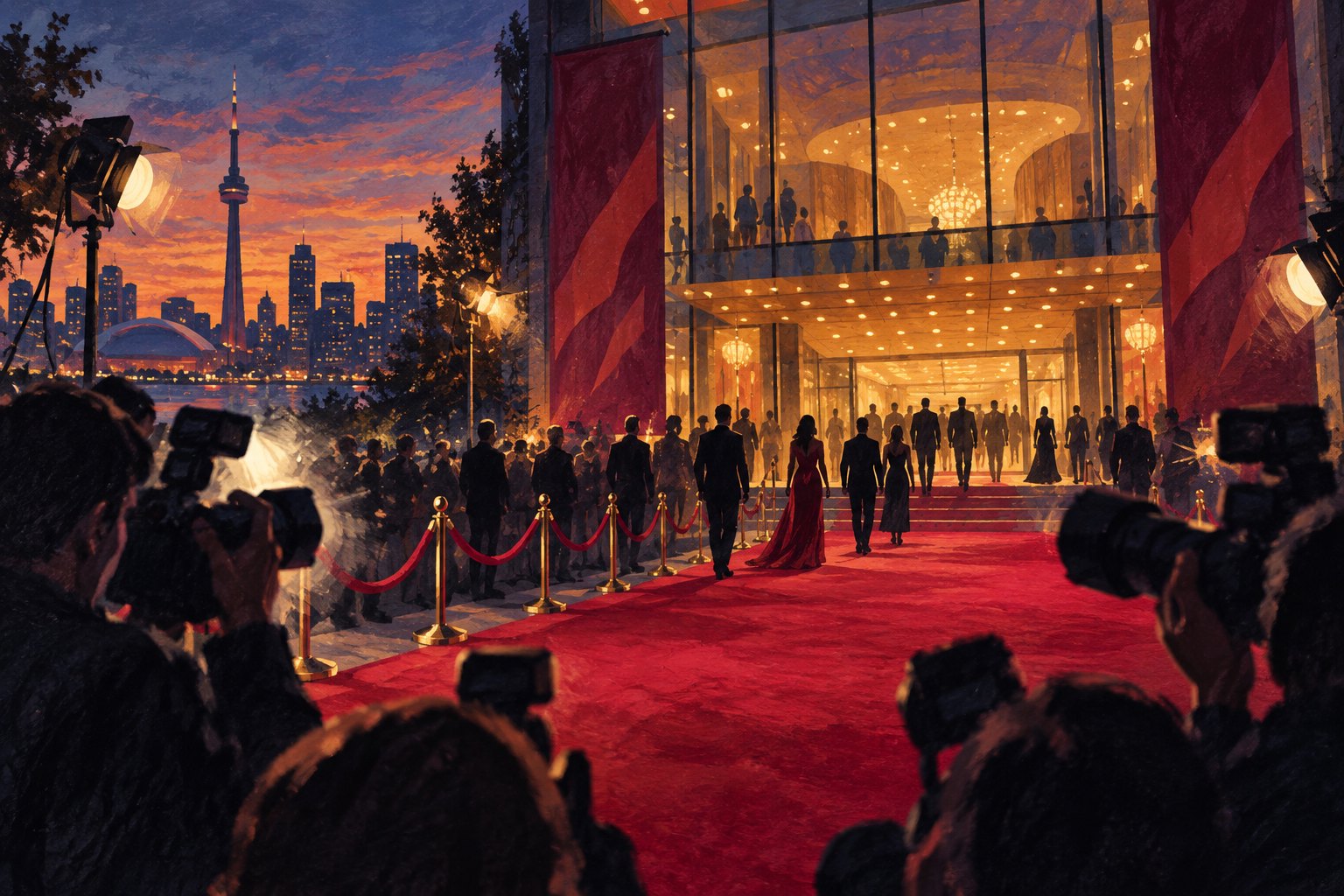
The 2026 Toronto Film Festival’s opening ceremony and the premieres of Being Heumann, Rapinoe and Stuffed are the focus of Deadline’s festival photo coverage. For readers looking for those events, the central distinction is straightforward: these are images of films meeting the public, rather than images that explain what happens within the films.
That distinction makes the coverage interesting on its own terms. A premiere introduces a movie through people, clothes, gestures and ceremony before many viewers encounter its opening scene. It gives an unfamiliar title a public identity. The useful critical question is how much of that identity we carry into the theater—and how willing we are to revise it once the movie starts.
This is spoiler-free festival commentary, not a screening review of the three films. The accompanying illustrations are conceptual scenes, not photographs documenting the Toronto events.
What the opening ceremony adds to the story
An opening ceremony does two jobs at once. It celebrates the act of gathering around movies, and it presents an institution’s image of itself. Formal arrivals, posed portraits and group photographs belong to that second function: they make a large, complicated cultural event legible through individual faces.
That is useful journalism when captions establish who is pictured and which occasion the image records. But a photograph’s emotional suggestion is a separate matter. A smile can communicate warmth without demonstrating confidence in a finished film. A solemn expression can look significant without revealing what anyone was thinking.
My preference is for festival coverage that preserves this ambiguity. People arriving at work, celebrating a collaboration or pausing for photographers need not become instant symbols of triumph or disappointment. Letting an image remain a moment can make it more revealing than attaching an oversized narrative to it.
For Toronto’s opening coverage, this means treating ceremony as context. It helps explain the environment in which Being Heumann, Rapinoe and Stuffed are being introduced. It does not establish a verdict on any of them.
Three titles, three invitations to look closer
Being Heumann: keep the title separate from a verdict
Being Heumann has a title that invites attention to personhood. That is a reading of its wording, not a claim about its plot. The word “being” suggests a life experienced from within, something a premiere portrait can evoke but cannot show in sustained detail.
A character-focused review would need to investigate how the film creates that interior perspective. Whose knowledge guides a scene? Does the camera allow us to notice a reaction before another character does? Are private choices given the same attention as publicly significant moments? Those questions require the film itself.
The premiere can supply a reason to become curious. The eventual criticism should explain whether that curiosity is rewarded through specific scenes, performances and formal decisions. Admiration surrounding a title should never have to do the work of that explanation.
Rapinoe: recognition is only a starting point
A surname used as a title can make recognition feel like understanding. Rapinoe offers a useful occasion to resist that shortcut. Whether a viewer arrives with strong associations or none at all, the meaningful question is what the film adds to the name.
Premiere photography operates through immediate identification. A film has time to complicate an initial impression, establish relationships and let competing perspectives develop. Good criticism should follow those changes rather than merely restate what a viewer already associates with the subject.
That concern connects with our examination of who controls the story when a public figure becomes a film subject. The relevant principle is to examine the perspective a movie constructs. Familiarity with a name cannot substitute for attention to its storytelling.
Stuffed: let the movie define its own title
Stuffed presents a different kind of invitation: a compact word with several possible associations. It can make a reader curious without providing a reliable synopsis. Guessing a premise from that word would turn an appealing title into misleading information.
The same restraint applies to a premiere’s visual presentation. Clothing, lighting and promotional styling may encourage an expectation about tone, but they cannot establish how a movie actually feels across its running time. Tone emerges through pacing, performance, sound and the relationship between scenes.
For viewers adding Stuffed to a watchlist, the next useful step is to seek an accurately established premise and criticism grounded in the film. A memorable public introduction earns attention; the storytelling determines what happens to it.
How to read premiere photographs more carefully
Festival galleries become more useful when we distinguish three layers: what is visible, what a caption establishes and what we infer. An image may show several people standing together. Its caption may identify their roles and the event. Calling the group harmonious, tense or triumphant adds an interpretation that the photograph alone may not support.
- Start with the caption. Identify the event and people before interpreting their expressions or relationships.
- Notice the frame. A close portrait emphasizes an individual; a wide image can reveal collaborators, photographers and the surrounding occasion.
- Separate attendance from reception. Being photographed at a premiere does not establish audience response or critical consensus.
- Leave room for what is absent. A gallery’s selection cannot represent every participant or every part of an evening.
This is not a reason to distrust the pleasure of festival pictures. It is a way to appreciate their particular strengths: faces, textures, arrangements and brief encounters. As our commentary on the relationship between photographic style and cinematic appeal explores, an image’s atmosphere and the information it communicates deserve separate attention.
When the lights go down, the questions change
The deeper interest of Toronto’s premiere coverage lies in the movement between two kinds of attention. Outside the theater, we recognize people and register an occasion. Inside, a movie asks us to follow an experience across time: to remember a look, reconsider a decision or understand why a relationship has changed.
That transition is where character analysis belongs. Memorable dialogue matters because of who says it, what has happened beforehand and what the words cost the speaker. A quotation detached from those conditions can become another promotional flourish. The same is true of an ending explained without the choices that make it meaningful.
Being Heumann, Rapinoe and Stuffed should each have the opportunity to establish those conditions for themselves. Toronto’s opening images offer an introduction to their public lives. The most rewarding response is to carry the curiosity forward while allowing the films to change our first impressions.
Original content by this site's editorial team. Published: September 13, 2026 at 05:01:42 PDT (Los Angeles time)