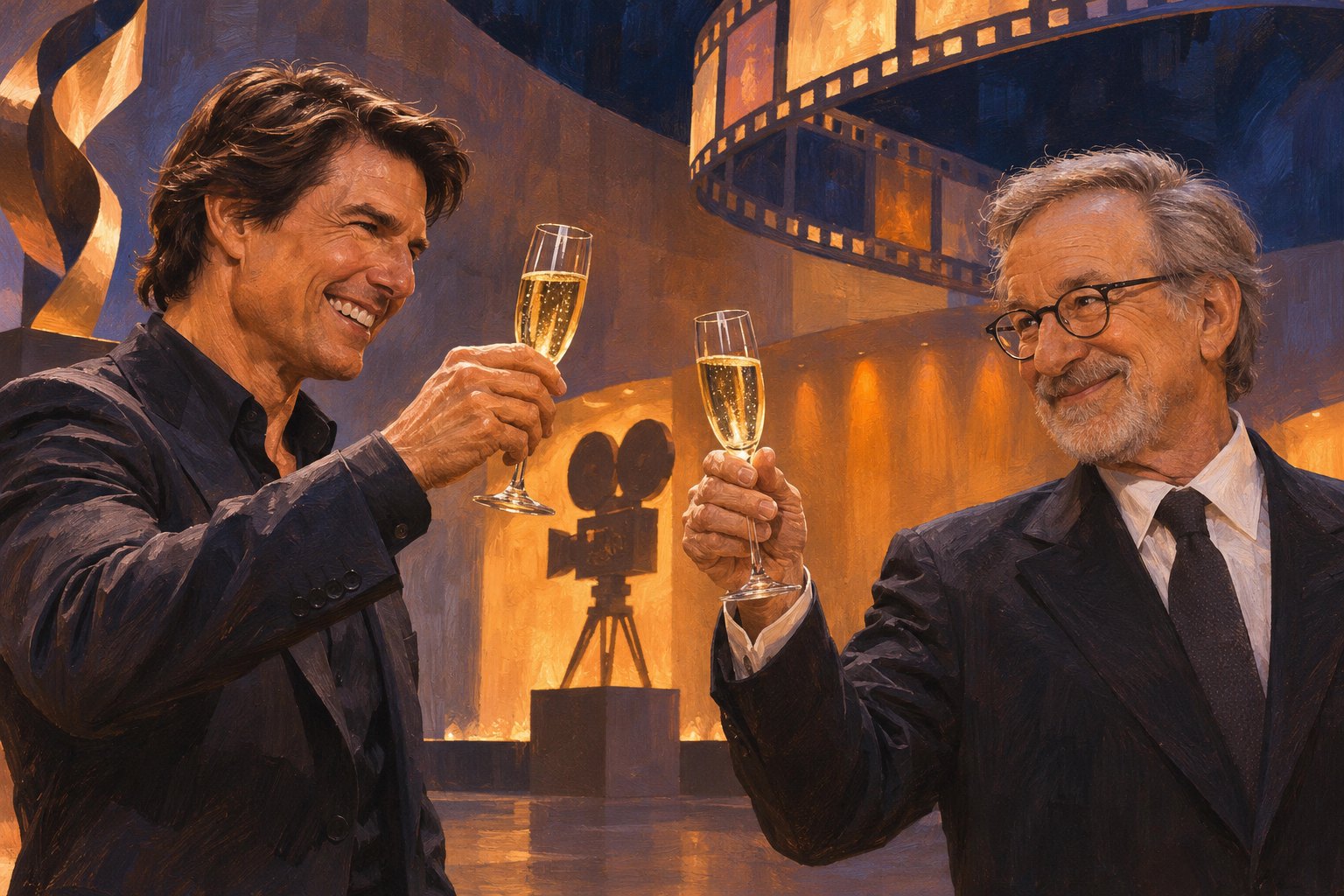
Tom Cruise led toasts for Steven Spielberg at a MoMA film gala, according to The New York Times. The occasion puts an actor and director with a particularly compelling screen partnership back in the spotlight. Their collaboration offers something more interesting than a straightforward meeting of Hollywood heavyweights: Spielberg found ways to make Cruise’s commanding presence look dangerously uncertain.
The reported tribute is the news here; the discussion below is a critical interpretation of their work, not an account of the speeches. No particular sentiment or quotation from Cruise’s toast should be inferred from it. Instead, the occasion provides a useful invitation to revisit Minority Report, the 2002 science-fiction thriller that first brought them together.
Our earlier look at Spielberg’s MoMA tribute and the emotional endurance of his films considered his gift for attachment and separation. Cruise opens another avenue: the director’s ability to make a confident protagonist confront the damage hidden inside his confidence.
Spoiler warning: The following review discusses the central revelations and ending of Minority Report.
John Anderton needs Precrime to be right
Set in Washington, D.C., in 2054, Minority Report follows John Anderton, the officer played by Cruise who leads a unit that arrests people before predicted murders occur. Its intelligence comes from three human beings with precognitive abilities. Their visions supply the images; police officers interpret them and intervene.
Anderton’s commitment has an intimate foundation. His son Sean disappeared, leaving him with a loss he cannot resolve. Precrime gives him a professional identity built around preventing the kind of catastrophe that broke his family. The system’s promise therefore reaches beyond public safety. It offers him a way to imagine that helplessness can be engineered out of life.
That distinction makes Cruise’s performance work. Anderton’s decisiveness feels practiced, almost protective. At work, he can sort images, issue commands, and move toward an answer. In private, recordings of his family keep returning him to something that cannot be repaired by working harder.
My reading is that the movie’s deepest tension begins before Anderton becomes a suspect. He already lives between two incompatible relationships with images: he treats recordings of the past as an emotional refuge and visions of the future as unquestionable evidence. Neither gives him a complete understanding of another person.
Spielberg makes certainty thrilling before making it frightening
The opening intervention establishes Anderton as exceptionally good at his job. Fragmentary visual clues become a location; a countdown becomes a rescue. Spielberg makes the process exciting enough that accepting its assumptions feels almost automatic. We want the officers to arrive in time.
Then a prediction identifies Anderton as a future murderer. The machinery that gave his life purpose now defines him through an act he has not committed. His flight supplies the chase movie, but the more revealing drama is his insistence that there must be an explanation that preserves his innocence.
He has difficulty extending that same uncertainty to everyone the system has already imprisoned. This is the character’s moral problem, and Cruise does not need to announce it. The urgency with which Anderton demands an exception exposes how little room he previously allowed for doubt.
For me, this is the strongest use of Cruise’s physical intensity. Running demonstrates his resourcefulness while exposing the limits of resourcefulness itself. He can escape a pursuer without escaping the beliefs that made him useful to the institution pursuing him.
Agatha changes what the audience is asked to see
Samantha Morton’s Agatha is essential to that reckoning. Within Precrime, she is treated as a source of information. The organization depends on her extraordinary perception while arranging her life around its own needs.
Her question, “Can you see?”, gives the film a compact challenge. Anderton can inspect a vision for clues, but noticing the person who experiences it requires a different kind of attention. His investigative skill does not automatically produce empathy.
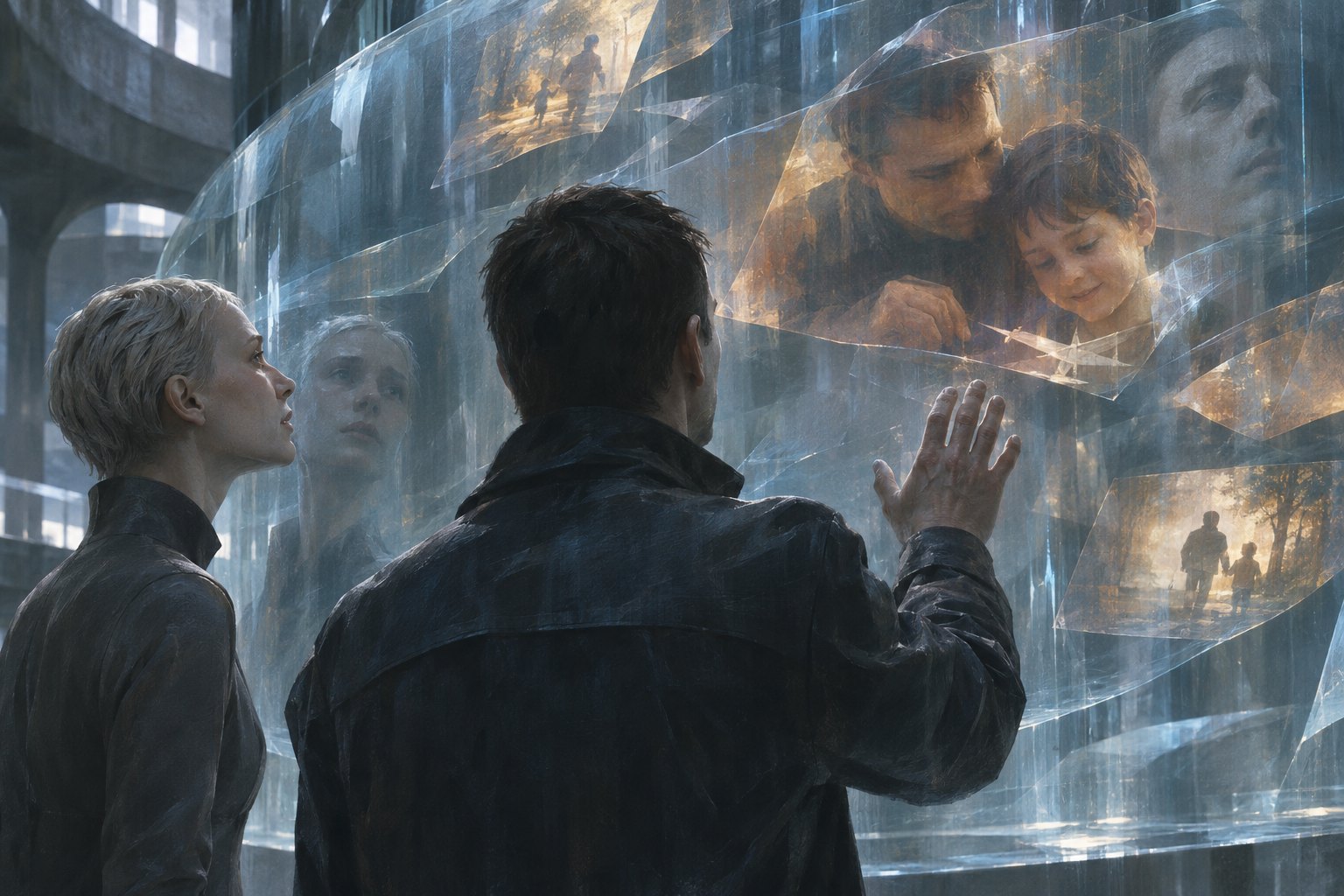
Once Agatha leaves the facility with Anderton, the film’s human imbalance becomes harder to overlook. She can help him navigate danger, yet she is physically vulnerable and dependent on his protection. Morton makes that coexistence of knowledge and vulnerability deeply uncomfortable. Knowing what may happen does not mean having control over your own circumstances.
The mystery involving her mother, Anne Lively, also restores a personal history to someone the institution has reduced to a function. Agatha has attachments and losses of her own. She does not exist simply to solve Anderton’s problems.
The Leo Crow confrontation turns restraint into action
The encounter with Leo Crow brings Anderton’s grief and the prediction together. Evidence planted in Crow’s room persuades Anderton that he has found the man responsible for Sean’s disappearance. What began as an effort to avoid a foretold killing becomes a situation in which revenge feels available.
Agatha’s insistence, “You still have a choice,” matters because it addresses his behavior rather than promising him a convenient escape from the vision. Anderton has to decide what to do while the emotional pressure remains unbearable.
He chooses to arrest Crow instead of deliberately executing him. Crow then reveals the arrangement behind the setup and forces the fatal confrontation. The sequence preserves a crucial distinction: an image can show a death without adequately explaining intention, coercion, or responsibility.
Cruise’s strongest work here is the struggle to stop. The performance makes restraint feel effortful, not passive. Spielberg gives an action star a decisive moment in which refusing the expected action becomes the measure of his character.
A satisfying thriller with an uneasy resolution
The eventual exposure of Lamar Burgess explains how a person with institutional knowledge can manipulate the handling of visions. The revelation connects corruption to an established habit: trusting the system’s interpretation more readily than the people caught inside it.
I find the film less elegant when the concluding explanation gathers its mysteries into a single conspiracy. Anderton’s personal ordeal is resolved more neatly than the wider ethical problem deserves. Removing a corrupt authority cannot, by itself, answer every question about prediction and punishment.
Nevertheless, the ending offers a meaningful change in emphasis. Precrime is abandoned, and Agatha and the other precogs are given a life away from their enforced service. Their peace matters as much as Anderton’s vindication. The people who supplied the spectacle finally receive some privacy.
What Cruise’s tribute invites us to revisit
Watching Minority Report again, pay attention to when your trust shifts between Anderton and Agatha. Our guide to watching films through character decisions offers a useful approach: follow what a character chooses when information changes, rather than only tracking the next revelation.
That approach reveals why the Cruise-Spielberg partnership deserves attention alongside the MoMA celebration. Spielberg uses Cruise’s authority to draw us toward Anderton, then asks whether identification has made us too forgiving of him. The star remains compelling even as his judgment becomes suspect.
The deeper achievement is a film about the responsibility of looking. Images demand interpretation; expertise needs humility; grief does not grant moral permission. Cruise’s toast honors the filmmaker in public. Minority Report gives audiences a lasting reason to examine the work: it makes the pleasure of watching inseparable from the obligation to question what we think we have seen.
Original content by this site's editorial team. Published: November 13, 2026 at 13:18:59 PST (Los Angeles time)