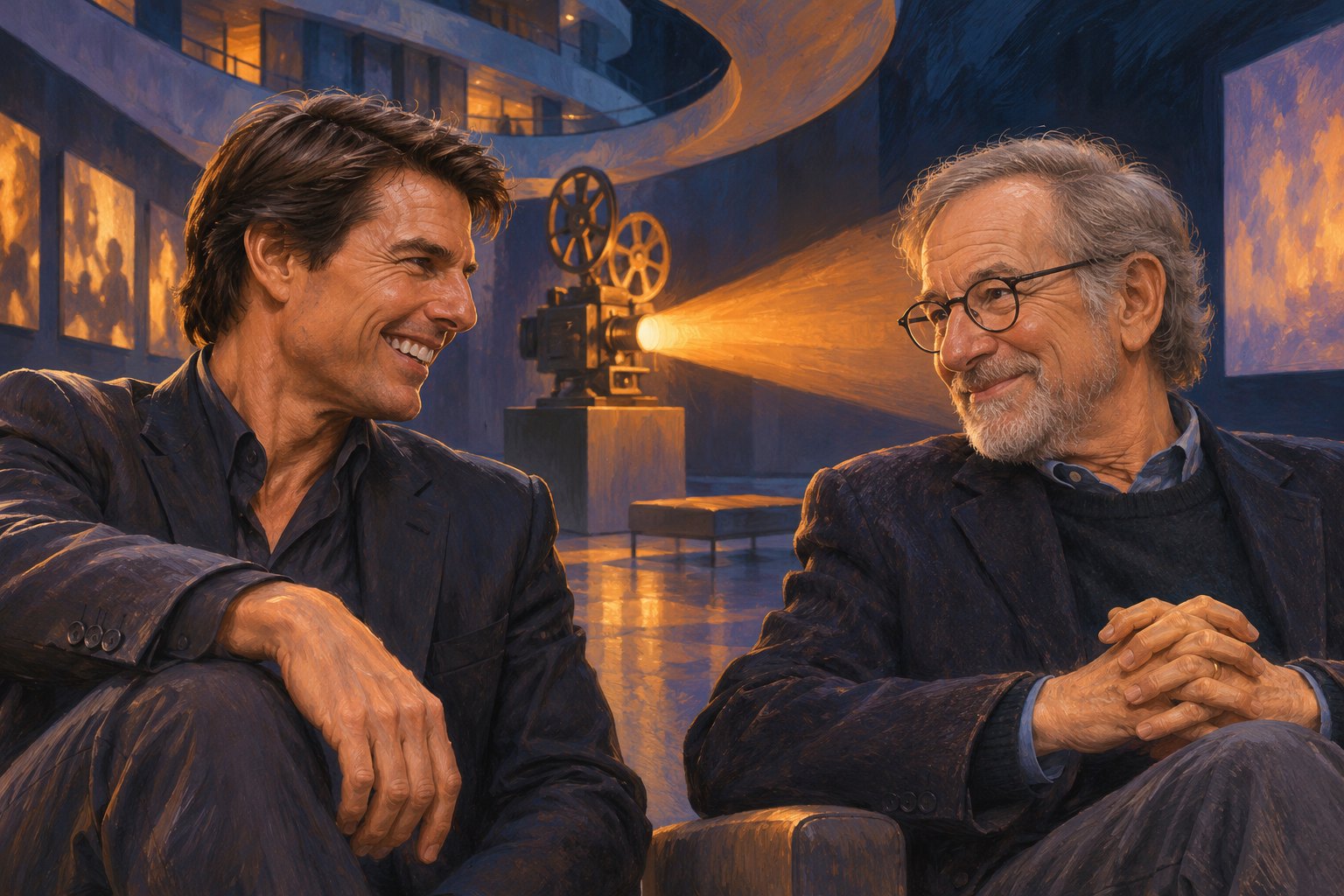
Tom Cruise’s participation in the celebration of Steven Spielberg at the Museum of Modern Art carries a particular resonance for movie lovers. The New York Times placed Cruise at the center of its coverage of the tribute; [Associated Press reporting](https://apnews.com/article/1b3958ee841b8e3fa6b30c52b7e6ba2f) also confirms his appearance honoring the filmmaker. Their shared movies offer a compelling explanation for why this pairing matters beyond the ceremony.
In Minority Report and War of the Worlds, Spielberg gives Cruise formidable physical challenges while questioning whether physical capability is enough. These are movies about men who can run, improvise, and fight, yet struggle to understand what other people need from them. The affection surrounding the MoMA tribute becomes an invitation to revisit that demanding artistic relationship.
Spoiler warning: The following review discusses major developments and endings in both films. Interpretations are critical judgments, separate from reporting about the tribute.
A collaboration built around the limits of control
Cruise’s intensity makes him especially effective as someone who believes effort should produce results. Spielberg puts pressure on that belief. His protagonists here are fathers confronting threats that expose the gap between wanting to protect someone and being able to do so.
John Anderton tries to make uncertainty disappear through a policing system. Ray Ferrier discovers that getting his children through a catastrophe requires more than issuing instructions. One man starts with institutional authority; the other barely commands respect in his own household. Both have to learn that confidence can conceal a failure to listen.
That is the strongest reason to watch these films together. Their machinery and monsters are memorable, but their most revealing special effect is the gradual erosion of Cruise’s assurance.
Minority Report: John Anderton’s certainty becomes a trap
Spielberg’s Minority Report arrived in 2002, with Cruise playing John Anderton, a leading officer in a system that predicts murders before they happen. [Amblin’s account of the film](https://amblin.com/movie/minority-report/) identifies this as their first collaboration and places its surveillance-driven future at the heart of the premise.
Anderton initially looks beautifully suited to his job. His movements have the fluency of someone who has repeated a demanding task until it feels instinctive. Watching him manipulate predictive images, we understand the attraction of his authority: he makes confusing information look manageable.
But his investment is personal. His son’s disappearance has left him desperate for a world in which catastrophe can be stopped before it reaches a family. In my reading, his professional dedication also functions as an attempt to bargain with an irreversible loss. If enough other children can be protected, perhaps his own failure will become less unbearable.
The film becomes most interesting when its prediction apparatus identifies Anderton as a future killer. His predicament forces him to demand the uncertainty he previously denied other suspects. Cruise makes that contradiction uncomfortable: Anderton’s terror is understandable, but it does not automatically excuse the system he helped operate.
Agatha supplies the argument that action cannot
Agatha, played by Samantha Morton, changes the film’s emotional center. As one of the precognitives whose visions power Precrime, she has been treated as an instrument. Her presence beside Anderton makes the human cost of that arrangement impossible to ignore.
At the confrontation with Leo Crow, whom Anderton believes responsible for his son’s disappearance, her appeal is simple: “You still have a choice.” Later comes the even shorter insistence, “You can choose.” The [film’s dialogue transcript](https://www.springfieldspringfield.co.uk/movie_script.php?movie=minority-report) records both lines. They matter because they interrupt his conviction that grief and prediction have already determined his behavior.
For me, this is the film’s strongest passage. Suspense rests on whether a man can refrain from acting. Cruise’s familiar forward momentum becomes a danger; stillness becomes an achievement. Spielberg turns the expected release of an action scene into a test of restraint.
The elaborate conspiracy can sometimes crowd out this cleaner moral conflict. Even so, the film earns its central distinction: seeing an image is not the same as understanding a person. Anderton has to recognize that difference before he can become more than an efficient operator.
War of the Worlds: survival through a frightened family’s eyes
In War of the Worlds (2005), Cruise’s Ray Ferrier is a divorced dockworker suddenly responsible for protecting his children during an alien invasion. [Paramount’s synopsis](https://www.paramount.com/movies/war-of-the-worlds-2005) establishes his estrangement from Rachel and Robbie, a crucial starting point for the drama.
Ray is not introduced as a father whose competence simply needs a sufficiently large stage. His family relationships already require repair. The invasion intensifies those weaknesses: practical resourcefulness can keep people moving without making them feel understood or safe.
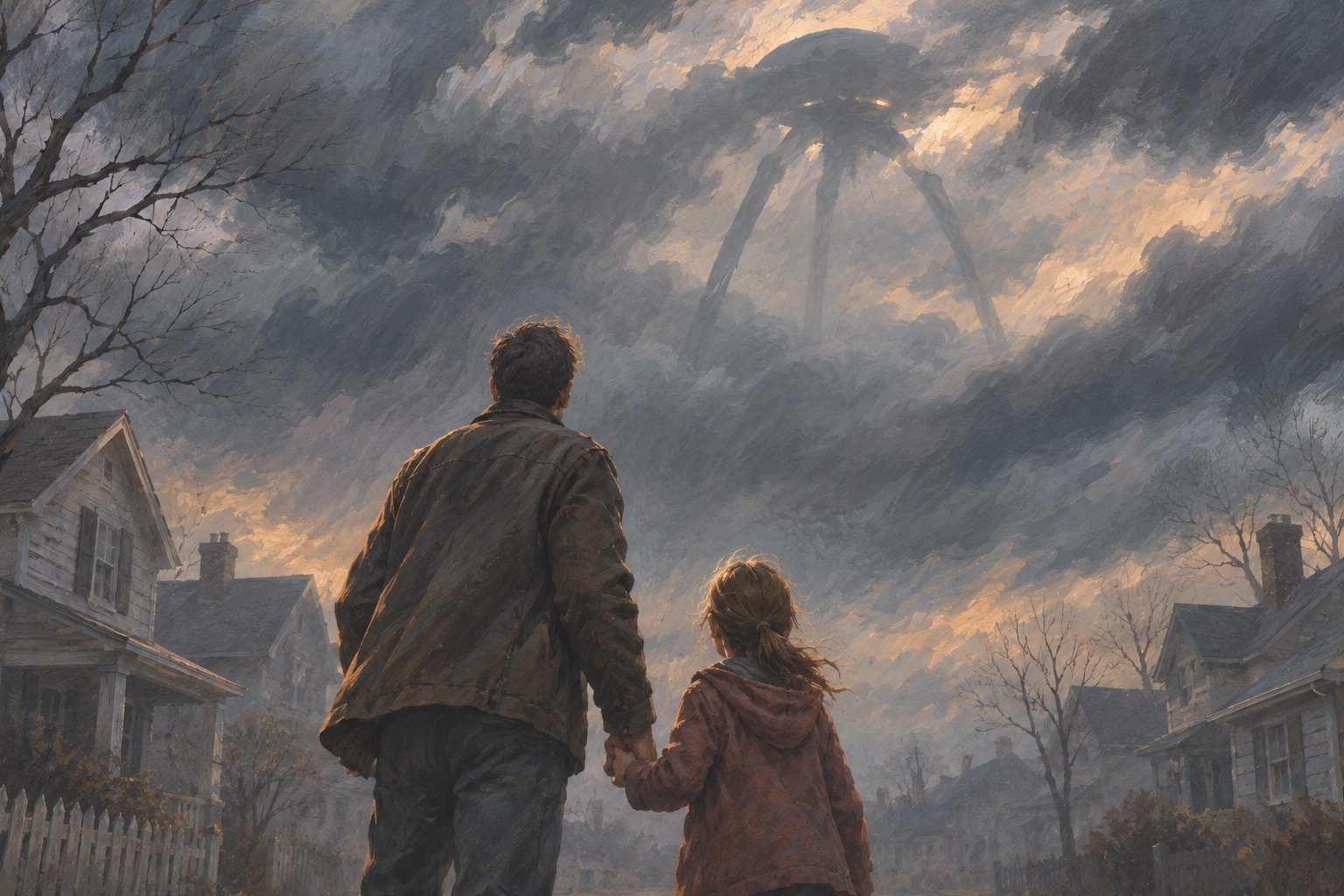
Spielberg’s ground-level perspective is essential. Buildings and machines dwarf the people beneath them, while information arrives in frightening fragments. We experience the disaster through a family trying to get through the next few minutes, rather than through a command center explaining the whole conflict.
Rachel’s question, “Is it the terrorists?”, gives that confusion a recognizable vocabulary. As preserved in the [film’s dialogue transcript](https://www.springfieldspringfield.co.uk/movie_script.php?movie=war-of-the-worlds), it is a child’s attempt to name something overwhelming. The line lands because her father has no reassuring explanation ready.
Dakota Fanning’s performance makes fear an ongoing demand on Ray’s attention. From Rachel’s perspective, an escape route is only part of protection; she also needs emotional steadiness. Cruise is compelling when those responsibilities pull him in different directions. His urgency helps them survive, yet that same urgency can make him impatient with the person he is protecting.
The uncomfortable limits of a reassuring ending
My reservation is that the final family reunion provides a degree of reassurance the preceding terror makes difficult to accept. The film has been so effective at establishing vulnerability that its emotional release can feel unusually tidy.
Still, Ray’s limited place in the larger outcome gives the story force. He cannot personally master the invasion. His meaningful achievement lies closer to home: remaining responsible for someone vulnerable when responsibility has become exhausting and frightening.
These are also films whose scale benefits from attentive presentation. Our discussion of how theatrical presentation shapes the viewing experience explores why framing, sound, and shared attention matter to that encounter.
What the MoMA tribute brings back into focus
A celebration can make a filmmaker’s legacy sound settled. These collaborations reward a less comfortable response: watching again, noticing the flaws, and asking why the characters remain compelling. As in our examination of lasting character journeys across movie trilogies, endurance depends on more than memorable spectacle.
My deeper reading of Spielberg and Cruise’s partnership is that both films make protection inseparable from humility. Anderton must stop confusing prediction with moral certainty. Ray must discover the daily weight of being needed. The star’s energy remains indispensable, but the director makes that energy answer to other people.
That gives Cruise’s tribute at MoMA an artistic significance beyond celebrity affection. Their shared work demonstrates what an ambitious actor-director partnership can accomplish: allowing a commanding movie star to become frightened, mistaken, dependent, and, through those limitations, more human.
Original content by this site's editorial team. Published: November 15, 2026 at 10:29:23 PST (Los Angeles time)