
Tom Cruise’s Digger makes an environmental emergency inseparable from a struggle over who gets to explain it. Directed by Alejandro G. Iñárritu, the film places oil tycoon Digger Rockwell among scientists and political leaders confronting the consequences of destructive drilling. Its most unsettling proposition is that recognizing a catastrophe does not necessarily make powerful people interested in preventing it. They may become more interested in choosing its narrator.
Slate’s sharply negative headline frames Cruise’s new movie as a disaster itself. That is a critical judgment, not a settled description of the film’s reception: other published assessments have been considerably more enthusiastic. The useful question underneath that disagreement concerns the dramatic machinery. Does the collision of environmental danger and oversized personalities illuminate how power works, or simply give powerful characters more room to talk?
Spoiler scope: This analysis examines the opening crisis and dialogue documented in published reviews. It leaves the film’s larger structural revelations and ending undisclosed and does not present a firsthand screening assessment.
The emergency begins with a failure to listen
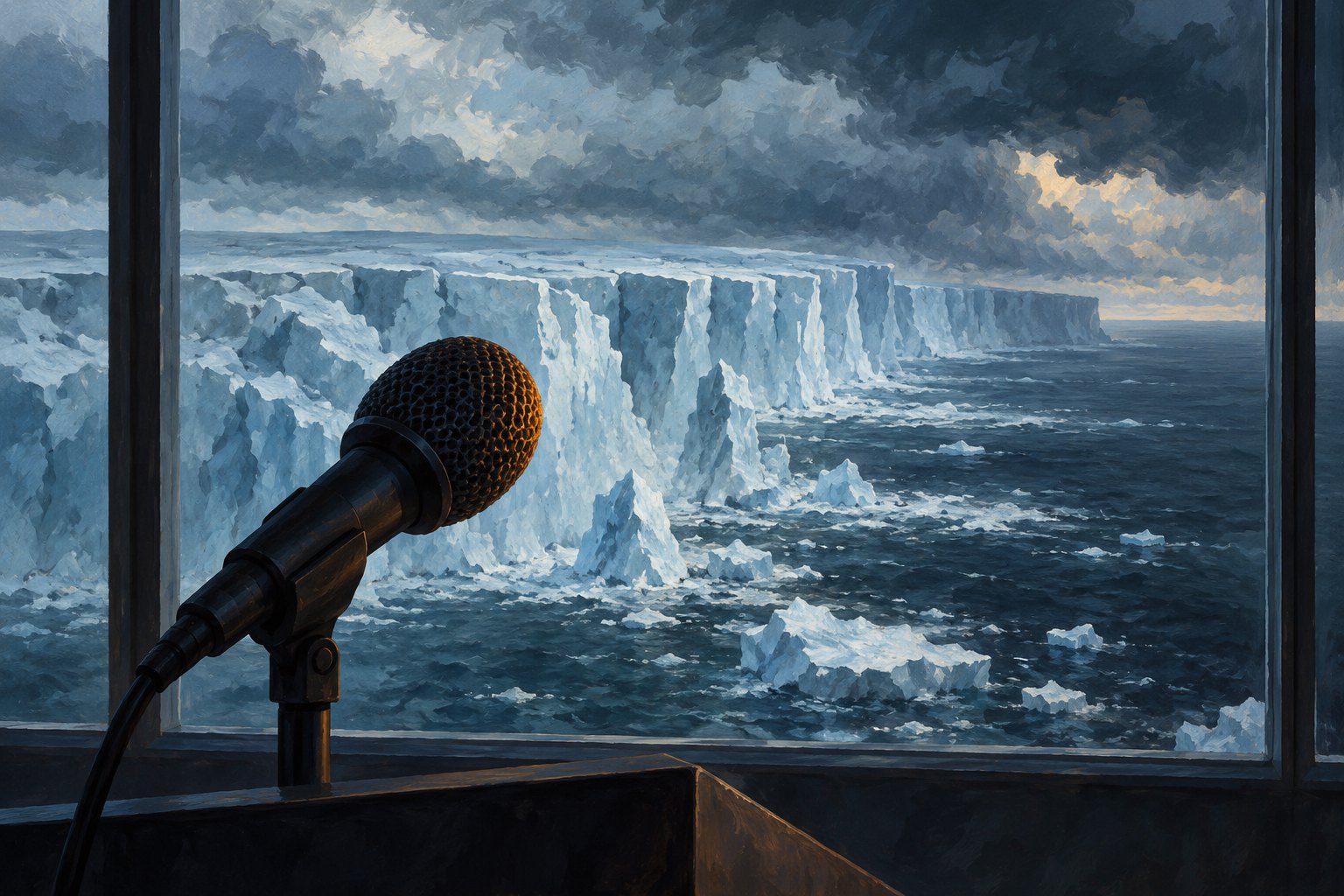
The Associated Press describes early warnings from a drilling operation in Greenland, where a crack and a methane leak alarm scientists. Digger responds with the language of business motivation, pushing for greater output. His demand for “hustle” is a small but revealing verbal choice: a warning about physical limits becomes, in his vocabulary, an invitation to work harder.
That distinction matters to character. Digger’s authority rests on believing that obstacles can be overcome through pressure, confidence, and production. Scientific information threatens him because it introduces conditions that cannot be negotiated. An environmental limit does not become more accommodating when the person addressing it raises his voice.
My reading is that the opening conflict becomes most interesting when understood as a failure of translation. The scientists describe a danger; Digger hears an impediment to business. Both can be discussing the same event while assigning it entirely different meanings. The resulting comedy carries an ugly implication: a warning can reach the correct person and still fail completely.
Digger wants authorship as much as authority
Two brief statements attributed to Digger in Time Out’s review crystallize this impulse: “They know the facts,” followed by “The story is yet to be told.” The separation is chilling. Knowledge has already arrived. What remains available for manipulation is the account that will make knowledge politically usable.
For Digger, telling the story offers a way to remain indispensable after his judgment has become suspect. If he can establish what the crisis means, he can influence which failures matter and which people should answer for them. This makes his verbal energy consequential even when it produces no practical solution.
That is a different problem from the selective compassion explored in our analysis of who receives Digger Rockwell’s care. Here, the issue is control over public understanding. A character can acknowledge damage while still resisting any interpretation that would reduce his authority.
Ganesh faces the limits of being right
Riz Ahmed’s scientist Ganesh brings the crisis into human conversation. Published plot accounts place him among the people attempting to make the danger intelligible to those with decision-making power. His dramatic position is inherently uncomfortable: possessing useful knowledge does not give him command of the room.
From Ganesh’s perspective, the essential task should be establishing what is happening and what responses remain possible. Around Digger, however, information must pass through other people’s concerns about status, culpability, and appearances. Expertise becomes something the powerful can consult without necessarily accepting its implications.
This makes Ganesh more interesting than a simple embodiment of reason. The question to watch is whether he can change anyone’s behavior. A speech may be accurate, urgent, and morally persuasive while leaving the distribution of power untouched. His frustration gives the disaster a more recognizable scale: the experience of explaining something clearly to someone who benefits from misunderstanding it.
As a critical principle, that is where the character’s value lies. Scientific dialogue should alter a relationship, expose a dependence, or force a choice. When it merely delivers the film’s message, the person speaking risks becoming an explanatory device.
President Compson makes responsibility harder to locate
John Goodman plays President Compson. Published accounts describe the president and other officials becoming involved as the threat escalates. Bringing political authority into Digger’s orbit changes the character dynamics: the emergency now implicates both private influence and public decision-making.
The most productive way to read this relationship is through competing needs. Digger has reasons to preserve his standing. A president has reasons to preserve the appearance of command. Those objectives can overlap even when the men disagree, creating the possibility that an argument over responsibility becomes a performance of action.
This is where an apocalypse can generate claustrophobic drama. The threat is vast, but the conversation becomes restricted by what its participants can bear to concede. Every admission threatens an identity: successful businessman, competent leader, authoritative expert. The room contains people with different kinds of power, none of which automatically produces wisdom.
Why the film’s volume becomes a critical fault line
The disagreement among reviewers is instructive. The Associated Press questions the film’s comic effectiveness, while Time Out embraces its excess. These judgments suggest different tolerances for a satire that makes unpleasantness part of its attraction. Neither reaction establishes what every viewer will experience.
My reservation about this approach is structural. If every exchange reiterates that wealthy and influential people protect themselves, escalation can replace discovery. A character study needs differences between its participants to matter. Ganesh’s dependence, Compson’s official position, and Digger’s private influence should generate distinct pressures rather than interchangeable demonstrations of selfishness.
There is also a potential strength in that discomfort. Conventional disaster storytelling often rewards decisiveness so automatically that confidence starts to resemble competence. A satire can interrupt that reflex by making decisive speech sound impressive while exposing how little it accomplishes. The challenge is sustaining that distinction without repeating it past the point of dramatic interest.
These artistic questions should remain separate from commercial predictions. Our examination of Digger’s box-office prospects and the limits of star recognition considers another issue; a hostile review alone cannot establish financial failure.
The deeper question: who gets to define an adequate response?
The strongest interpretation of Digger begins with the gap between acknowledging a problem and accepting an obligation. Facts can enter a conversation without changing its priorities. Powerful people can concede that danger exists while continuing to argue over the account that best protects them.
That makes the characters’ language worth watching as closely as their proposed solutions. Who answers a question directly? Who changes its terms? Who treats uncertainty as a reason for care, and who uses it to postpone responsibility? These are practical distinctions through which a political satire can become a study of behavior.
For me, the premise’s sharpest implication is that controlling the story can feel like controlling the event. Digger’s authority depends on maintaining that confusion. The moral pressure comes from everything outside his account: consequences that continue developing whether or not the people in charge have agreed on what to call them.
Original content by this site's editorial team. Published: October 2, 2026 at 10:37:09 PDT (Los Angeles time)