Ti West’s Remnants puts a familiar horror proposition inside an unfamiliar viewing experience: enter a supposedly haunted building, then discover how little your powers of observation can protect you. The immediate attraction is proximity. The more interesting dramatic question is whether that proximity deepens our connection to the person facing danger—or simply makes the danger harder to ignore.
Apple identifies the film as a 27-minute ghost story set around Woldmere Castle. Its compact running time makes it a short film, rather than a feature-length addition to West’s filmography. [Apple’s film listing](https://tv.apple.com/us/movie/remnants/umc.cmc.1b2og5ni6y2blpwxnagog6j1a).
Scope and spoilers: This is a critical reading of the premise and techniques described in published coverage, not a firsthand headset review. It discusses the setup and selected scare mechanics without explaining the ending. Claims about the experience below remain attributed to the critics who experienced it.
Eleanor Enters the Castle With a Job to Do
In William Earl’s Variety account, the story begins in 1886 London. Eleanor, played by Lucy Boynton, intends to appraise the abandoned Woldmere Castle despite a local man’s warning; Ralph Ineson plays that cautionary figure. Their introductory encounter takes place in a pub. [Earl’s review](https://variety.com/2026/digital/columns/ti-west-remnants-review-apple-immersive-horror-film-1236918255/).
That occupation gives the premise a useful tension. An appraiser approaches a building as something that can be examined and understood. A ghost story challenges the sufficiency of that approach. Before assigning Eleanor any unverified private history or hidden motivation, we can recognize the conflict already present in her task: she enters expecting to assess a property whose haunted reputation resists ordinary assessment.
It would be too easy to reduce her decision to the familiar complaint that horror characters should know better. From inside a character’s situation, a warning is information to evaluate, not necessarily a command to obey. Eleanor has a practical reason to continue. The audience has genre expectations that she need not share.
That distinction matters because suspense often depends on unequal knowledge. We anticipate a haunting because we know what kind of film we are watching. She must navigate the place itself. A character-centered reading should preserve that difference instead of treating her as foolish for failing to possess the audience’s advance certainty.
Looking Around Does Not Mean Taking Control
Laura Mingail’s UploadVR review describes a noninteractive experience that gives the viewer no character to inhabit. West changes viewpoints, including close and elevated perspectives, while the audience remains unable to intervene. Mingail finds that this restricted control contributes to the unease. [UploadVR’s review](https://www.uploadvr.com/remnants-is-a-haunted-experience-beyond-your-control-in-apple-immersive/).
This is the most productive way to think about the relationship between Eleanor and the viewer. Greater visual access does not automatically create greater agency. You may feel positioned near a character without acquiring any ability to warn her, open a door, or change her decision.
For horror, that separation has real expressive potential. Watching someone approach danger is already uncomfortable. A stronger sensation of sharing their surroundings can make the inability to help feel less abstract. The dramatic opportunity lies in the mismatch between apparent presence and actual powerlessness.
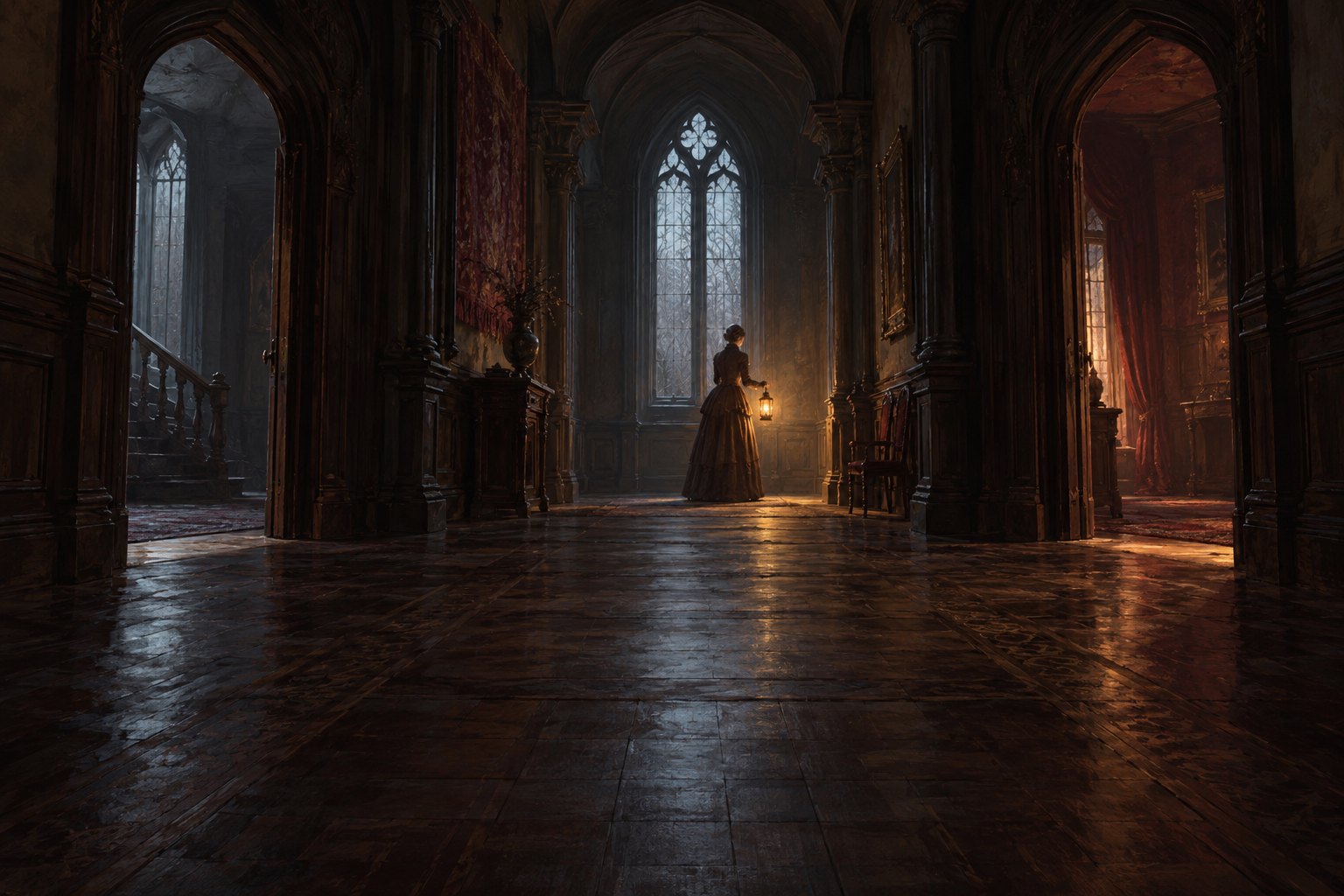
There is also a possible cost. If the viewer becomes preoccupied with inspecting the environment, Eleanor’s emotional responses may compete with the architecture for attention. An immersive film still needs to establish what deserves our concern. A large visible space cannot make that decision by itself.
Our discussion of how visibility shapes audience assumptions explores a related problem: access to more of an image does not necessarily produce a fuller understanding of what is happening within it.
Why Familiar Scares Can Feel Different
Earl describes moments involving rain, a supernatural presence apparently passing through the viewer, and hiding beneath covers. His account suggests that familiar haunted-house devices acquire force through their apparent relationship to the spectator’s body. Those are his reported reactions, rather than a guarantee of how every viewer will respond.
The distinction between surprise and vulnerability is useful here. A surprise interrupts an expectation. Vulnerability lasts longer: it is the awareness that a boundary may not protect you. A doorway, a bed, or the space immediately around a person can become frightening when its ordinary promise of separation stops feeling reliable.
Consider hiding as a dramatic action. It expresses a desire to become unavailable to danger. In conventional screen storytelling, we observe that effort from a visible distance. An immersive presentation has the potential to make the shelter feel shared, so the character’s attempt to withdraw becomes something the viewer can imaginatively participate in.
That does not prove that a particular scare is well timed or emotionally earned. It identifies the formal possibility. The strongest use of proximity would connect the audience’s physical anticipation to Eleanor’s immediate predicament, giving the sensation a human reason to matter.
A Simple Story Still Needs an Emotional Shape
Earl regards the plot as slight, while Mingail emphasizes that the short provides room for a developing haunting rather than merely a succession of shocks. These assessments are not necessarily incompatible. Narrative complexity and sustained atmosphere measure different things.
A short horror film does not need an elaborate mythology to be satisfying. It does need change: a developing understanding of danger, an altered relationship to a place, or a meaningful shift in how a character behaves. Without some progression, intensity risks becoming repetitive even when the images remain striking.
For Eleanor, the useful critical question is how her original purpose survives contact with fear. Does practical attention become defensive attention? Does looking help her understand, or make her increasingly conscious of what she cannot manage? These are questions for evaluating the finished performance and construction, not assertions about unverified plot developments.
They also provide a better basis for judgment than counting startling moments. Our analysis of attention and character in Perfect Days considers a very different emotional register, but the underlying principle applies: looking becomes dramatically meaningful through the person doing it.
The Deeper Tension: Presence Without Power
The most compelling interpretation available from the documented premise is that Remnants brings two forms of limited control together. Eleanor approaches a place with a purpose, while the viewer approaches a film with the freedom to observe. Neither kind of access necessarily confers authority over what follows.
That reading does not require inventing a symbolic explanation for the ghost or claiming knowledge of the ending. It arises from the relationship between the character’s task and the audience’s position. Inspection can reveal a problem without offering a solution. Being close can make helplessness more palpable.
For prospective viewers, the published responses support interest in Remnants as a compact experiment in bodily suspense. They do not justify declaring its emotional impact universal. The question worth carrying into the experience is whether its closeness to danger also produces closeness to Eleanor. A startling presence may seize attention; a character’s vulnerability gives that attention somewhere meaningful to go.
Original content by this site's editorial team. Published: October 27, 2026 at 22:59:40 PDT (Los Angeles time)