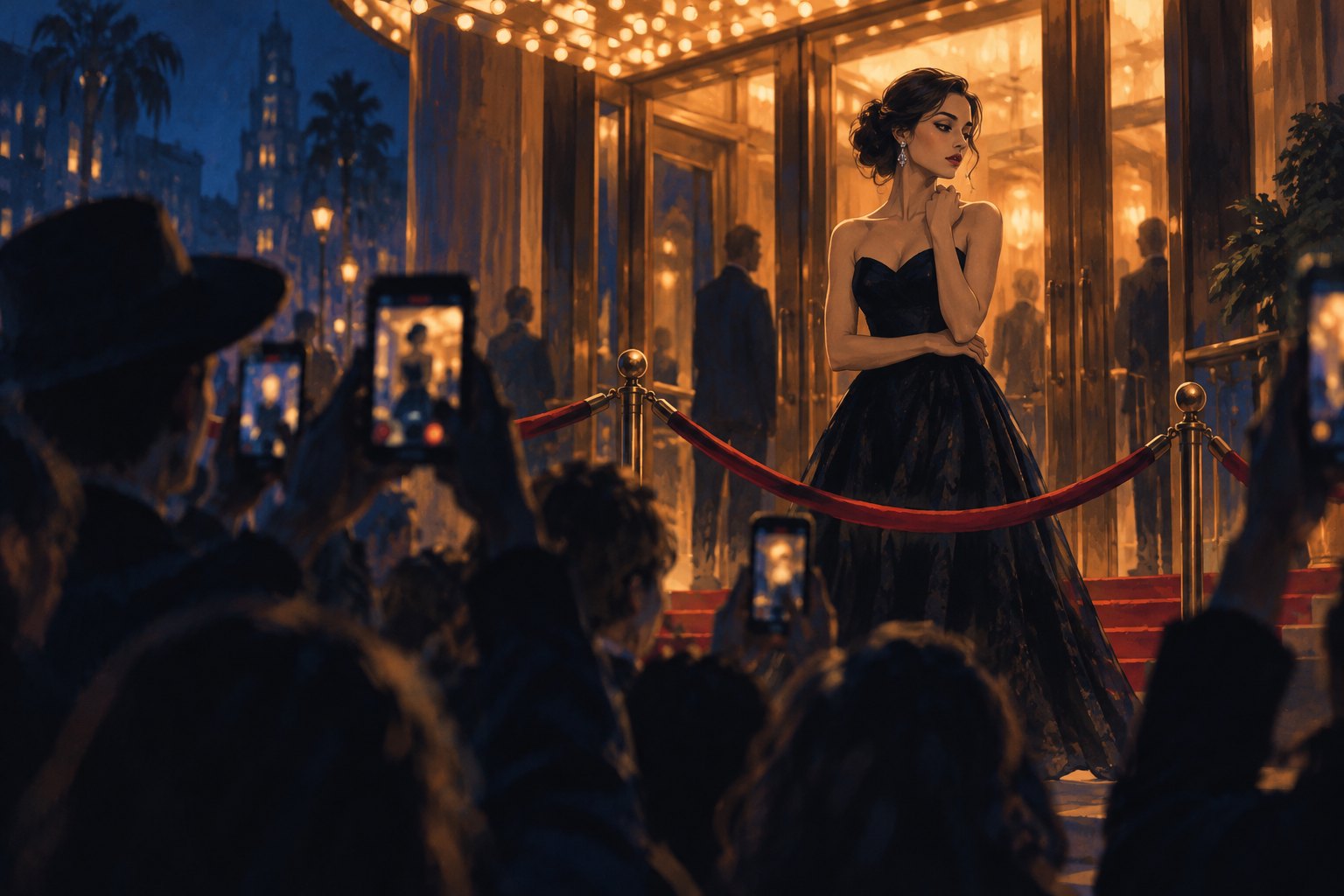
The unreachable movie star has an obvious problem: distance can make a person seem less than human. But replacing that distance with constant access creates another problem. A familiar face can begin to feel like someone we own. The most useful question in the debate over disappearing celebrity mystique is whether we want to understand performers—or simply expect them to remain available.
Notting Hill offers a revealing way into that question. Its romance depends on the thrill of meeting an apparently inaccessible woman, then asks what happens when the man who meets her mistakes celebrity for emotional invulnerability. My reading is that the film’s lasting appeal comes from this tension: it sells the fantasy of access while recognizing that access alone cannot sustain love.
Major spoilers follow for Notting Hill, including its ending.
Anna Scott’s fame makes her visible, not understood
Roger Michell’s 1999 romantic comedy, written by Richard Curtis, pairs Julia Roberts as movie star Anna Scott with Hugh Grant as London bookseller William Thacker. Their first encounters turn an extraordinary possibility into a string of ordinary inconveniences: shopping, spilled orange juice, an offer to clean up. The machinery of celebrity briefly gives way to the practical business of being a person.
That change of scale is the film’s strongest idea. William cannot compete with Anna’s professional world in money, spectacle, or influence. What he can offer is a situation in which she does not have to deliver a polished version of herself. Attraction grows in the gap between recognizing a famous face and deciding how to treat the person wearing it.
Roberts makes that gap compelling. Anna’s reserve can read as elegance, exhaustion, or defensiveness, sometimes within the same exchange. To my eye, the performance works best when those possibilities remain unresolved. We have to watch her rather than assume that a smile grants complete access to her feelings.
This is also where the movie complicates nostalgia for glamorous, distant stars. Anna’s mystery attracts William, but the burden of maintaining a public identity makes ordinary happiness difficult. The distance is seductive from the audience’s side. From hers, it can be lonely.
William has to stop confusing recognition with knowledge
William initially occupies a position familiar to any moviegoer: Anna matters to him before he has earned a place in her life. He knows who she is in the public sense. Learning who she is in a relationship requires a different kind of attention.
Grant’s hesitant delivery makes that imbalance funny. William keeps trying to behave correctly in situations for which he has no useful preparation. His embarrassment is charming because it exposes the absurdity of treating fame as a separate species of existence. A conversation remains a conversation, even when one participant appears on movie posters.
Yet his uncertainty eventually becomes more than a comic mannerism. When he resists another chance with Anna, the fear beneath his politeness is understandable: a failed relationship with someone whose image is everywhere would be difficult to escape. Her visibility would turn private heartbreak into an encounter he could never reliably avoid.
The film is stronger when it allows that fear to matter. William needs more than reassurance that an extraordinary woman finds him appealing. He needs to believe that his vulnerability will count as much as hers.
The birthday dinner offers a better model of access
Anna’s visit to the birthday gathering with William’s friends provides the film’s most persuasive alternative to celebrity worship. The room contains other people with their own disappointments, loyalties, and embarrassments. Her presence is exciting, but she enters a social world that already exists.
The scene works because ordinary company does not require Anna to become unremarkable. She can be famous and still take part. She can acknowledge unhappiness without the conversation becoming a publicity campaign or an interrogation.
That distinction matters to the larger argument about approachable stars. There is warmth in a performer sharing something personal, but familiarity becomes demanding when audiences expect every appearance to prove authenticity. A person should not have to disclose more and more to remain believable.

The illustration captures the kind of reciprocal attention the film values: two people occupying the same space without an audience directing the encounter. Privacy matters here because it allows a relationship to develop its own meaning.
“Just a girl” is a request for emotional equality
Anna’s most memorable appeal describes herself as “just a girl, standing in front of a boy, asking him to love her.” The line deliberately strips away the vocabulary of fame. For a moment, she asks William to judge the emotional offer in front of him.
It is effective partly because Roberts can carry both sides of the contradiction. Anna remains unmistakably a star while asking to be received as someone capable of rejection and hurt. The performance does not erase glamour; it makes glamour an inadequate explanation of the person.
There is a limitation, however. The line cannot resolve the practical inequalities the story has established. Affection does not automatically equalize money, exposure, or control over a shared narrative. The film’s emotional logic is convincing; its promise that the couple can manage those differences requires a larger leap.
That is where I find Notting Hill both moving and conveniently arranged. It understands the need for mutual recognition more fully than it examines the work of maintaining it.
The ending turns publicity into a private conversation
The press-conference reconciliation gives Anna’s answer, “Indefinitely,” two audiences. To the assembled journalists, it answers a question about her stay in Britain. To William, it expresses a willingness to remain. The same public statement carries a meaning that belongs particularly to them.
This is a satisfying romantic reversal, although it also reveals the film’s compromise. A story about the pressure of visibility resolves its central conflict in front of the press. The couple gains a shared future through a moment designed to become public.
My interpretation is that the scene offers selective openness: Anna can choose to make this declaration without surrendering everything that follows. Publicity becomes briefly useful because she has something she wants to say.
A star can be approachable and still belong to herself
The debate over the unreachable movie star becomes more productive when we separate a performance, a promotional appearance, and a private person. Each can reveal something. None provides complete knowledge of the others. Our examination of how an actor’s public identity shapes movie publicity approaches a related problem: the meanings attached to a performer can outrun the work itself.
For movie criticism, the practical response is to return to what happens on screen. Charisma matters, but so do choices, reactions, and the relationships a performance makes credible. That emphasis also informs our discussion of why character should remain central to a star-led film.
Notting Hill remains an engaging, imperfect romance because it gives the fantasy of reaching a star an emotional consequence. Once William reaches Anna, he still has to listen. Its deeper lesson is that intimacy requires reciprocity, not simply proximity. The unreachable star may lose some mystique as distance shrinks, but humanity becomes visible only when the audience accepts that some boundaries should remain.
Original content by this site's editorial team. Published: October 16, 2026 at 01:49:28 PDT (Los Angeles time)