Christopher Nolan’s The Prestige is set to return to theaters in 2027 for an engagement celebrating its 20th anniversary, according to Deadline, with the return also reported by [Variety](https://au.variety.com/2026/film/news/christopher-nolan-the-prestige-imax-70-mm-release-date-41619/). The occasion invites another look at a thriller whose strongest trick may be how thoroughly its secrets distract us from its suffering.
On a first viewing, the question is how two rival magicians perform their impossible illusions. On a second, a more troubling question takes over: why does either man consider victory worth the price? My reading is that the film becomes richer once its mechanisms are familiar. Knowing the answers makes the cruelty harder to overlook.
Full spoilers follow, including both central revelations and the ending.
Angier: Grief Becomes a Demand for Recognition
Robert Angier, played by Hugh Jackman, has an understandable starting point. His wife, Julia, dies during a water-tank escape, and Alfred Borden’s involvement in tying her restraints makes him the focus of Angier’s grief. The absence of a satisfying explanation leaves Angier with a grievance he can neither settle nor release.
Jackman’s performance makes the subsequent deterioration persuasive because Angier retains the social polish of someone we expect to like. His warmth can become a sales technique without disappearing altogether. He remains capable of presenting himself as the injured party long after injury has become his justification for inflicting harm.
The revealing episode is his use of a lookalike, Root, to reproduce Borden’s Transported Man illusion. The effect works, but Angier must remain beneath the stage while his double receives the applause. Success feels intolerable when somebody else gets to experience it.
That distinction exposes the limits of his devotion to magic. He wants more than an astonished audience: he wants its astonishment directed at him. A perfectly functioning illusion cannot satisfy a performer who experiences anonymity as humiliation. The hidden position that makes the trick possible becomes, to Angier, an insult.
This is why the rivalry generates such effective suspense. Each technical problem carries a personal wound, illustrating the importance of building a thriller around character. Angier’s ingenuity serves his insecurity, and every apparent breakthrough gives that insecurity more room to operate.
Borden: A Brilliant Method and an Unlivable Marriage
Christian Bale’s Borden initially appears to possess the artistic seriousness Angier lacks. He understands the mechanics of illusion and accepts demanding sacrifices. The revelation that Borden and his assistant Fallon are identical twins exchanging identities explains the Transported Man. It also transforms apparent inconsistency into a shared life that nobody outside the arrangement can properly understand.
The film’s compact explanation—“We were both Borden”—makes the professional achievement inseparable from personal erasure. The brothers have made themselves interchangeable to preserve something neither could perform alone. The dialogue and central deception are established in the [film’s screenplay](https://www.sellingyourscreenplay.com/wp-content/uploads/screenplay/scripts/The-Prestige.pdf).
Bale makes that arrangement interesting beyond the prosthetics. Borden’s affection and impatience do not always seem to belong to the same emotional rhythm. Before the reveal, those differences suggest an erratic husband. Afterward, they suggest the strain of people maintaining a common identity while wanting different lives.
Yet understanding the method does not excuse its consequences. From the brothers’ perspective, secrecy protects their vocation. From Sarah’s perspective, it makes the most basic question in her marriage impossible to answer reliably: does this person love her?
The asymmetry is brutal. The brothers know why intimacy changes from one encounter to another. Sarah must experience those changes without the information that would make them intelligible. Their private agreement governs her life even though she never agreed to its terms.
Sarah Sees What the Rivalry Conceals
Rebecca Hall gives the film its most painful measure of reality. Sarah recognizes a difference in the sincerity of her husband’s declarations even when she cannot explain it. Her perception matters because it challenges the assumption that being unable to solve a deception means being unable to recognize one.
Watching through Sarah’s eyes changes the balance of the movie. Borden’s commitment stops looking exclusively admirable. What the magician considers discipline, his wife experiences as emotional instability imposed on her. The trick succeeds partly because someone else must live with its contradictions.
Sarah’s death by suicide is also where the film’s limitations become difficult to ignore. Julia’s death launches the rivalry; Sarah’s suffering deepens its cost. Both women are given less narrative freedom than the men whose obsessions shape their lives. Hall brings specificity to Sarah, but the screenplay often recruits women’s pain to advance a story about male ambition.
That criticism does not cancel the film’s power. It identifies where its fascination with the magicians can crowd out the people they damage. A rewarding rewatch should give Sarah’s reactions as much attention as Borden’s movements.
The Ending Makes Every Triumph Suspect
Angier’s machine, built by the film’s fictionalized Nikola Tesla, produces duplicates. His final stage act depends on one Angier drowning beneath the theater while another receives the audience’s acclaim. Borden, meanwhile, is two brothers maintaining one public identity; one is executed, and the survivor ultimately reunites with his daughter. These are the film’s central resolutions, summarized in its [plot account](https://en.wikipedia.org/wiki/The_Prestige).
The machine turns Angier’s earlier humiliation into something grotesque. He has found a way to occupy the celebrated position while disposing of the person underneath. My interpretation is that the technological miracle changes the scale of his cruelty without changing the desire that drives it.
The uncertainty about which duplicate deserves to be called the original can become a distracting philosophical contest. Both have the same claim to personhood. Neither becomes disposable merely because another version can finish the performance.
Borden’s survival offers a different emotional possibility, but it is not a clean victory. Reuniting with his daughter cannot restore Sarah or his brother. The ending allows tenderness after the destruction without making that tenderness sufficient compensation.
Hidden Clues Worth Watching Again

The most rewarding details are planted clues rather than unrelated Easter eggs. “Are you watching closely?” sounds like an invitation to detect a method. It also becomes a challenge to notice whose experience the performance excludes.
- The bird trick: A child’s question, “But where’s his brother?”, points toward substitution and its concealed victim. The emotional response matters as much as the clue: the child worries about the missing life while the adults accept the successful effect.
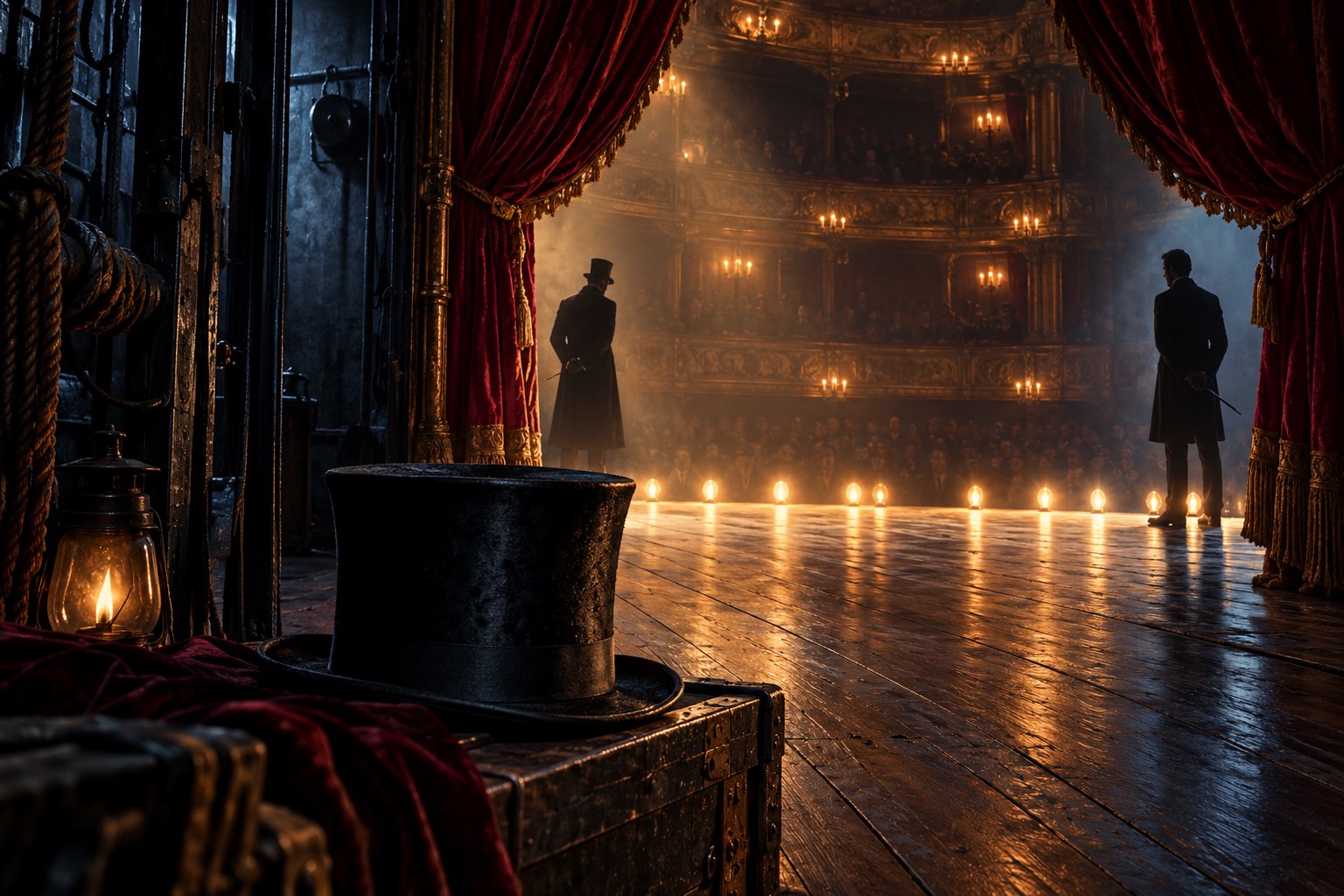
- The opening hats: The repeated objects introduce duplication before their significance becomes clear. On another viewing, an atmospheric image becomes evidence.
- The performance outside the theater: Borden’s understanding of Chung Ling Soo’s sustained physical deception anticipates a method that requires life itself to become a continuous act.
Why The Prestige Survives Its Own Reveal
For me, The Prestige remains exceptional because explanation increases its emotional pressure. The answers expose choices. Its shifting chronology first encourages us to solve the men; afterward, it forces us to judge what they have done.
That durability speaks to the difference between a hit and a movie that lasts. A surprise can work once. A character whose behavior becomes more disturbing with understanding can sustain repeated attention.
The 2027 return offers an opportunity to watch beyond the trick. Angier needs witnesses to his greatness; Borden needs protection for his secret. Both treat the people around them as costs their work entitles them to incur. The film’s deepest horror is how readily extraordinary dedication can become an excuse for ordinary failures of care.
Original content by this site's editorial team. Published: October 20, 2026 at 19:47:01 PDT (Los Angeles time)