
The Pitt is preparing to film scenes for its third season in Pittsburgh, according to TribLIVE’s TV Talk reporting. For viewers following the next chapter, that is the central development: preparations for filming in the city. It should not be mistaken for a description of the finished episodes or a revelation about where individual characters’ stories will go.
The news also raises an interesting creative question. What should a drama gain by putting its cameras in the place its story calls home? My view is that the strongest payoff would be a closer connection between the people inside the hospital and the lives continuing beyond its doors. A recognizable skyline can establish an address. A carefully chosen perspective can establish why that address matters.
Spoiler-free commentary: This article considers the reported production development and its storytelling possibilities. It does not review unseen season 3 episodes or disclose upcoming plot events.
What the Pittsburgh filming news establishes
The distinction between filming scenes in a city and explaining an entire season is worth preserving. The reported preparations connect Pittsburgh directly to season 3 production, but that headline alone does not establish how much screen time the footage will occupy, which characters will appear in it, or what dramatic purpose it will serve.
It also does not, by itself, supply a premiere date. Production activity and release scheduling answer different questions. Viewers looking for when they can watch the season should avoid treating a location-filming update as a release announcement.
That leaves a useful, specific takeaway: Pittsburgh is part of the reported plan for filming season 3 scenes. Anything more detailed about the resulting story requires further evidence. The creative significance lies in what those scenes might contribute once performance, framing, sound, and editing give them a place in the episodes.
A city becomes meaningful through someone’s eyes
Location photography has an obvious appeal: it gives a fictional world physical texture. Streets have depth, buildings bear the marks of use, and distances feel measurable. Yet those qualities become dramatically valuable when a scene connects them to a person’s attention.
Consider the different meanings a hospital entrance can carry in a medical drama. For a worker arriving, it may mark the moment professional responsibility takes over. For someone seeking help, it may represent uncertainty or relief. For a relative waiting nearby, the same doorway may become the boundary between knowing and not knowing. These are illustrative possibilities, not descriptions of announced season 3 scenes.
The distinction matters because a camera does more than record architecture. Its placement determines whose experience organizes the space. A wide view can make someone seem isolated; a closer view can let the surrounding city recede as a private concern takes over. Neither approach automatically produces depth. Each needs a character whose situation makes the choice meaningful.
That is the connection to our discussion of how framing and visual perspective create meaning beyond dialogue. A setting can communicate something a character would never explain aloud, provided the image gives us a reason to notice it.
The hospital doors should feel connected to ordinary life
My strongest hope for the Pittsburgh material is that it makes the surrounding community feel present. A hospital story can become so concentrated on immediate decisions that the world outside starts to feel abstract. Location scenes offer a way to restore a sense of continuity: people arrive from somewhere, other people wait for them, and life continues after an encounter ends.
That continuity is especially useful when thinking from a patient’s perspective. Within an institution, someone can become identified primarily by the problem requiring attention. Dramatically, a glimpse of their relationship to the wider world can resist that narrowing. The important question becomes who this person is beyond the situation that brought them through the door.
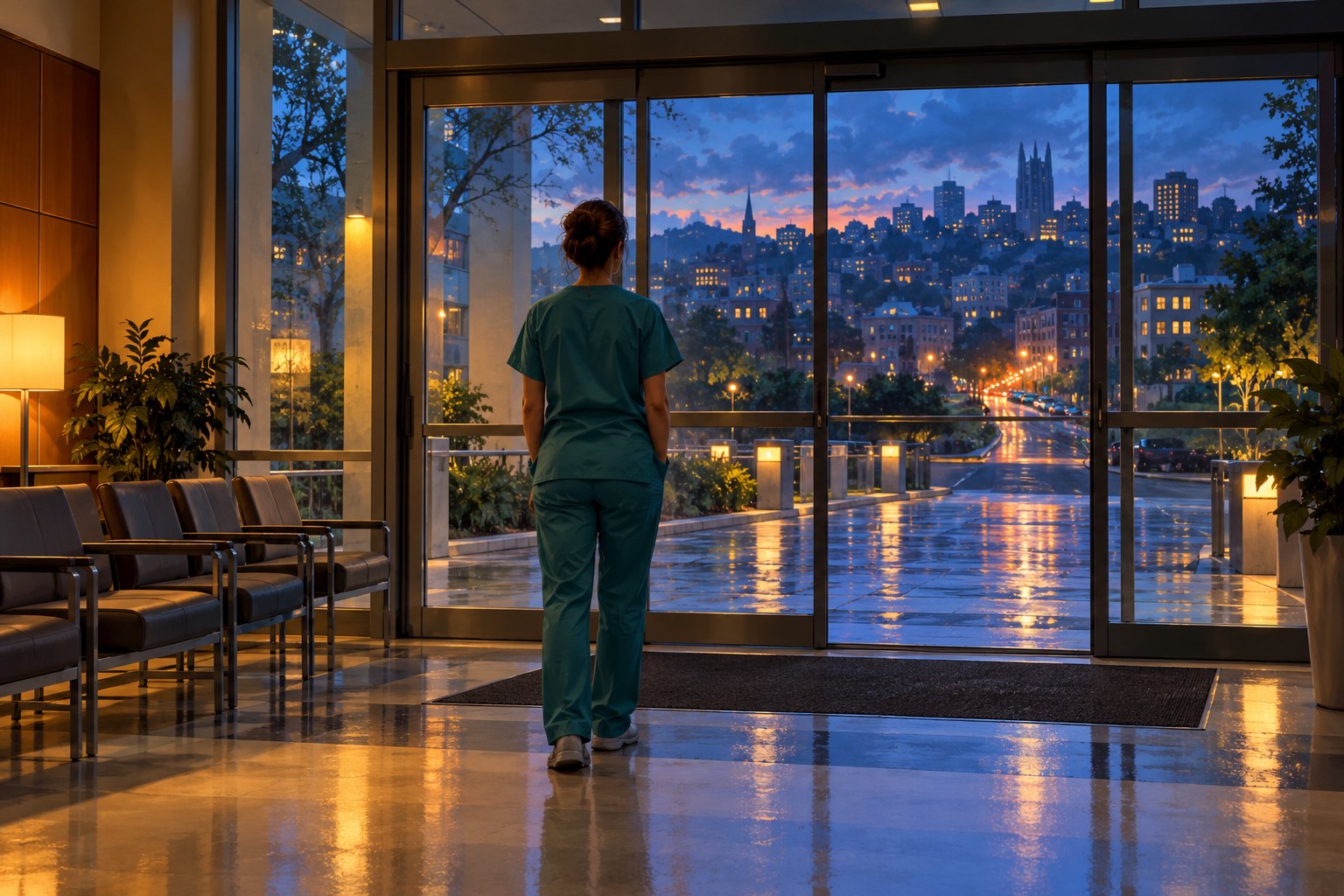
For healthcare-worker characters, the same connection can operate differently. The transition between an institutional interior and an open street offers a potential change in scale. Someone who appears decisive within a familiar workplace may seem less certain once that structure falls away. Whether season 3 uses such a transition remains unknown; it is one way to judge the eventual footage’s dramatic contribution.
Authenticity requires more than a recognizable background
Filming in Pittsburgh creates an opportunity for specificity. It does not automatically make every scene more truthful. A real location can still function as decoration if the action would carry exactly the same meaning against any other background.
My critical standard would be to ask whether the location affects behavior, rhythm, or relationships. Does the space determine how people approach one another? Does a pause become more revealing because of what surrounds it? Does the scene connect private distress with the ordinary movement of a city that cannot stop for every individual crisis?
Small performance choices are likely to matter as much as the view. An actor’s delayed response, altered pace, or glance toward an exit can give an exterior scene emotional purpose. Our commentary on the performance details that showcase scenes can overlook considers a related principle: character often develops through reactions and transitions rather than declarations.
There is also value in restraint. A city does not need to announce its identity in every shot. Allowing a place to exist around the characters, without constantly presenting it for recognition, can make the fictional world feel less arranged for our benefit.
What to watch for when the scenes reach the screen
Once the episodes are available, three questions will help separate attractive location work from storytelling that adds something substantial:
- Whose perspective shapes the scene? Notice whether the surroundings reflect a particular person’s attention or simply introduce a location.
- What changes during the scene? A shift in confidence, understanding, or connection can give a brief exterior sequence lasting importance.
- What carries back inside? The strongest location material may affect how we understand the next conversation, decision, or silence within the hospital.
These questions do not require a dramatic reveal. An apparently modest scene can alter how a viewer reads a character. Equally, an impressive city view may do necessary establishing work without carrying a larger symbolic meaning. Criticism should leave room for both functions.
The deeper promise of Pittsburgh in season 3
The most compelling possibility behind this production update is a richer sense of belonging. In a medical drama, the hospital can appear to contain an entire world. Showing its relationship to a particular city can remind us that it is also one institution within a much larger network of everyday lives.
That is where Pittsburgh could matter most to The Pitt: as a place that gives characters a life beyond their immediate dramatic function. The reported filming preparations are a concrete production development. The artistic achievement will depend on whether the finished scenes help us see those people more fully—and understand what they carry with them when they enter or leave the hospital.
Original content by this site's editorial team. Published: October 27, 2026 at 19:59:12 PDT (Los Angeles time)