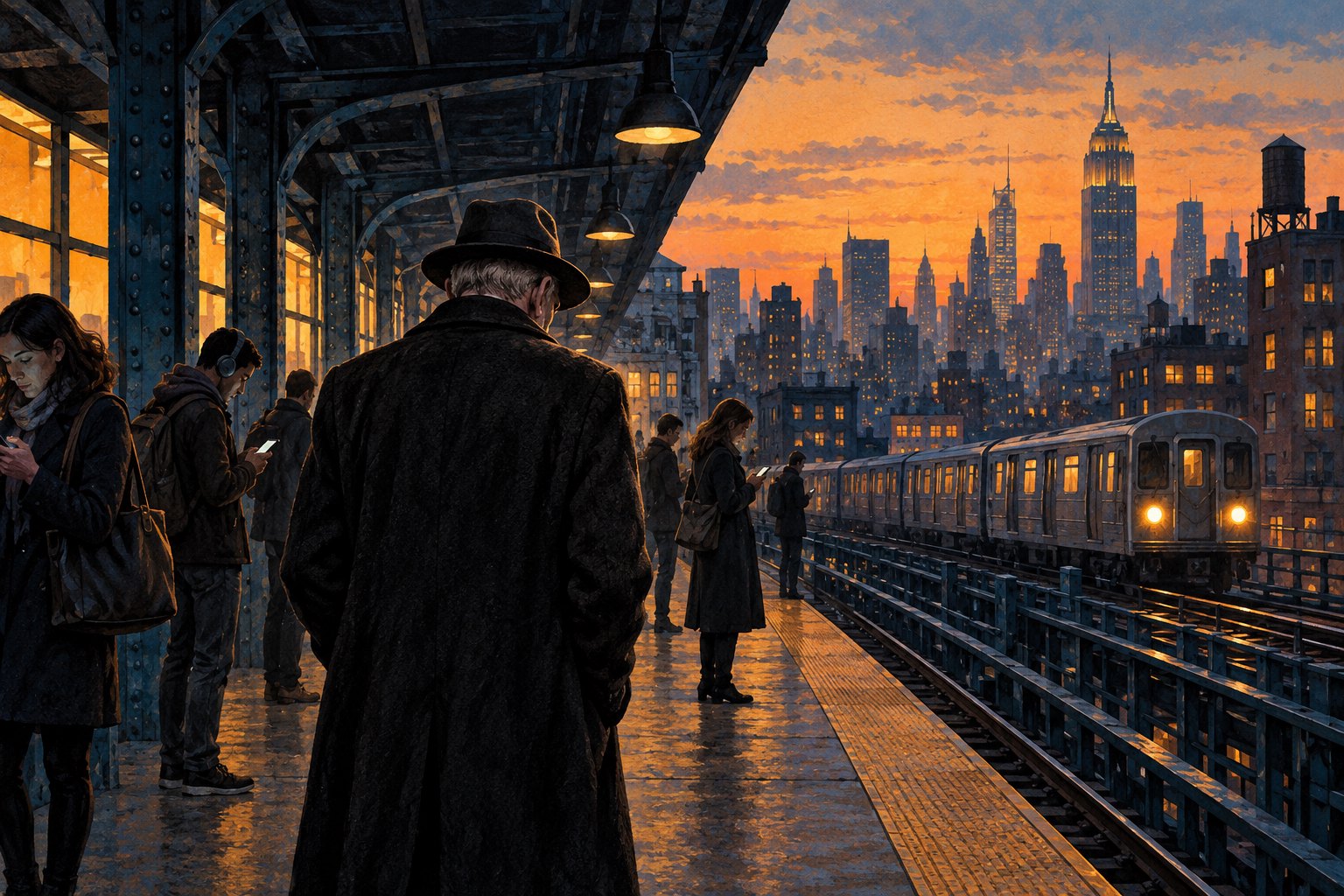
The Only Living Pickpocket in New York is finding theatrical attention alongside a very different proposition: Everest: The Other Side, which reached the $1 million mark in Deadline’s specialty box-office coverage. One offers an aging thief negotiating a city that has changed the meaning of money. The other draws audiences toward a mountain whose scale makes ordinary human concerns look almost impossibly small.
For viewers deciding what deserves their time, the intriguing question is what lies beneath those selling points. Noah Segan’s The Only Living Pickpocket in New York has a particularly useful tension: its central character possesses a skill he understands intimately, but increasingly misunderstands the world in which he must use it.
Spoiler note: The following character analysis discusses the crime that initiates Harry Lehman’s predicament and his family relationships. It does not reveal the ending. Interpretive judgments concern those established story elements, rather than offering an assessment of every scene or performance.
What the box-office attention actually tells us
Deadline’s report places Pickpocket among the weekend’s specialty talking points and identifies a $1 million milestone for Everest. Those are useful signals of theatrical visibility. They do not, by themselves, establish profitability, explain why individual viewers bought tickets, or tell us whether either film will sustain its audience.
That distinction matters especially here. A recognizable actor in an intimate crime story and a mountain documentary can attract people for different reasons. Genre, subject, presentation, and familiarity may all influence a ticket purchase. Without audience research, assigning the result to any single factor would be speculation.
Our character-focused discussion of Everest: The Other Side considers the documentary’s emotional territory. Here, the more revealing companion to its commercial milestone is Harry’s predicament: a man trying to preserve his place in a system that no longer rewards his expertise.
Harry Lehman can still steal a wallet. Its contents are the problem.
Sony Pictures Classics identifies John Turturro’s Harry as an aging pickpocket struggling to support himself and his disabled wife, Rosie. Cash has increasingly given way to credit cards that can be canceled. His hands have not necessarily lost their usefulness; the objects passing through them have changed.
That is a sharper dramatic idea than a generic complaint about smartphones. Harry’s problem separates competence from economic survival. Someone can remain capable at a task and still lose the livelihood it once provided. Viewed from his perspective, every disappointing wallet becomes a small verdict on whether the city has any further use for him.
There is also a moral complication worth preserving. Harry earns our attention through vulnerability, but his profession depends on taking from strangers. Caring for Rosie helps explain the pressure he faces; it does not make the people he steals from irrelevant. The most productive reading holds both truths together: he can be loving at home and harmful elsewhere.

The USB stick turns professional confidence into danger
The distributor’s synopsis confirms that Harry steals and passes along a valuable USB stick, then must recover it to escape a crime family’s retaliation. The object is an effective reversal of his usual advantage. A pickpocket relies on understanding another person’s possessions better than that person understands the immediate risk of losing them. Here, Harry takes something whose significance escapes him.
My reading is that the device makes the story’s generational conflict concrete. Wealth can occupy a tiny physical object while depending on knowledge entirely outside Harry’s experience. Possession and understanding become separate forms of power. He has the first briefly; his pursuers have the second.
The threatening dialogue makes the conflict personal. As quoted in Crooked Marquee’s review, Dylan tells him, “You’re done, Harry.” The line works on two levels: a criminal threatens another criminal, while a younger man declares an older man finished. Its cruelty comes from treating a living person as something already discarded.
The follow-up, “There’s no coming back from this,” intensifies that judgment. A threat about consequences becomes a claim that change is impossible. Against that certainty, Harry’s continued effort acquires meaning beyond recovering stolen property. He must act even when someone else has announced that his story is over.
Rosie and Kelly complicate the sympathetic outlaw
Sundance’s account of the film confirms that Dylan threatens Harry’s ailing wife. That moves the danger beyond a contest between men who chose criminal lives. Rosie’s vulnerability exposes the inadequacy of treating the situation as an entertaining professional rivalry: someone outside the theft bears its potential cost.
For Harry, the threat also collapses any separation between work and home. Whatever rules he imagines govern his criminal activity cannot protect his family once another participant refuses to recognize them. His personal code may matter to his identity, but it has no automatic authority over anyone else.
Harry’s estranged daughter, Kelly, played by Tatiana Maslany, introduces a different kind of accountability. Her existence prevents present-day caregiving from serving as a complete biography. A man can be devoted in one relationship while having damaged another. An estranged child carries a history that the sympathetic image of an aging father cannot erase.
That is where character analysis becomes more useful than simply labeling Harry an appealing rogue. The question is not whether we can find reasons to like him. It is whether affection leaves room for the experiences of people who have reasons to distrust him.
A changing city needs more than nostalgia
New York gives this conflict a setting larger than Harry’s individual misfortune. A city is both a physical place and a set of learned expectations: how people move, what they carry, whom they trust, and which exchanges require another human being. Harry’s profession depends on reading those expectations.
The danger in interpreting such a story is to assume that everything older is therefore better. Cash enabled his livelihood, but that livelihood was theft. Familiarity gave him confidence, but confidence could become complacency. Nostalgia becomes interesting when it reveals those contradictions instead of polishing them away.
The same distinction applies to familiar performers. Recognition can draw us toward a character before the story has earned our trust in him. As our essay on looking beyond famous faces in movie images argues, identifying an actor is only the beginning of understanding what a film asks us to see.
The deeper question is who gets to remain useful
The strongest interpretive possibility in The Only Living Pickpocket in New York is that Harry confuses professional usefulness with personal worth. If stealing is the thing he knows how to do, losing its rewards threatens more than his income. It threatens his explanation of who he is.
His family relationships challenge that narrow definition, while also refusing him an easy escape into self-pity. Being needed is not the same as being forgiven. Being endangered is not the same as being innocent. Those distinctions give the premise an emotional seriousness that a valuable stolen object alone could never provide.
The specialty box-office attention offers a reason to notice the film. Harry’s contradictions offer a reason to discuss it afterward. Beneath the chase sits a harder question: when the world stops rewarding the identity someone has built, can that person discover another way to matter?
Original content by this site's editorial team. Published: November 1, 2026 at 16:20:26 PST (Los Angeles time)