The Mosquito Bowl puts four college football stars on the front lines, but its most interesting dramatic question concerns the reputation they bring with them. What happens when men already celebrated as heroes enter circumstances that demand an entirely different understanding of courage? Netflix’s trailer presentation gives that question immediate force by placing athletic achievement alongside the vulnerability of young people at war.
Scope and spoilers: This is a spoiler-light critical discussion of the trailer’s premise and character framing, not a review claiming firsthand access to the complete film. It does not reveal the characters’ ultimate fates.
Four Names Matter More Than One Collective Label
Netflix’s official trailer coverage identifies the central figures as John McLaughry, played by Nicholas Galitzine; Bob Bauman, played by Bill Skarsgård; Tony Butkovich, played by Ray Nicholson; and Dave Schreiner, played by Tom Francis. The presentation follows college football standouts into service as Marines after Pearl Harbor, placing their experiences within the Pacific war.
That introduction provides a clear point of entry, especially for viewers who do not know the history. Athletic achievement makes their interrupted possibilities immediately understandable. These are young men with recognizable ambitions, public identities, and futures that other people have already begun imagining for them.
Yet the collective description also creates a challenge. Four accomplished athletes can quickly become one generalized image of promising youth. A persuasive ensemble drama needs to make their differences matter as much as their shared circumstances. Remembering four faces is a beginning; understanding four distinct ways of responding to pressure is the deeper work.
From a character-centered perspective, the useful question is therefore not simply who appears toughest. It is whose understanding of himself becomes hardest to maintain. That distinction leaves room for uncertainty, dependence, and embarrassment—experiences that heroic labels tend to conceal.
The Word Hero Arrives Before the Characters Can Define It
The trailer’s premise introduces these men through an identity bestowed by spectators. College football heroes are watched, discussed, and measured. Their achievements belong partly to a public story: the school, the team, the supporters who see their hopes represented by someone on the field.
War changes the audience for their actions. A decision may matter most to the person immediately beside them, with no crowd present to recognize its significance. That shift offers a more compelling dramatic possibility than a straightforward progression from sporting greatness to military greatness. Recognition and responsibility are different pressures.
My reading of the premise is that its strongest potential lies in examining that difference. Does a man still feel obliged to appear fearless when fear would be the most honest response? Can someone accustomed to being relied upon admit that he needs help? Those are interpretive questions raised by the setup, not claims about particular scenes or conversations.
There is a useful parallel with our discussion of how football footage supports judgments about an exceptional performance: a reputation directs attention, but specific behavior must justify the conclusion. Film characterization requires comparable patience. A familiar label should invite closer observation rather than finish the argument.
Brotherhood Needs Differences to Feel Convincing
Four protagonists allow a story to examine belonging from several directions. Friendship can involve comfort, rivalry, disagreement, or the effort to understand someone whose instincts differ from your own. If everyone responds identically, the group may look unified while remaining dramatically thin.
For this premise, the most revealing material would be the behavior between declarations of loyalty. Who notices that another person has withdrawn? Who fills an uncomfortable silence? Who mistakes reassurance for dismissal? Such moments need not be large to establish a relationship. They give viewers evidence that these people recognize one another as individuals.
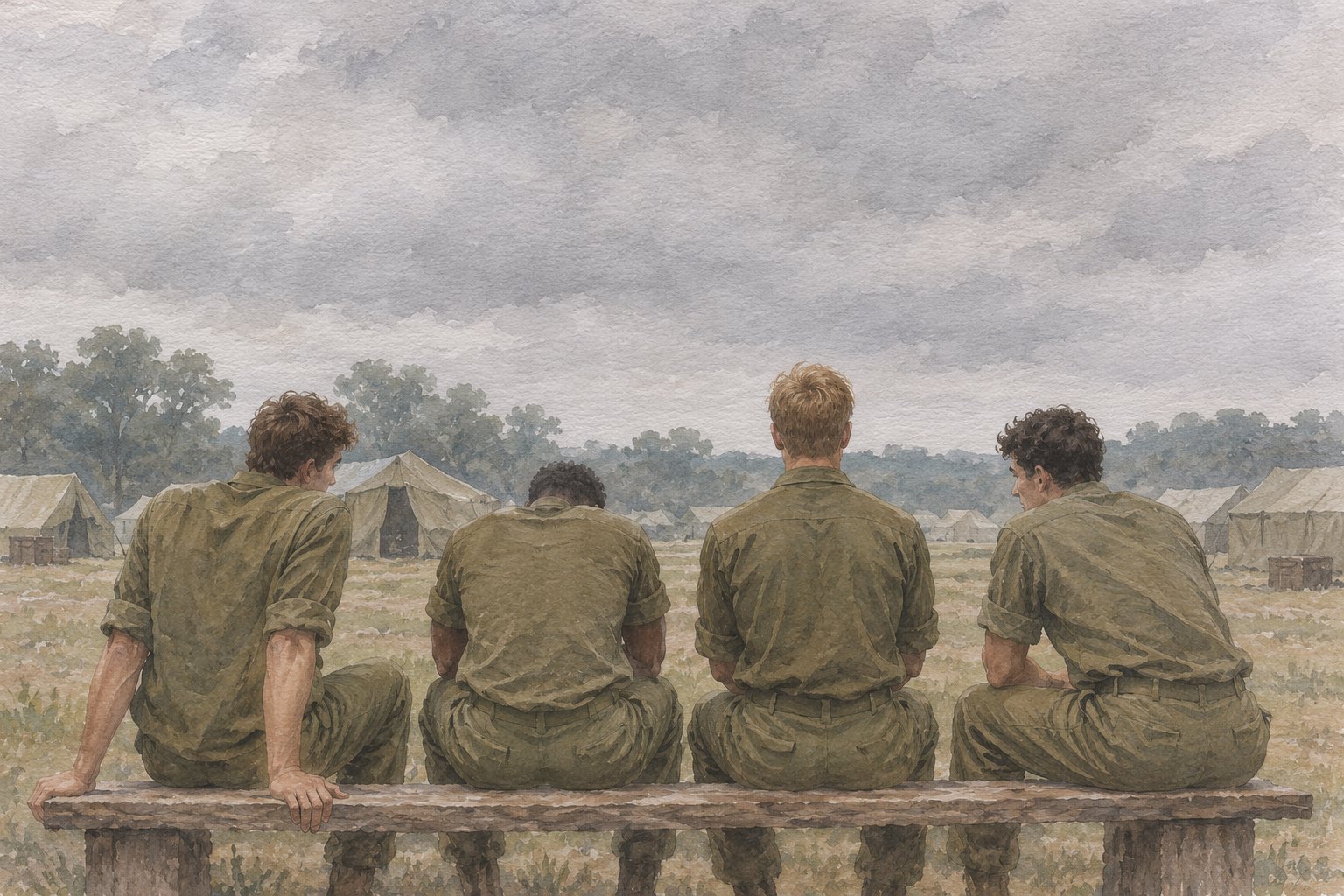
This is also where restraint becomes valuable. A war drama does not need every private feeling converted into an inspirational speech. Allowing a character to remain uncertain can reveal more than giving him an eloquent explanation of what the audience should feel.
The trailer premise establishes the group and the pressure surrounding it. Whether the complete film earns those intimate distinctions is a separate judgment. Promotional material can introduce relationships efficiently; it cannot supply the accumulated familiarity that makes an ensemble emotionally persuasive.
A Football Background Does Not Promise a Sports-Movie Payoff
Football supplies a recognizable dramatic language: preparation, coordination, setbacks, and the possibility of another attempt. Audiences bring that language with them, even when a story moves into a setting where its expectations no longer apply.
In Netflix’s coverage, director Peter Berg makes the distinction explicit: “This is not a football movie.” That is a statement about his intended approach, not dialogue spoken by a character. It is useful because it warns against treating the athletes’ background as a promise of a conventional sports-film resolution.
The distinction matters beyond genre labeling. A comeback narrative often encourages viewers to interpret suffering as preparation for a rewarding finish. Applied carelessly to war, that expectation can make devastation seem like a necessary stage in someone’s personal development. The people enduring it deserve more complicated treatment.
My preference would be for the football identity to deepen our understanding of these men without determining the meaning of everything they experience. Their former achievements can explain a habit, a bond, or an expectation. They should not become a universal explanation for courage or a measure of whose life matters most.
How to Read the Trailer Without Letting It Review the Film
The practical distinction for viewers is between an effective invitation and a demonstrated achievement. A trailer can make a premise legible, establish emotional stakes, and create curiosity. Sustained characterization, pacing, and the handling of consequences require the complete work.
Three questions offer a useful way to carry this trailer into a viewing:
- Can you distinguish the four men through their choices? Names and faces establish identity; decisions reveal character.
- Does the film allow vulnerability to remain uncomfortable? Immediate reassurance can simplify experiences that deserve time and attention.
- Do relationships change how events feel? An ensemble becomes meaningful when understanding one person changes how we understand another.
These questions also approach the film from a different direction than our earlier discussion of audience response to The Mosquito Bowl. Popular reception concerns how a movie has been received. The trailer invites us to examine the expectations formed before that judgment.
The Deeper Stakes Are About Being Seen
The most compelling interpretation of this premise begins with the distance between being admired and being understood. Athletic fame makes the four men visible. A serious character drama has the opportunity to look beyond that visibility, attending to feelings and needs that public admiration cannot resolve.
That is why the heroic framing deserves scrutiny rather than automatic acceptance. Calling someone a hero can express gratitude, but it can also place him at a distance, seemingly beyond ordinary fear or dependence. The dramatic task is to let the person remain present inside the designation.
The Mosquito Bowl offers an arresting starting point: four men whose futures seem recognizable entering an experience that unsettles that recognition. For me, the premise becomes most affecting when it invites attention to their individuality. Their sporting distinction draws us toward the story; their humanity is what should hold us there.
Original content by this site's editorial team. Published: November 28, 2026 at 20:48:23 PST (Los Angeles time)