The phrase “Met Gala of the West Coast” makes a promise: clothes worth looking at closely, personalities large enough to carry them, and an evening whose images invite debate. What makes a look deserve that attention? My answer begins with the relationship between the garment and its wearer. A memorable outfit gives the eye something specific to discover while leaving room for the person inside it.
The New York Times’ “10 Best Looks From the Met Gala of the West Coast” frames the occasion through the pleasures of selection. This commentary considers the aesthetic question behind that framing; it does not reproduce the publication’s selections or assign unverified outfits to attendees. For film lovers, the compelling issue is how red carpet style participates in the construction of a star’s public image.
What the Met Gala Comparison Asks Us to Expect
As a description, “Met Gala of the West Coast” encourages an appetite for spectacle before we have examined a single seam. It suggests that formalwear should offer something beyond looking appropriate for dinner. We begin looking for invention, theatricality, and an outfit that might hold our attention after the event itself has faded.
That expectation can narrow our judgment. An enormous silhouette announces its ambition immediately; subtle tailoring takes longer to register. My preference is to give both the same test: does each choice strengthen the overall effect? Volume can be expressive, but so can restraint. Neither deserves automatic credit.
The comparison also invites us to treat an evening as a unified fashion statement. Unless a dress code or theme has been established, however, judging every guest against an imagined assignment is unfair. An outfit can succeed through its own internal logic without satisfying the story a nickname leads us to expect.
Start With Silhouette, Then Look Again
Silhouette is the outline that remains when you stop concentrating on surface detail. Look at the shoulder, the waist, the line of the trousers or skirt, and the distribution of volume. These relationships determine whether a look feels compact, expansive, severe, soft, or deliberately unsettled.
A useful first step is to describe the shape without naming its wearer or designer. That removes two powerful shortcuts: affection for a celebrity and admiration for a label. If the description yields something precise—a narrow torso opening into a wide skirt, for example—you have begun identifying what the clothes actually do.
Then examine where that structure leads your attention. A dramatic shoulder might frame the face beautifully. It might also overwhelm every other element. A long train can extend the composition, but length alone does not create an interesting relationship between the garment and the body. These are questions of proportion, not rules about which bodies should wear which clothes.
The Close-Up Should Reward the Wide Shot
After the overall shape comes material. Does the fabric absorb light or reflect it? Do folds appear controlled or incidental? Does an embellishment reinforce the garment’s lines, or compete with them? A successful look can offer a clear first impression and still reward a closer examination.
Photography complicates this assessment. Strong lighting can flatten texture, obscure dark fabric, or turn reflective surfaces into bright patches. One photograph may reveal a dress’s structure while another makes the same dress difficult to read. That is a reason to qualify a judgment, especially when deciding whether something looks beautifully constructed or simply photographs dramatically.
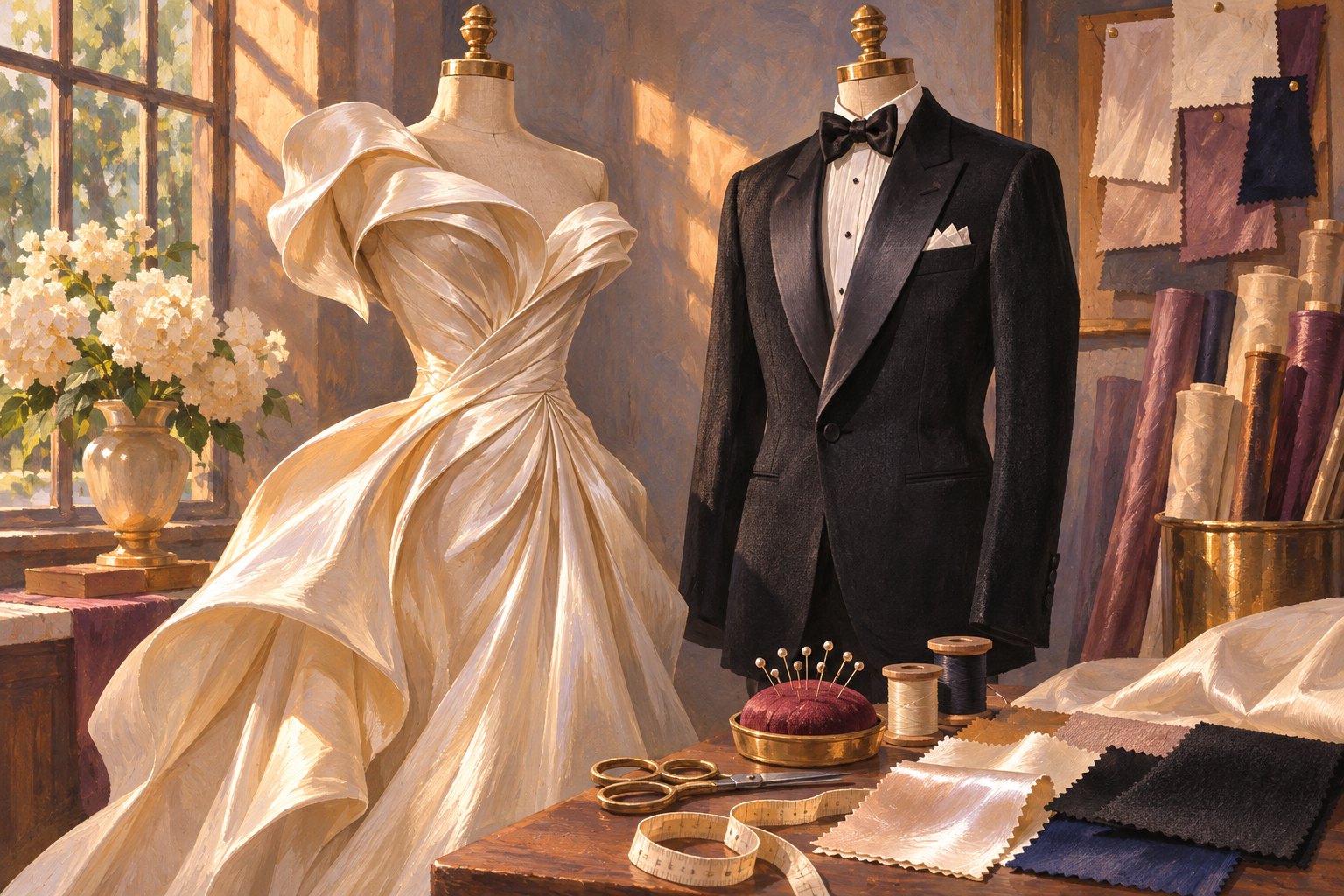
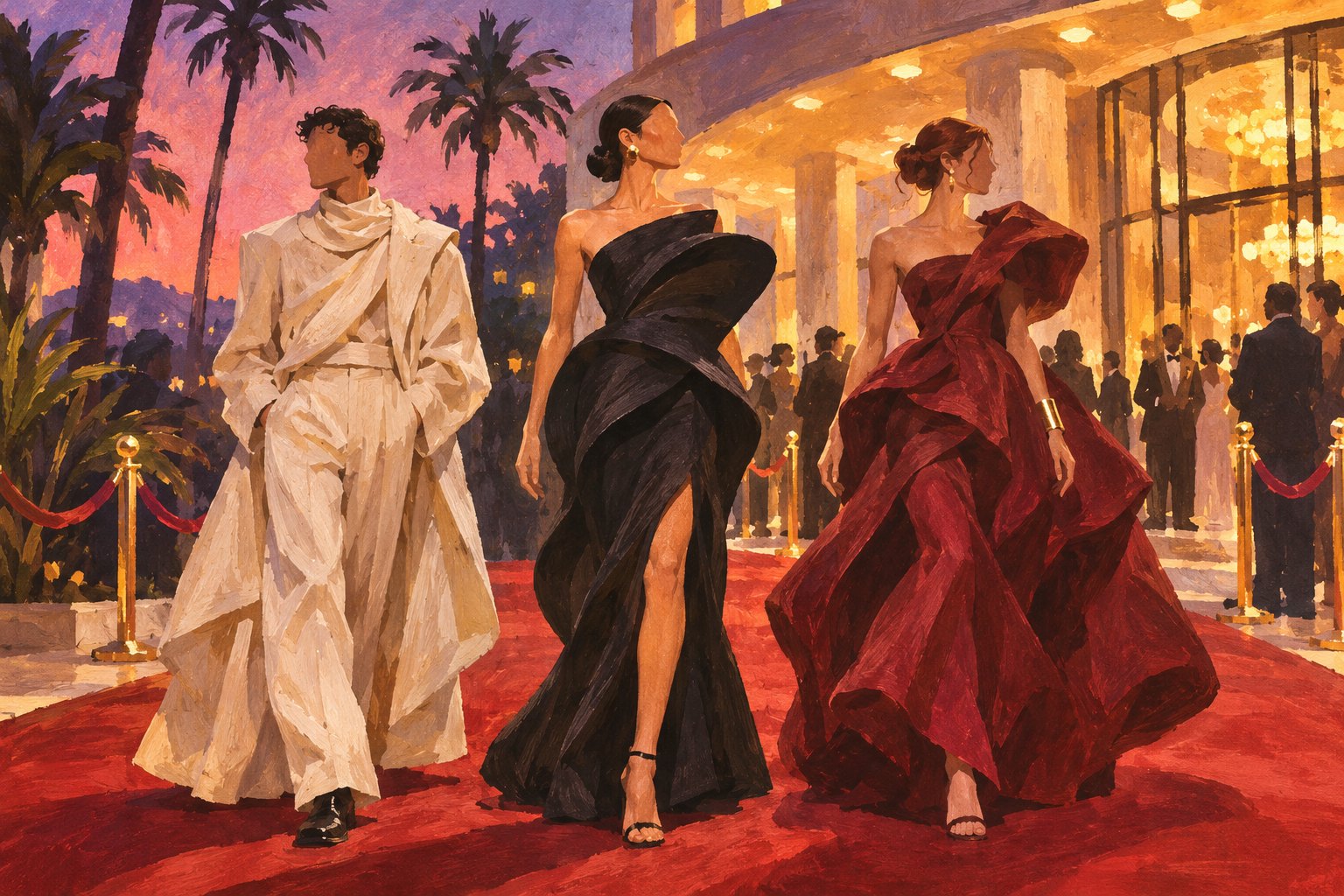
The conceptual illustration above isolates this distinction: the gown invites attention through folds and volume, while the tuxedo depends on the clarity of its edges. Both require construction to make the idea legible. Neither image depicts an actual gala outfit.
Movement Changes the Verdict
A red carpet photograph freezes a negotiation between fabric, posture, and timing. Movement reveals another dimension. A skirt may become more expressive when its wearer turns; a jacket may lose the clean line it held in a stationary pose. When footage is available, it can materially change a fashion judgment.
I place particular value on continuity between the pose and the movement around it. Does the outfit remain convincing when the wearer walks, acknowledges someone, or relaxes their arms? That does not mean clothing must appear effortless. Deliberately restrictive or sculptural design can have expressive force. The question is whether its demands contribute to the effect.
We should also resist diagnosing comfort or confidence from a single expression. A person caught between poses may look distracted for reasons the photograph cannot explain. Criticism becomes more useful when it describes visible relationships instead of inventing an emotional biography.
The Star Arrives With an Imaginary Wardrobe
Film audiences bring remembered characters to a public appearance. An actor associated with authority may seem especially imposing in formal tailoring. Someone remembered for vulnerable performances may appear unexpectedly remote in a severe silhouette. Those responses reveal something about the viewer’s associations, even when the styling has no intended connection to a role.
This is where film commentary can deepen fashion criticism. We can examine how a look interacts with a screen persona while acknowledging that an actor is a person whose clothing choices need not explain a fictional character. Our discussion of listening for the character behind the star explores a related distinction between familiar celebrity presence and the specifics of performance.
Likewise, resemblance is not confirmation of an homage. A gown that recalls a movie costume may draw on a broader fashion tradition. A suit that suggests a familiar screen archetype does not establish a casting announcement. Treating every accessory as a hidden clue can replace observation with wishful storytelling.
How to Form a Defensible Favorite
A satisfying choice needs a reason more specific than “iconic.” Before settling on a favorite, try three questions:
- What is the central visual idea? Identify the shape, texture, color relationship, or styling choice that organizes the look.
- Which details support it? Consider shoes, jewelry, hair, and accessories as parts of the composition rather than separate purchases.
- What survives a second look? Distinguish the pleasure of surprise from details that remain interesting after the initial reaction.
These questions leave room for disagreement. Someone may prefer visual coherence; another viewer may value a productive clash. Naming the standard makes the disagreement worth having. The same habit informs learning to trust your own taste as a film viewer: enthusiasm becomes more interesting when you can explain its source.
Why the Image Lasts
The deeper appeal of the “Met Gala of the West Coast” framing is its invitation to see dressing as a public act of imagination. For a moment, silhouette, expression, light, and cultural memory meet in a single image. We respond to the clothes, but also to the possibilities they seem to open around their wearer.
For me, the strongest gala look sustains that possibility without requiring an invented backstory. Its proportions hold attention, its details reward attention, and the person remains present. That is the difference between an outfit we recognize immediately and an image we want to examine again.
Original content by this site's editorial team. Published: November 10, 2026 at 10:00:31 PST (Los Angeles time)