
The Little Prince is heading toward a new live-action film with the director of The Imitation Game, according to Variety. The announcement raises an intriguing creative question: how can a movie make Antoine de Saint-Exupéry’s delicate story feel physically present while preserving its emotional mysteries?
The strongest answer lies in its relationships. The prince’s encounters matter because they gradually change his understanding of other people—and of the flower he left behind. A convincing adaptation needs to make those changes visible in behavior, without turning every discovery into an explanatory speech.
This is a critical preview, not a review of a completed film. The discussion below considers the original story and possible adaptation choices, rather than claiming knowledge of the new screenplay, performances, or finished images. Light spoilers for the book follow. The quoted lines come from the literary work, not confirmed movie dialogue.
The aviator must learn how to listen
The book places its adult narrator in an immediately practical predicament: an aviator stranded in the Sahara encounters a child whose concerns seem to belong to another universe. The prince’s request, “Please... draw me a sheep!” interrupts the adult’s priorities with an imaginative demand. That encounter is outlined in the [official account of the book](https://www.lepetitprince.com/en/the-book/).
For an actor playing the aviator, the interesting movement would be from distraction toward attention. An impatient response, a glance back toward an unfinished task, or a pause before answering could establish an adult who initially hears the prince without fully listening. The relationship becomes meaningful when that habit changes.
From the aviator’s perspective, the child is difficult because he asks for a different kind of competence. Technical knowledge can address a broken machine. It cannot automatically explain why a particular flower matters to someone. The story makes room for both kinds of concern, but it asks the adult to recognize the limits of his own expertise.
My preference would be for a performance that allows embarrassment and irritation alongside tenderness. Immediate affection would make the relationship easier to watch, but less revealing. The aviator needs something to learn.
The prince needs uncertainty as well as wisdom
The title character is easy to flatten into an endlessly quotable dispenser of truths. That approach would weaken his dramatic purpose. The prince travels because there are things he does not understand; his questions are part of an education.
His innocence therefore needs texture. Curiosity can coexist with impatience. Affection can coexist with confusion. A child who notices the absurdities of adult behavior need not possess complete knowledge of his own feelings. Those contradictions give a performer—or any visual interpretation of the character—something more substantial than an emblem of purity.
On screen, this distinction could determine whether the conversations feel alive. If every question sounds like the setup for a lesson, viewers are invited to admire the writing from a distance. If the prince appears to need an answer, viewers can share the uncertainty that prompts him to ask.
That is also why selecting recognizable episodes would only begin the adaptation work. As our discussion of The Crying Boy’s move from illustrated storytelling to film explores, preserving an image and preserving its dramatic effect are different creative tasks.
The rose makes love a problem of understanding
The prince’s attachment to his rose gives the journey an intimate center. The Morgan Library’s description of the book emphasizes his confusion about his feelings as the rose becomes demanding. That uncertainty makes their relationship dramatically useful: affection exists before the prince knows how to interpret it. See the [Morgan’s account of the story](https://shop.themorgan.org/products/the-little-prince).
From his perspective, the rose’s behavior can feel bewildering. From hers, a filmmaker might explore how vulnerability hides beneath difficult behavior. That second perspective is an interpretive opportunity, not a claim about the announced movie’s characterization.
A thoughtful adaptation would resist making either character entirely right. Turning the rose into a simple obstacle would excuse the prince from reflection. Making her flawlessly sympathetic would remove the friction that makes his confusion credible. Their bond becomes interesting because caring for someone does not guarantee that either person knows how to communicate.
The cinematic challenge would be to give care a tangible form. Small, repeated gestures could establish a relationship more persuasively than a speech declaring its importance. A viewer should begin to notice what the prince notices, and eventually understand why an apparently modest attachment occupies so much of his inner life.
The fox needs time, not just a memorable speech
The fox brings the story’s understanding of attachment into focus. The familiar phrase “what is essential is invisible to the eye” appears in the Morgan Library’s examination of the manuscript, which documents Saint-Exupéry’s repeated revisions of that thought. Its apparent simplicity was carefully achieved. The [Morgan’s manuscript exhibition notes](https://www.themorgan.org/sites/default/files/pdf/press/LittlePrincePressRelease.pdf) describe that process.
For a movie, the danger is treating the line as an emotional shortcut. Music can swell and the camera can move closer, but neither choice establishes why these particular characters matter to one another. The relationship must earn the sentence.
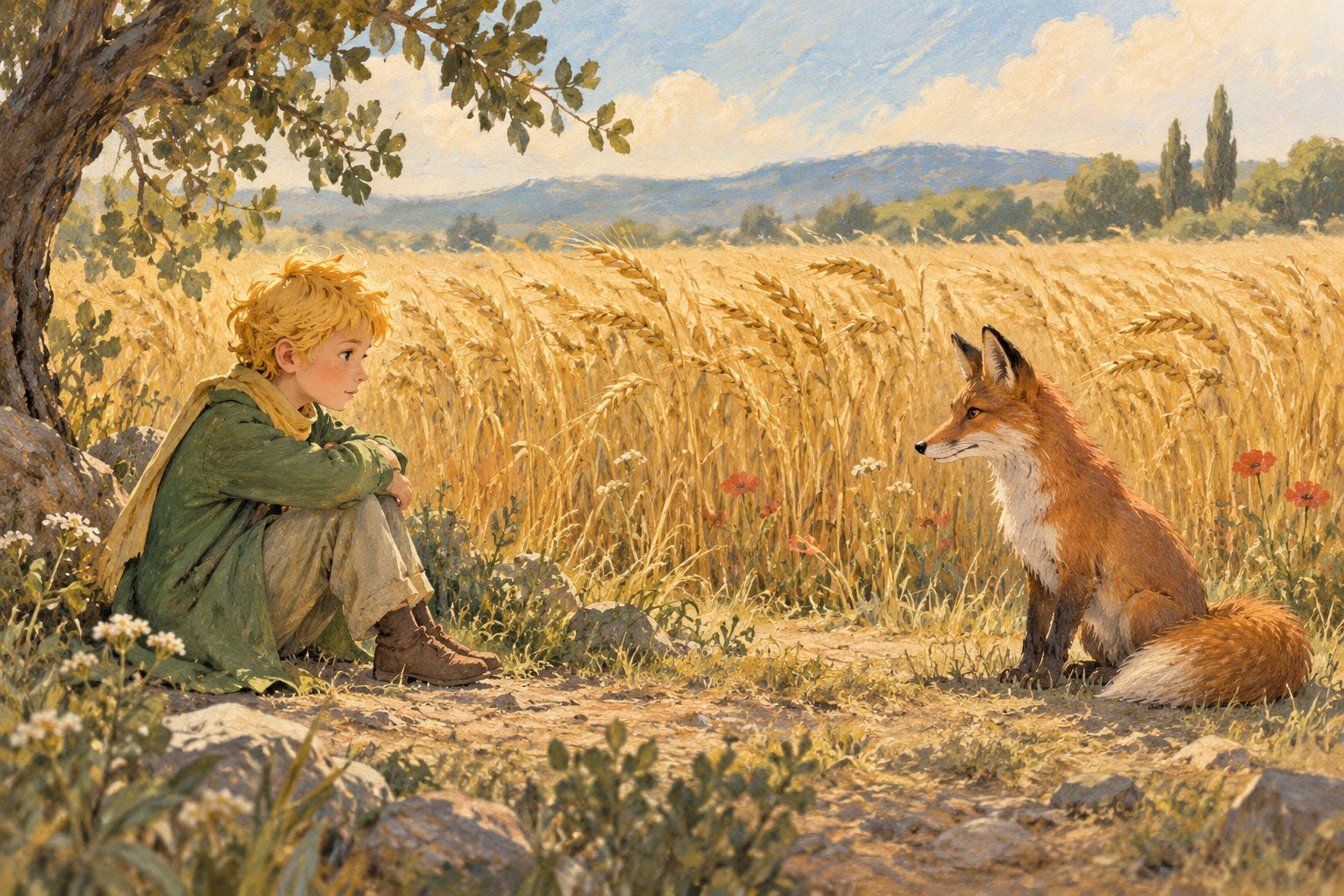
I would look for patience in this passage: room for observation, hesitation, and the gradual comfort of another presence. Editing determines how much of that process the audience experiences. Move too quickly and friendship becomes a plot requirement; allow meaningful pauses and it can become something viewers feel developing.
The fox also presents a useful test of character perspective. Is the scene organized entirely around what the prince learns, or does the fox seem to have desires and emotional stakes of its own? Our examination of character perspective in Neon’s SCP Foundation anthology considers a related question: whose experience gives an extraordinary premise its human weight?
What the director announcement can—and cannot—tell us
The association with The Imitation Game gives readers a recognizable filmmaking reference. It does not establish the new project’s tone, narrative structure, or effectiveness. A director’s attachment is meaningful development news; the finished film still has to demonstrate how its choices serve this particular material.
Live action creates an especially interesting tension here. Physical settings and embodied performances can give loneliness and companionship immediate weight. Yet excessive visual explanation could narrow a story whose suggestiveness is part of its appeal. More detail is useful when it deepens a relationship; it becomes distracting when it merely answers questions the audience did not need resolved.
The deeper test is whether attention becomes love
My reading of The Little Prince is that its tenderness depends on a demanding proposition: recognizing another being’s importance requires attention, and attention creates obligations. Its gentle manner does not make that proposition easy.
The prince and the aviator offer complementary ways into it. One is trying to understand an attachment; the other must become receptive to an unfamiliar way of seeing. Their meeting suggests that maturity can include recovering curiosity while accepting responsibility for what curiosity reveals.
That is what would make this live-action film worth watching. Beautiful deserts, expressive creatures, and unfamiliar planets could invite us into its world. The lasting achievement would be quieter: making us understand why one voice, one friendship, or one imperfect rose cannot simply be replaced.
Original content by this site's editorial team. Published: September 30, 2026 at 21:27:06 PDT (Los Angeles time)