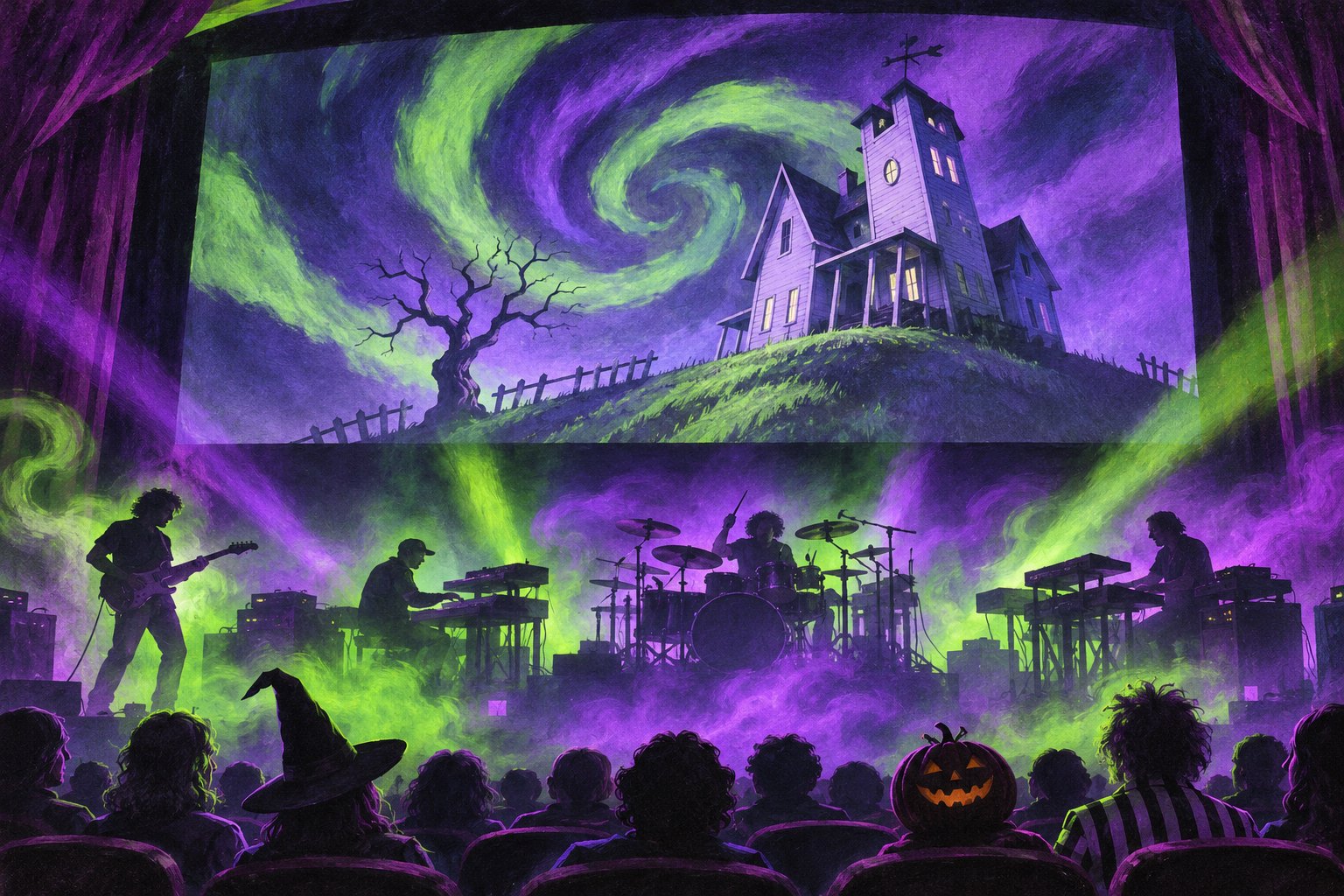
The Disco Biscuits performed to Beetlejuice on Halloween movie night, according to Relix. The pairing makes immediate artistic sense: Tim Burton’s 1988 supernatural comedy repeatedly turns domestic conflict into performance, with music breaking through characters’ attempts to control their surroundings. Its ghosts want privacy, its homeowners want an audience, and its most vulnerable character wants someone to notice her.
The reported event provides the occasion for this review; specific arrangements, synchronization choices, and audience reactions are outside its scope. What the film itself offers is unusually fertile ground for a musical encounter: exaggerated movement, sudden tonal changes, and two memorable sequences in which dancing means very different things.
Spoilers follow for the original Beetlejuice, including its ending.
The Maitlands: haunting as a defense of home
Adam and Barbara Maitland, played by Alec Baldwin and Geena Davis, begin with an ordinary desire: to enjoy their house together. After a fatal car accident, they return to discover that being dead has complicated rather than ended their attachment to the place. The arrival of the Deetz family makes that attachment territorial.
Burton’s clever reversal puts the audience beside the ghosts. We experience the living as intruders because we have already encountered the home through the Maitlands’ affection for it. Redecoration becomes a kind of erasure. Objects and rooms that hold personal meaning can be discarded by people who see only an opportunity to impose their own taste.
Baldwin and Davis make their characters’ shortcomings productive. Their awkwardness as would-be terrors is funny because they remain recognizably polite people trying to perform hostility. They want the results of cruelty without becoming cruel. Their growing temptation to outsource the job to Beetlejuice exposes the weakness in that compromise.
For me, this is the film’s strongest foundation. Its fantastic world rests on an understandable emotional mistake: believing that preserving a home requires keeping everyone else out. The supernatural machinery gives that mistake spectacular consequences.
Lydia sees people where the adults see problems
Winona Ryder’s Lydia Deetz changes the terms of the conflict. Her ability to see the Maitlands gives them a relationship with someone they initially regard as part of an invading household. She makes it harder to treat the living as a single category of unwanted occupants.
“I myself am strange and unusual,” she explains. The line works as both adolescent self-definition and a description of her attention. Lydia notices what the adults overlook. Her black clothing announces difference, but her willingness to listen gives that difference substance.
Ryder’s restraint is essential. Around her, the adults perform confidence, expertise, taste, or supernatural authority. Lydia often seems to be conserving energy because she expects those performances to disappoint her. Her friendship with the Maitlands gives her somewhere to direct an affection that has found little purchase elsewhere.
The film’s treatment of her isolation is sometimes hurried; its appetite for the next grotesque joke can interrupt its emotional development. Still, Lydia prevents the movie from becoming merely a contest between incompatible decorators. The house matters because people need relationships inside it.
The dinner party turns music into a struggle for control
The possession sequence built around Harry Belafonte’s recording of “Day-O (The Banana Boat Song)” is the clearest reason to reconsider Beetlejuice through the Disco Biscuits’ movie-night premise. Music does not simply accompany the scene. It changes what the characters can do.
Delia Deetz, played by Catherine O’Hara, loses command of her own presentation as the dinner becomes an involuntary musical performance. O’Hara makes the transition deliciously uncomfortable: the hostess’s carefully maintained authority gives way to movement she cannot explain or stop.
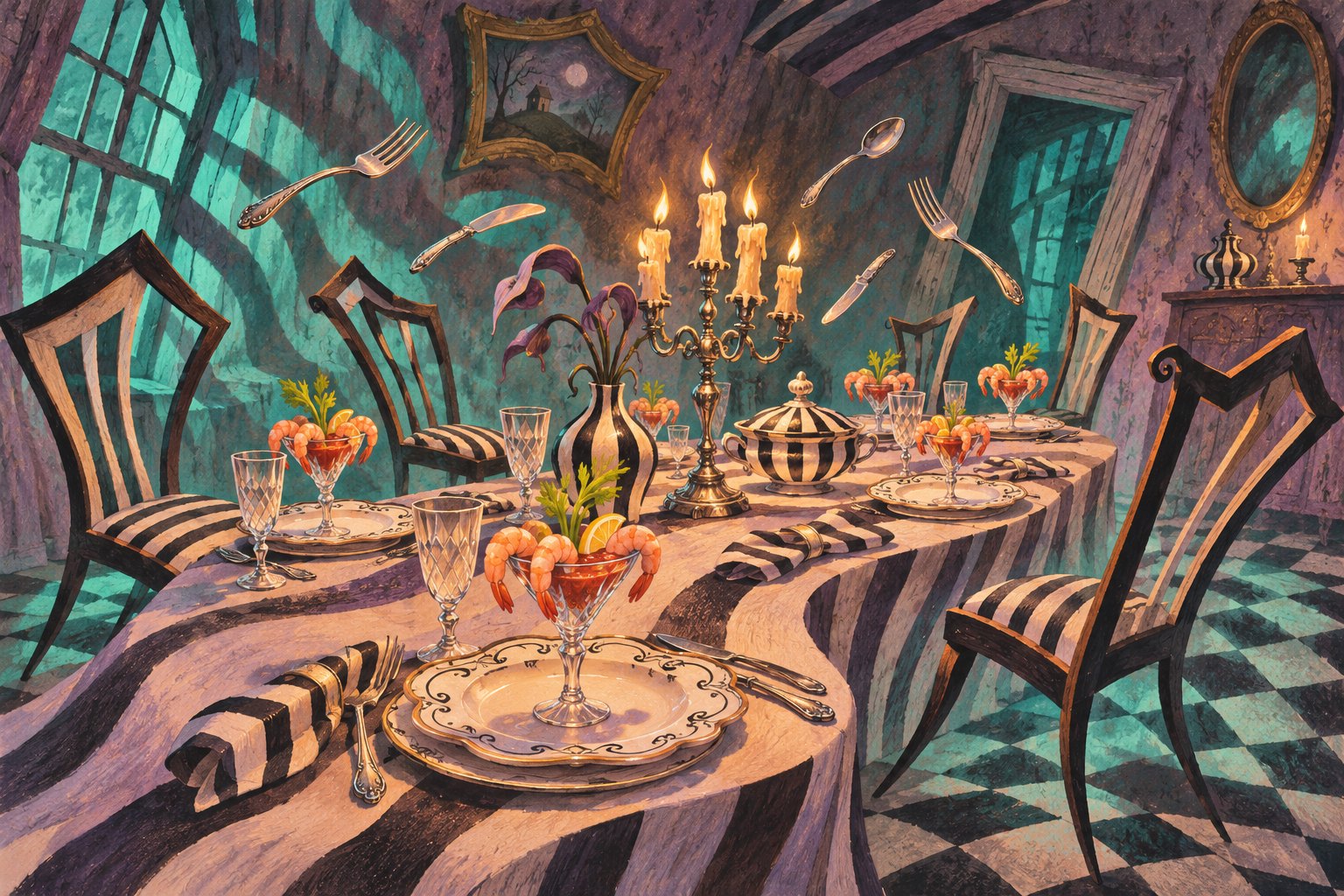
The crucial joke arrives in the response. The Maitlands intend to frighten their unwanted housemates away, but the spectacle fascinates the living. Their haunting succeeds as entertainment and fails as eviction. That distinction makes the sequence sharper than a detachable comedy routine.
Charles Deetz’s interest in exploiting the supernatural extends the joke: even evidence of an afterlife can become a business proposition. The dead cannot regain privacy by becoming more spectacular when spectacle is precisely what the living value.
This is also why the musical choice matters beyond recognition. The recording’s buoyancy rubs against the characters’ alarm, allowing pleasure and coercion to occupy the same scene. Our discussion of Sukiyaki and the dramatic possibilities of a familiar song approaches a related question: how music acquires new meaning through the people and circumstances surrounding it.
Beetlejuice makes charisma look dangerous
Michael Keaton’s title character offers a different model of performance. He does not struggle to command attention. He assumes that attention belongs to him, then escalates whenever someone challenges that assumption.
“It’s showtime!” is practically his governing philosophy. Keaton makes the character exhilarating through abrupt changes of voice, posture, and intensity. Yet the energy should not obscure his function in the story. He sells relief from a problem, then makes himself a larger one.
His demand that Lydia marry him in exchange for saving the Maitlands exposes the transaction beneath his comic patter. Her concern for others becomes something he can exploit. Reading him as merely a lovable troublemaker misses the ugliness that gives the performance its edge.
The film benefits from keeping him disruptive rather than making him its emotional center. Adam, Barbara, and Lydia establish needs we can understand; Beetlejuice barrels through them. His appeal to the audience and his danger to the characters coexist, producing the movie’s most uncomfortable laughter.
What the movie-night pairing brings into focus
A performance to Beetlejuice invites attention to its changes in tempo: awkward pauses in conversation, frantic transformations, rigid social rituals breaking apart. Those qualities make it an intriguing musical partner, although the premise alone cannot establish how successfully any particular performance engaged with them.
Watching the film with rhythm in mind also reveals a useful contrast. The dinner party makes bodies move against their owners’ wishes. The later sequence featuring Belafonte’s “Jump in the Line” gives Lydia a moment of delighted release. Similar musical exuberance supports opposite emotional situations.
That difference matters more than simply identifying recognizable songs. A musical reading that follows only the film’s manic surface could miss the transition from domination to participation. Its warmth emerges when characters stop insisting that everyone else disappear.
The ending: belonging requires room for other people
The eventual coexistence of the Maitlands and the Deetz family answers the movie’s original territorial dispute. Adam and Barbara cannot recover their former life by freezing the house around their memories. Lydia cannot find connection through alienation alone. Their shared future depends on making room.
That gives Beetlejuice an unexpected kinship with the films in our guide to fall movies that earn their warmth through complicated relationships. Comfort becomes convincing when it follows friction, adjustment, and a change in how people treat one another.
My verdict: Burton’s comedy remains most rewarding when its grotesque inventions serve this domestic argument. Its emotional transitions can be abrupt, but the contrast between possessiveness and generosity holds the chaos together. The Disco Biscuits’ Halloween pairing offers an apt reason to listen again: beneath the shouting and supernatural salesmanship, the film moves toward a household whose members can finally enjoy the same song.
Original content by this site's editorial team. Published: November 2, 2026 at 08:56:41 PST (Los Angeles time)