The Devils feels urgently contemporary because its persecutors understand something terrible about public life: an accusation can remain useful after its credibility collapses. Ken Russell’s 1971 film makes that process personal. A priest’s vanity, a nun’s loneliness, and a government’s ambitions converge until a human being becomes the designated explanation for an entire community’s supposed corruption.
Fifty-five years later, the film’s relevance lies in that convergence. Its seventeenth-century setting offers no comforting distance from the habit of treating spectacle as proof. My judgment is that Russell’s excess remains essential to the experience, even when it threatens to overwhelm the people whose suffering gives the movie its force.
Major spoilers follow, including the ending. The film contains sexual imagery, religious desecration, torture, and execution. This review discusses Russell’s dramatization rather than treating every scene as a historical record.
Grandier’s flaws make the injustice harder to dismiss
Oliver Reed’s Father Urbain Grandier is charismatic, sexually irresponsible, and accustomed to commanding a room. Russell gives us ample reason to distrust his self-image before asking us to recognize the injustice done to him. That choice matters: defending Grandier requires separating his actual behavior from the fantastic crimes attributed to him.
The political conflict concerns Loudun’s fortifications and the independence they protect. Grandier opposes their destruction, placing himself in the way of Cardinal Richelieu’s centralizing ambitions. Witchcraft accusations subsequently provide a means of removing an inconvenient opponent. The city’s vulnerability and the priest’s vulnerability become inseparable.
Reed makes this progression convincing through changes in presence. Grandier initially seems to occupy more space than anyone around him. His confidence can look like courage or entitlement, sometimes within the same exchange. As his circumstances contract, that imposing physical authority stops protecting him. The performance becomes moving because Reed lets us see fear beneath the dignity.
Grandier’s declaration, “These crimes are not my crimes,” identifies the moral distinction on which the film rests. He can acknowledge wrongdoing without accepting a fabricated identity. A fair judgment would examine specific conduct; his enemies need a monster whose existence justifies whatever they intend to do next.
That is also why the movie resists becoming a simple celebration of a misunderstood hero. Grandier does not have to become retrospectively faultless for his persecution to be intolerable. Russell makes the audience practice a distinction that the authorities deliberately erase.
Jeanne gains an audience and loses control of her story
Vanessa Redgrave’s Sister Jeanne is the film’s most troubling figure. Her longing for Grandier mixes erotic desire with religious imagery, and her frustration becomes entangled with the accusation against him. Redgrave makes that longing painful before it becomes dangerous. Jeanne wants recognition, but the available language for her experience turns desire into contamination.
Her position within the convent does not give her freedom from confinement or humiliation. Russell’s treatment of her body can itself feel cruel; the film sometimes approaches the grotesque so aggressively that compassion has to struggle through the imagery. Redgrave supplies the necessary resistance. Her Jeanne remains a person whose emotional needs cannot be exhausted by a shocking composition.
Once the investigation begins, Jeanne’s story acquires powerful managers. Father Barre’s exorcisms turn intimate distress into a public event. The authorities can authorize her speech while determining in advance what it means. An accusation is evidence; hesitation becomes another obstacle to overcome.
Her attempted reversal makes the trap explicit: “I’ve wronged an innocent man, Father.” The admission cannot repair the damage because the machinery surrounding her no longer needs her independent judgment. The woman whose testimony helped establish the case is denied authority over its correction.
Jeanne therefore occupies two morally uncomfortable positions. She contributes to Grandier’s destruction, and she becomes subject to a process that exploits her. Recognizing the second does not erase the first. It explains why the film’s account of complicity is more disturbing than a portrait of straightforward malice.
The empty reliquary exposes a system that can survive exposure
One of the film’s sharpest demonstrations involves a supposedly holy relic. The nuns respond to its apparent power, only for the container to be revealed as empty. The scene makes a compact visual argument: an authoritative presentation can produce the reaction that is then offered as proof of authority.

The more frightening point is that exposure does not end the persecution. Demonstrating the fraud and stopping its consequences are separate achievements. Too many people have something invested in the proceedings: prestige, revenge, entertainment, obedience, or political advantage.
This is where the film’s contemporary resonance becomes especially persuasive. The comparison does not require assigning each character a modern counterpart. The recognizable pattern is a public narrative that rewards participation and makes correction inconvenient. Once institutions organize themselves around an accusation, a contrary fact may threaten the institution more than the accused.
There is a useful contrast with the controlled menace of Patrick Stewart’s Darcy in Green Room. Both films locate terror in people who organize other people’s violence. Russell surrounds that organization with an extravagant ceremony, giving spectators something to watch while power gets its work done.
Madeleine gives faith a different emotional meaning
Gemma Jones’s Madeleine offers the film a quieter register. Her relationship with Grandier, including their secret marriage, allows tenderness to exist alongside the surrounding obsession with sexual wrongdoing. She addresses him as someone capable of love and responsibility.
That difference changes how the religious conflict reads. Faith can provide a vocabulary for compassion and commitment, even as officials use religious authority to enforce a predetermined verdict. Madeleine’s presence prevents those possibilities from disappearing beneath the brutality.
Grandier’s admission, “And I am afraid,” is equally important. Reed does not present courage as an absence of terror. The character’s eventual composure has weight because it belongs to someone who wants to live. His suffering cannot be tidied into an attractive emblem without losing the human fear the performance preserves.
Russell’s visual excess is both the strength and the difficulty
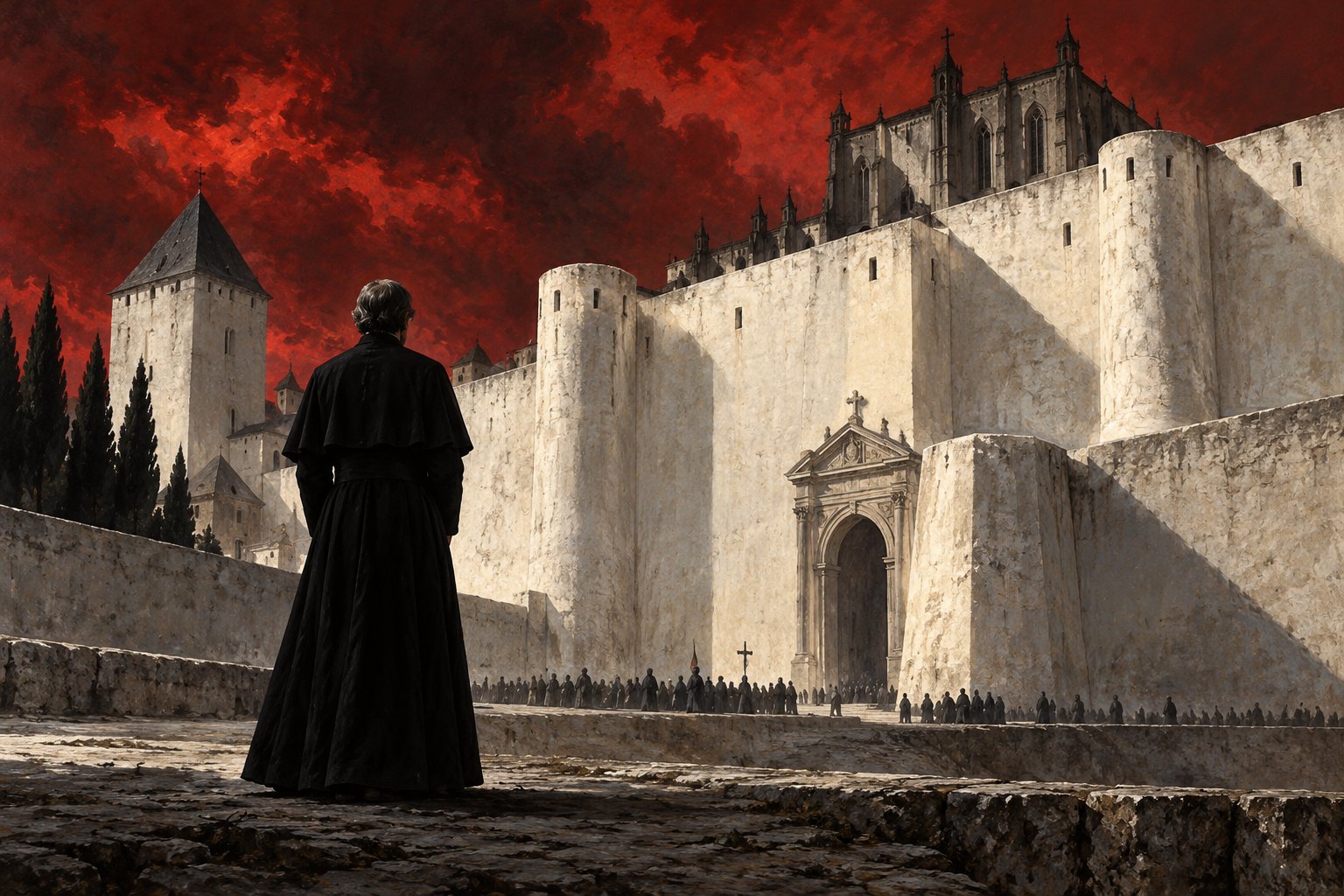
Derek Jarman’s production design gives the film its extraordinary architectural severity. White surfaces and imposing geometry make Loudun feel exposed, as though its inhabitants already occupy a space arranged for observation and judgment. Against that order, Russell places bodies, noise, theatrical gestures, and disorder.
The collision can be exhausting. Some sequences hold the spectacle long enough that viewers may reasonably question whether the film is reproducing the humiliation it condemns. That tension is part of my reservation about its methods. Russell’s intensity does not automatically make every image equally illuminating.
Yet the exhausting quality also has a dramatic purpose. Public cruelty becomes an attraction, and the audience must examine its own appetite for watching. The film denies us the easy position of observing a barbaric crowd from a place of perfect innocence.
The ending reveals what the spectacle accomplished
Grandier’s execution and the destruction of Loudun’s walls bring the political and personal stories together. The persecution has produced a material result. A body is destroyed, and a community loses the protection around which its resistance gathered.
Madeleine’s departure leaves survival looking desolate. Like the uncertain freedom examined in our reading of The Graduate’s ending, movement away from a place does not guarantee a meaningful future. Here, escape occurs after devastating loss.
The deepest horror of The Devils is that its participants need not share one motive to produce one catastrophe. Desire, ambition, certainty, resentment, and passive spectatorship can cooperate. Russell makes that cooperation visible through people who misunderstand themselves while confidently explaining everyone else. At 55, the film remains powerful because it asks us to recognize how readily a community can call its appetite for punishment a defense of the good.
Original content by this site's editorial team. Published: November 1, 2026 at 03:00:40 PST (Los Angeles time)