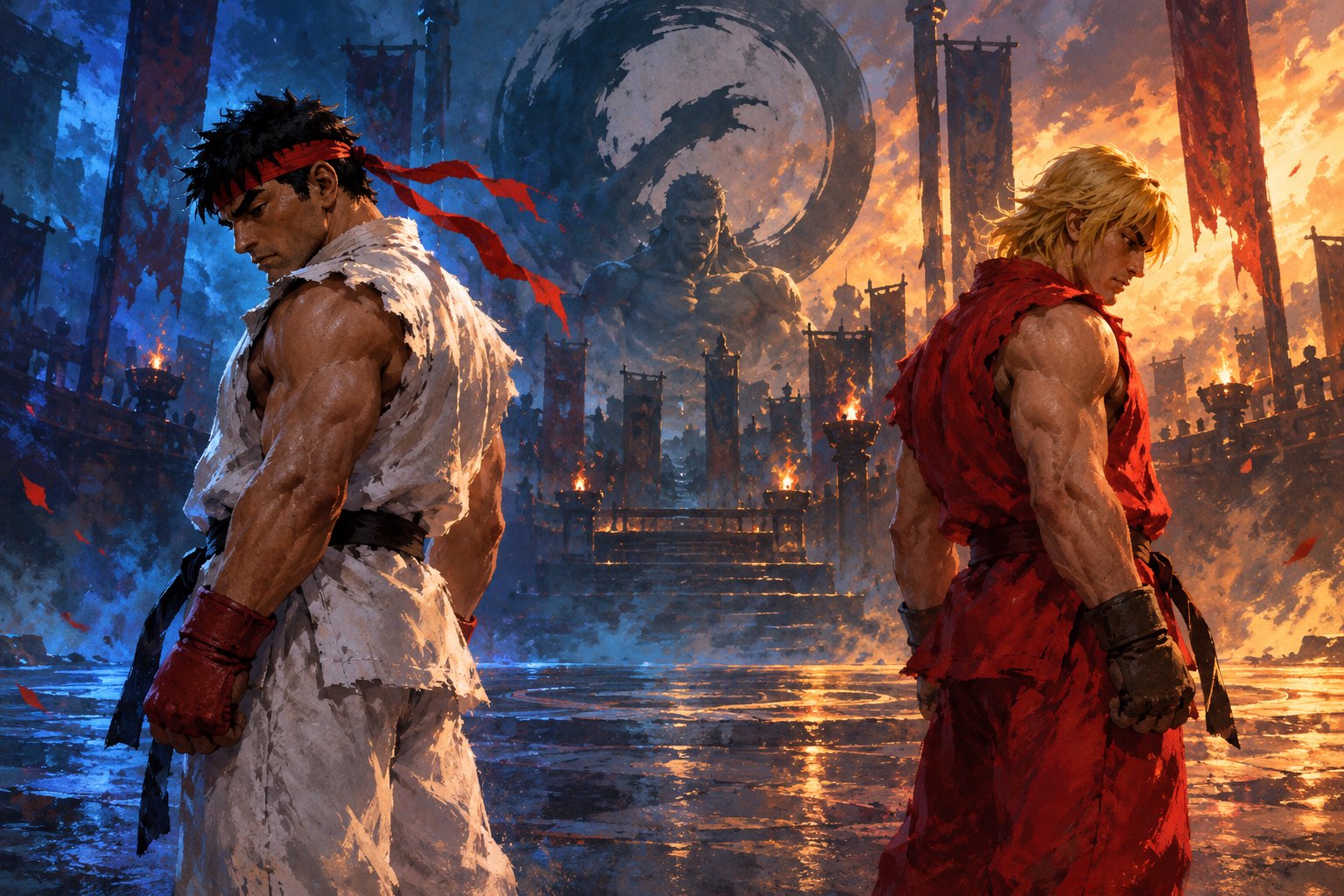
Street Fighter’s most interesting contest is the struggle to make its fighters matter between punches. Ryu and Ken bring a damaged relationship into a world built for exaggerated spectacle, creating a potentially compelling clash between private hurt and public performance. The question is whether the comedy gives that relationship personality or keeps interrupting its development.
Kenneth Shepard’s [Kotaku review](https://kotaku.com/street-fighter-2026-movie-review-guile-ken-ryu-chun-li-2000746803) finds an uneven film whose comic commitment nevertheless makes it an entertaining group watch.
Spoiler notice: This is an independent critical analysis based on the official synopsis and published accounts of the film, rather than a firsthand screening review. It discusses character motivations and selected story developments. The illustrations are interpretive artwork, not production stills.
The tournament begins with an unfinished friendship
Directed by Kitao Sakurai, the 2026 film places Andrew Koji’s Ryu and Noah Centineo’s Ken Masters in 1993. Callina Liang’s Chun-Li recruits the estranged fighters for the World Warrior Tournament, where a conspiracy intersects with their unresolved past. Paramount lists the American theatrical release as October 16, 2026. [Paramount’s film information](https://www.paramountpictures.com/movies/street-fighter) confirms these credits and the central premise.
That setup offers a useful dramatic advantage: an opponent can know exactly where to hurt you without throwing a punch. Former friends carry memories that strangers cannot access. A tournament can therefore measure two things simultaneously—physical ability and the capacity to acknowledge what went wrong.
The distinction matters when adapting an ensemble game. Recognizing a fighter creates immediate pleasure; understanding why that fighter needs to win creates suspense. Our discussion of why an adaptation needs a character at its center addresses the same underlying challenge: scale becomes meaningful through individual desire.
Ken turns insecurity into a public performance
Time Out describes Centineo’s Ken as swaggering and insecure, contrasting him with Koji’s more disciplined presence. That characterization suggests a productive reading: Ken’s extravagance can function as emotional camouflage. Being conspicuous is easier than admitting that another person’s opinion still matters. [Time Out’s review](https://www.timeout.com/movies/street-fighter-review-2026) identifies this contrast between the leads.
For a character like Ken, humiliation can do more than generate slapstick. It can expose the distance between the identity he sells and the reassurance he needs. The crucial question is what follows the laugh. Does embarrassment alter his behavior, or does the next scene simply reset him?
Comedy becomes characterization when a joke leaves a bruise. Without that continuity, insecurity remains a descriptive trait rather than something the audience experiences developing. Ken does not need fewer ridiculous moments. He needs those moments to accumulate into recognizable choices.
Ryu makes strength feel dangerous
GamesRadar reports that Ryu has withdrawn after failing to save Gouken and fears the dark force connected to his fighting. Read psychologically, that makes retreat more than passivity: his ability threatens his sense of responsibility. Ken’s outward display and Ryu’s withdrawal consequently suggest opposite responses to vulnerability. [GamesRadar’s review](https://www.gamesradar.com/entertainment/live-action-movies/street-fighter-movie-review/) describes this backstory.
A reluctant fighter presents an especially interesting action-film problem. Viewers want the very thing the character fears doing. Good staging can make that tension tangible through hesitation, distance, and the decision to stop. A spectacular attack need not automatically signify triumph.
This is also where performance and editing must cooperate. A held reaction can communicate apprehension before an explanation arrives. If every pause becomes an opportunity for another interruption, the audience may understand the premise intellectually without feeling its pressure.
Chun-Li’s mission deserves its own dramatic weight
William Bibbiani’s account in TheWrap describes Chun-Li’s pursuit of Bison as revenge for her father’s murder, while also detailing sexualized jokes surrounding her. That juxtaposition raises a specific critical concern: whether the film allows her purpose to govern a scene. [TheWrap’s review](https://www.thewrap.com/creative-content/movies/street-fighter-review-capcom-noah-centineo-andrew-koji/) supplies these reported details.

Agency is more specific than combat competence. A character can win a fight while the surrounding scene still treats her primarily as something for others to look at. Her tactical decisions, withheld information, and willingness to take risks should shape our attention.
Humor need not disappear from that framework. The stronger approach would let it emerge from her judgment of the people around her. Revenge supplies a motive; perspective makes the person pursuing it distinctive. That difference determines whether Chun-Li feels like a protagonist sharing the film or an efficient mechanism for moving its male leads into place.
Signature moves can become a form of dialogue
“Yoga fire!” is among the recognizable calls noted in Time Out’s account. Such a phrase carries unusual weight in an adaptation: it announces an action while also identifying a character through sound. Its brevity is part of its appeal.
The cinematic opportunity goes beyond recognition. A signature move can reveal confidence, impatience, desperation, or restraint depending on when it appears. Repeating an attack after a relationship changes can make the same movement mean something different.
That is why spatial clarity matters even in deliberately absurd action. Viewers need to understand who acts, who reacts, and what changes. Exaggeration can expand the possibilities of a fight; it still benefits from readable cause and effect. The broader principle also informs our analysis of how adaptations develop their own screen language.
What the fight for power can mean
TheWrap describes Bison’s plan to extract Ryu’s fighting power. One interpretation of that premise is especially revealing: the villain treats ability as a possession separable from the person who developed it. Strength becomes something to acquire rather than a responsibility to exercise.
That distinction provides a useful lens for the entire movie. An adaptation can collect costumes, attacks, and familiar faces just as easily as a villain can covet power. The harder achievement is preserving the relationships that give those elements significance.
My reading is that Street Fighter’s most promising emotional subject is recognition: the desire to be understood beyond a reputation, a failure, or an impressive body. Its comedy can support that subject when it exposes defensive behavior. It can weaken it when every vulnerable moment becomes disposable. The decisive measure is whether a fight changes how these people understand one another. A memorable finishing move ends a round; a meaningful choice gives the round a reason to exist.
Original content by this site's editorial team. Published: October 16, 2026 at 16:35:16 PDT (Los Angeles time)