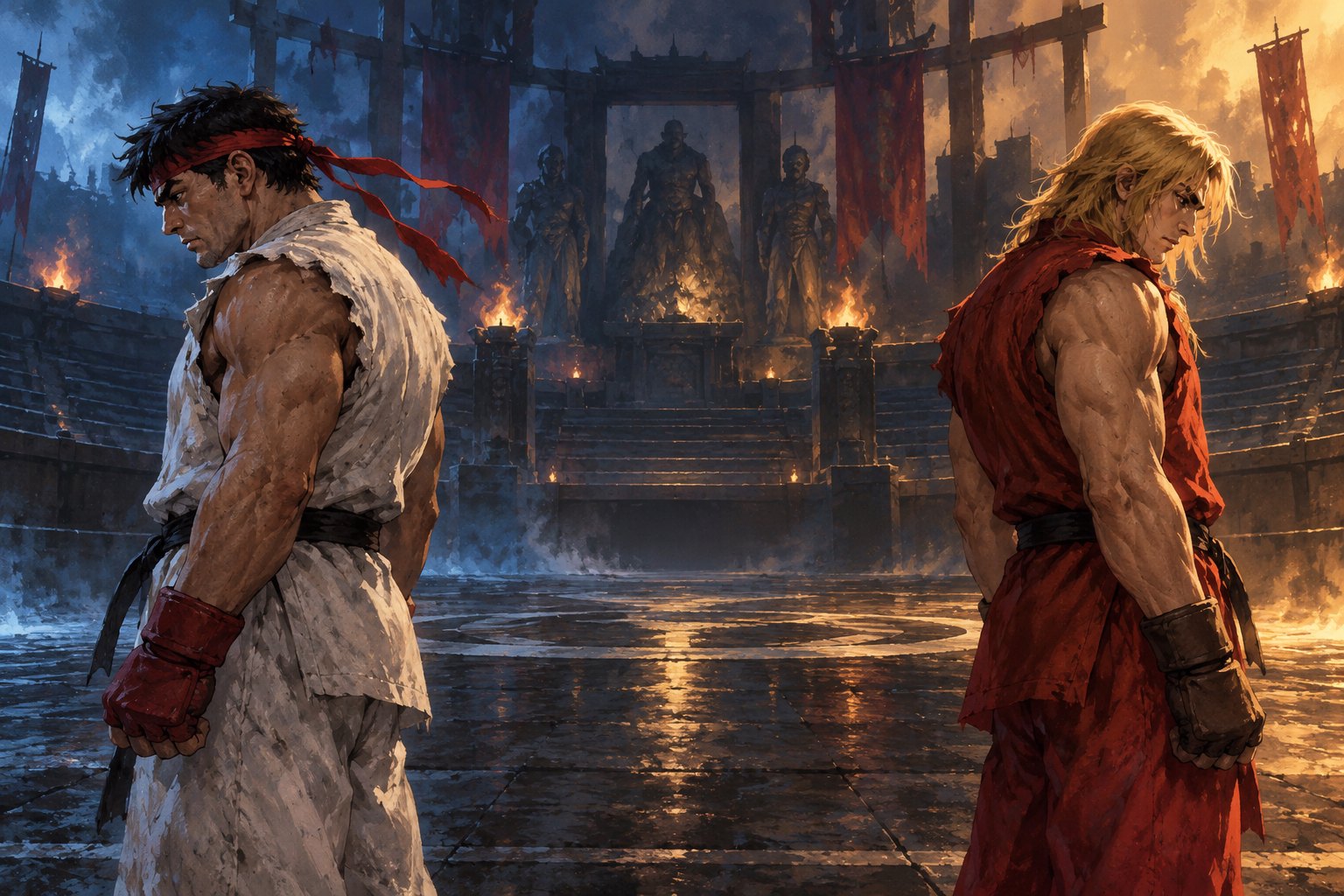
Street Fighter does not need to be flawless to inspire affection. But explaining that affection requires more than pointing at a familiar costume and declaring victory. The strongest argument for Kitao Sakurai’s 2026 adaptation lies in the relationship beneath its extravagant fighters: Ryu and Ken are former companions whose abilities have outlasted their connection. A tournament can put them in the same place. Becoming brothers again is a different challenge.
Eric Francisco’s Esquire review captures the split between pleasure and judgment, praising the film’s exuberance while criticizing its storytelling and fight payoffs. That reaction invites a closer question: what makes these characters worth following when the surrounding movie becomes disorderly? This is a critical reading of documented story details and published reception, rather than a firsthand screening verdict. [Esquire’s review](https://esquiresg.com/god-help-me-i-actually-loved-street-fighter/)
Spoiler notice: The discussion below covers the central setup, character conflicts, and Bison’s objective. It does not explain the ending.
Ryu and Ken Bring Different Wounds to the Tournament
Set in 1993, the film brings Andrew Koji’s Ryu and Noah Centineo’s Ken Masters back into combat through Callina Liang’s Chun-Li and the World Warrior Tournament. Their estrangement is central to the official premise, which also places a conspiracy behind the competition. These are returning partners with unresolved history, not strangers discovering a convenient shared mission. [Official trailer and synopsis](https://www.youtube.com/watch?v=bBY5Eo6sbwo)
That distinction matters. A stranger can underestimate your strength; a former friend can remember when you were a better person. Rivalry between these men consequently carries two possible injuries. Losing a fight threatens their pride, while being understood threatens the stories they tell themselves about why they separated.
My reading is that this gives the adaptation an accessible emotional foundation. Viewers do not need a detailed knowledge of the games to understand the discomfort of meeting someone who knew them before disappointment hardened into personality. Recognition of the characters can add pleasure, but recognition of that feeling supplies a reason to care.
Ryu’s Retreat Makes Strength a Responsibility
Paramount describes Ryu as withdrawn and disciplined, having abandoned fighting in pursuit of peace. Learning that Ken is in danger draws him toward involvement again. The studio also identifies Bison’s interest in harnessing Ryu’s power. Those details establish a useful tension: the ability Ryu would rather set aside remains valuable to other people, including people who would exploit it. [Paramount’s character and production overview](https://cms-corp.paramount.com/news/street-fighter-brings-an-arcade-favorite-to-the-big-screen)
Retirement is therefore more complicated than refusing another contest. From Ryu’s perspective, withdrawal can look like ethical restraint. From the perspective of someone who needs him, the same withdrawal can look like abandonment. Neither interpretation automatically wins. Peace achieved through isolation may protect the person seeking it while leaving an obligation unanswered.
The published dialogue transcript gives his position a compact expression: “I don’t fight anymore. I made a promise.” The interesting word is promise. It makes restraint a commitment rather than a passing mood, which means returning to action requires more than renewed confidence. It requires deciding what that commitment was supposed to protect. [Published dialogue transcript](https://www.springfieldspringfield.co.uk/movie_script.php?movie=street-fighter-2026)
Ken’s Pride Is More Interesting Than His Swagger
Ken offers the complementary problem: what happens when public performance becomes a substitute for purpose? Chun-Li’s blunt assessment, “You’re not a warrior anymore. You’re a sideshow,” identifies the distinction. Being watched and being respected are different forms of attention. An audience can reward someone for behaviors that make genuine self-respect harder to maintain. [Discussion of Chun-Li’s dialogue](https://www.watchmojo.com/en-gb/articles/10-differences-between-street-fighter-2026-movie-and-games)
Read this way, the insult hurts because it questions the value of Ken’s success. He cannot answer it simply by becoming louder or more impressive. Those are the skills the accusation has already discounted. The dramatic challenge is to discover what remains when applause stops serving as evidence that everything is fine.
This is also where the brotherhood becomes more useful than a conventional rivalry. Someone who remembers your earlier ambitions can make your current triumphs feel embarrassingly small. Ryu’s presence creates that possibility for Ken without requiring either man to explain an entire emotional history in a speech.
Chun-Li Changes the Terms of Their Reunion
Chun-Li recruits fighters while pursuing her own reasons for approaching Bison. Her role places her between the tournament’s public invitation and the private motives that bring its participants together. She supplies movement where Ryu and Ken’s damaged relationship risks producing only repetition.
From her perspective, their unfinished argument is also a practical obstacle. The men may experience their estrangement as the center of the world; someone pursuing a separate objective cannot afford to treat it that way. That difference in priorities gives an ensemble useful friction.
The critical test is whether she retains that independent purpose as the story develops. A character can initiate the plot and still become secondary to other people’s emotional needs. Our discussion of what makes an ensemble matter beyond its cast list addresses the same distinction: presence becomes meaningful when a character changes another person’s available choices.
Recognizable Costumes Can Carry Character
According to Paramount, costume designer Kym Barrett collaborated with the production and photography departments on a physical, worn-in world, including Ryu’s gi and headband. Those textures offer more than a resemblance to an established design. Wear can suggest repeated effort, turning an instantly recognizable silhouette into something associated with labor.
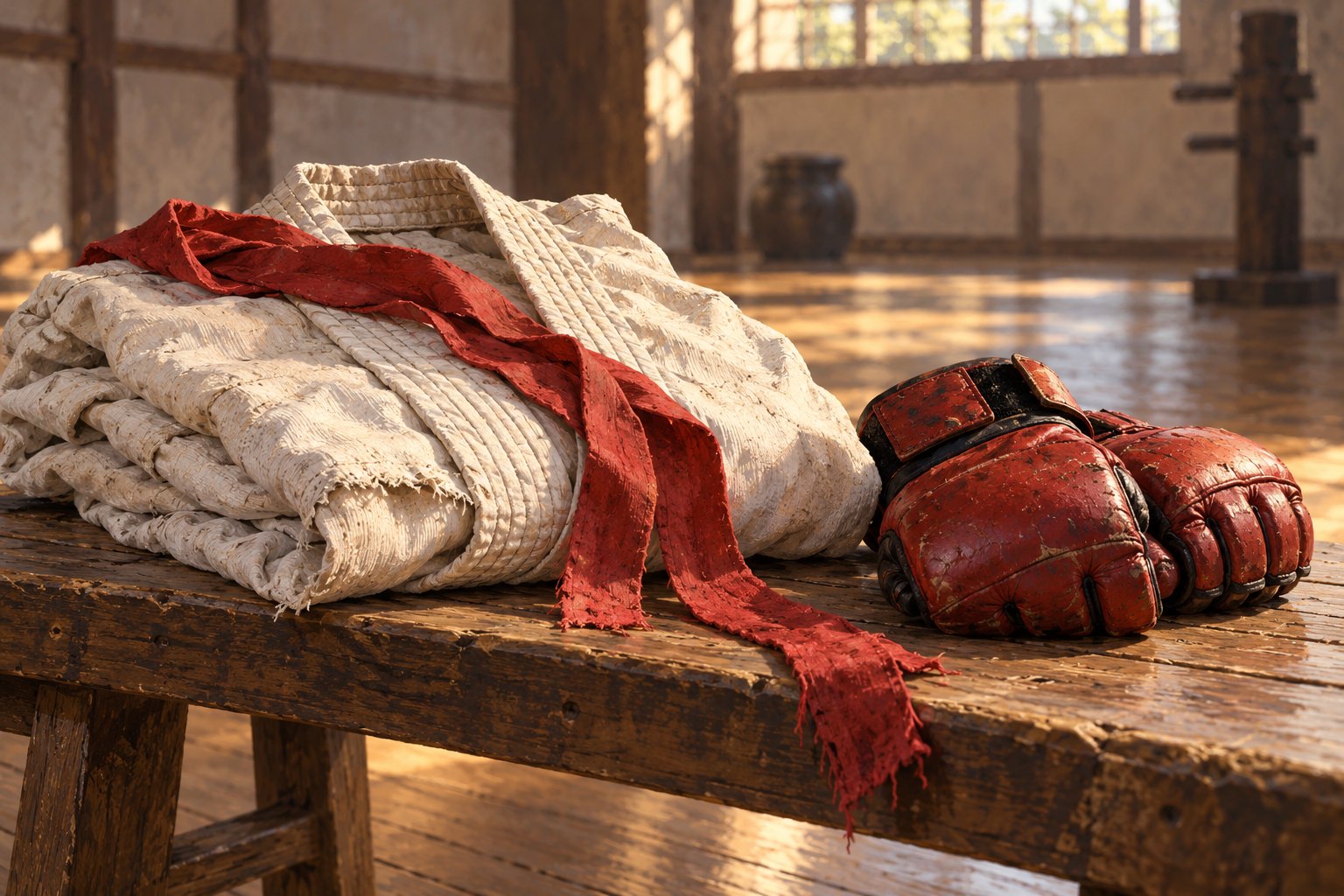
The illustration offers a symbolic reading of that idea, rather than recreating a scene. Empty training clothes invite attention to the person who normally occupies them: the routines, injuries, and choices that make a fighter recognizable beyond a color scheme.
As in our examination of how costume craftsmanship shapes a character’s presence, the useful question is what the clothing communicates about its wearer. Accuracy can introduce a character. Texture and performance must help sustain one.
Enjoyment Does Not Cancel the Need for Consequences
Francisco’s mixed response distinguishes memorable individual effects from satisfying dramatic construction. That is a valuable distinction for a tournament film. A spectacular blow provides an immediate sensation; a consequential bout changes what someone can do next.
The distinction also explains why affection and frustration can coexist. A viewer may enjoy a performer’s commitment, an exaggerated stance, or an impossible movement while wanting the surrounding sequence to build and resolve more persuasively. Pleasure is evidence of something working. It is not evidence that everything works.
The Deeper Conflict Is About What Strength Is For
The most productive interpretation of Street Fighter places its characters around competing uses of power. Ryu’s retreat raises the question of restraint. Ken’s wounded pride raises the question of recognition. Chun-Li’s intervention asks what ability can accomplish when directed toward a purpose. Bison’s objective makes power something to acquire from other people.
Under that reading, brotherhood matters because it offers a relationship that cannot be reduced to winning. Protecting someone may require admitting dependence, accepting criticism, or surrendering the pleasure of being right. None of those achievements fits neatly on a tournament bracket.
That is the strongest case for taking this supposedly guilty pleasure seriously. Its emotional premise asks whether formidable people can become dependable people. The answer deserves clear storytelling, however extravagant the spectacle surrounding it. Loving the spectacle and asking more of the story are perfectly compatible responses.
Original content by this site's editorial team. Published: October 21, 2026 at 20:22:06 PDT (Los Angeles time)