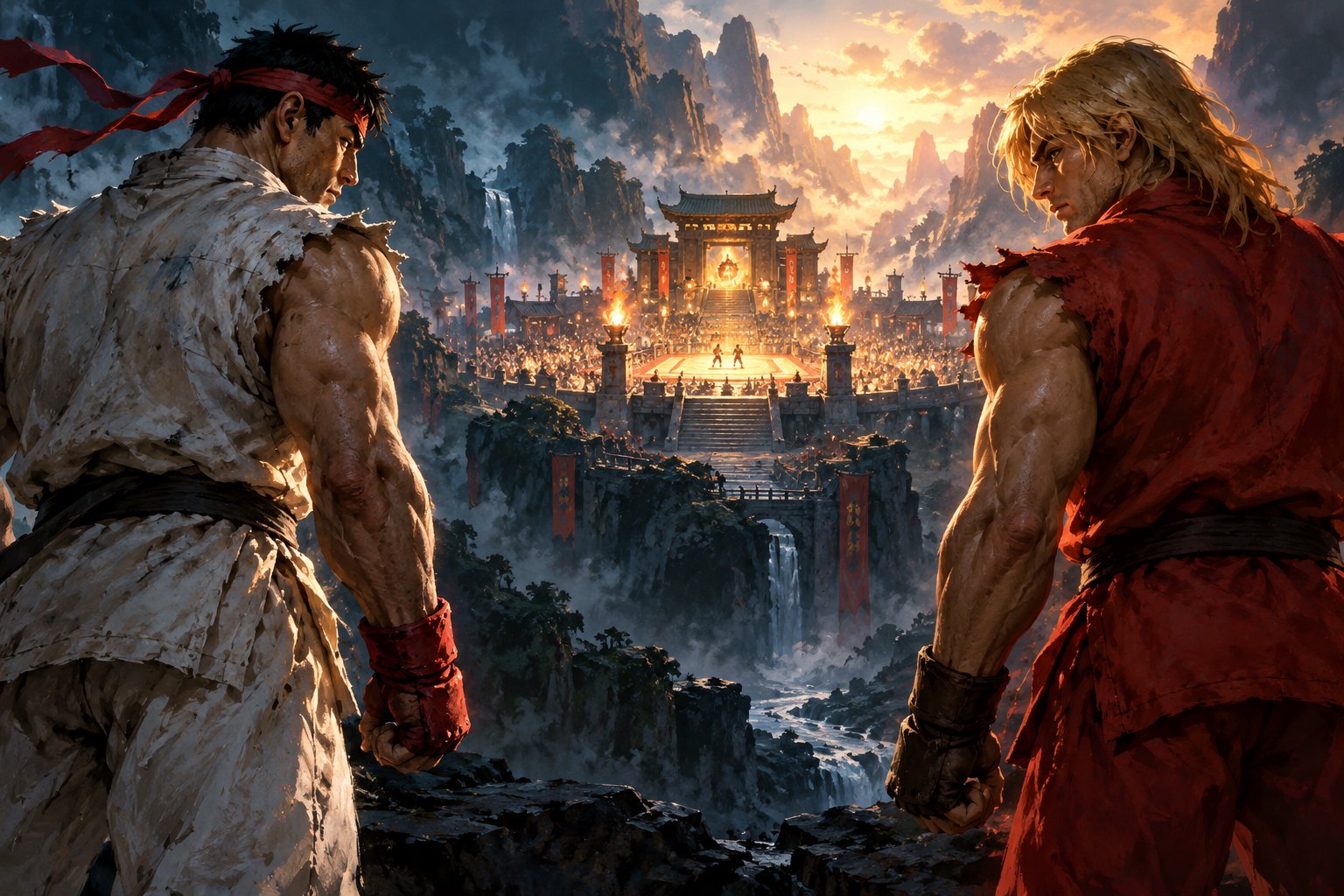
Street Fighter has a more interesting conflict inside its tournament than the question of who hits hardest. Ryu and Ken have both lost their footing, but they have responded in opposite ways: one retreats from public life, while the other keeps selling a version of himself. My reading of the 2026 adaptation is that this broken friendship offers its strongest dramatic idea. The spectacle has an emotional purpose whenever fighting exposes what these men cannot comfortably say.
Spoiler warning: This analysis discusses character backgrounds, the tournament’s underlying scheme, and selected dialogue and callbacks.
Ryu: Disappearing Is Not the Same as Finding Peace
Directed by Kitao Sakurai, the film places its main action in 1993. Andrew Koji plays Ryu, a former champion now living outside the spotlight and selling Japanese food from a cart. Noah Centineo’s Ken has followed a different downward path, turning his diminished celebrity into advertising work. Their estrangement gives the tournament a personal history before either man steps into competition. [Catholic Review’s account](https://catholicreview.org/movie-review-street-fighter/) establishes these contrasting circumstances.
The crucial distinction is between Ryu’s modest circumstances and his emotional condition. An ordinary job does not make him a failed person. Nor does leaving competition necessarily make him enlightened. The character invites a harder question: has he chosen a life that suits him, or narrowed his life to avoid another devastating attachment?
The backstory makes that question concrete. Ryu won an earlier World Warrior Tournament in 1987; his master was subsequently murdered, and Ryu disappeared. Even Ken does not know where his friend has gone. That sequence connects Ryu’s withdrawal to loss, rather than simply presenting him as the naturally quiet half of a comedy pairing. [UPI’s review](https://www.upi.com/Entertainment_News/Movies/2026/10/15/Street-Fighter-movie-review-video-game/3511792121698/) describes this history.
From that perspective, returning to combat is emotionally ambiguous. Ryu may be reclaiming something meaningful, but he is also reentering an environment where others value his usefulness more than his well-being. A comeback can look triumphant from the stands while feeling threatening to the person making it.

Ken: The Exhaustion of Remaining Visible
Ken’s predicament reverses Ryu’s. He still has a public image, but maintaining that image has become its own degrading occupation. The advertisements matter because they turn his former athletic authority into a product. He can keep appearing on a screen without feeling that he still belongs in the ring.
This makes the friendship more complicated than a contrast between humility and vanity. Ken’s hunger for recognition can be read as a fear of becoming disposable. If Ryu’s retreat leaves other people outside, Ken’s performance of success keeps them at another kind of distance. Neither strategy makes honest conversation easy.
Sammy Barker’s review identifies Ken’s feeling of being the overlooked understudy as part of the film’s competing character threads. That provides a useful way to understand his rivalry: beating Ryu would mean more than earning a sporting result. It could seem to promise release from a comparison that has shaped his identity. [Push Square’s character assessment](https://www.pushsquare.com/features/movie-review-street-fighter-gaudy-testosterone-fuelled-action-film-is-fun-but-not-a-knockout) describes that imbalance.
But a victory cannot do all that emotional work. If Ken measures himself entirely against Ryu, even winning leaves Ryu at the center of his life. Their relationship becomes compelling when recognition means seeing the other person clearly, rather than securing a superior position.
That distinction between talent and its marketable image also runs through our analysis of ambition and unequal partnerships in Jailhouse Rock. The settings differ, but both stories invite scrutiny of what happens when a gifted person becomes a commodity.
Bison Turns Competition Into Extraction
David Dastmalchian’s Bison gives this identity crisis a literal fantasy mechanism. He stages the tournament to obtain Ryu’s power. The apparent opportunity to compete is therefore also a trap: the champion sees a contest, while its sponsor sees something he wants to possess.
My interpretation is that Bison represents the ugliest possible answer to the film’s questions about achievement. He wants the result of another person’s discipline without accepting its demands. Ryu struggles with carrying his abilities; Ken struggles with being recognized for his. Bison reduces ability to a resource that should belong to whoever can seize it.
This is why the tournament’s organization matters as much as its individual matches. Fair-looking competition can conceal an unequal arrangement when the person setting the terms has a private objective. Bison does not merely threaten a fighter’s body. He threatens the distinction between being powerful and being owned.
Chun-Li Has a Purpose Beyond the Men’s Rivalry
Callina Liang’s Chun-Li appears to be working within Bison’s operation, but she has her own agenda. Published accounts identify her mission as revenge against the man who murdered her father. Her involvement therefore brings a separate moral pressure into the tournament: the public event is also an opening for a private reckoning.
Her position is especially interesting because cooperation and loyalty are not identical. Working close to someone can be a means of opposing them. The dramatic tension lies in the distance between what Bison thinks her participation means and what she intends to accomplish.
Revenge also complicates the film’s emphasis on overcoming ego. Chun-Li’s grievance cannot simply be folded into Ryu and Ken’s wounded pride. A story that treats every character’s anger as interchangeable loses the differences that make an ensemble worth following. The same need to distinguish resistance from obedience informs our reading of conscience and authority in Pan’s Labyrinth.
When Fighting Becomes a Failure to Communicate
One small line offers an unexpectedly useful lens: “Guys, stop fighting.” The Associated Press records the plea during a scene involving bickering warriors in a car. It is a joke that also exposes the limits of their shared vocabulary. [The AP review](https://apnews.com/article/12e3981dc13cdf4e36033ff84c2f6df9) describes the moment.
Physical action can reveal character, but only when the confrontation changes something. Otherwise, another clash postpones the conversation the audience is waiting for. For this story, the meaningful measure of a fight is whether it alters trust, exposes a motive, or forces someone to abandon a comforting self-image.
Easter Eggs That Reinforce the Theme
The title card’s “Round 1: fight!” recalls the games’ announcer. Bison’s “For me, it’s Tuesday” echoes Raúl Juliá’s famous dismissal in the 1994 film. Both callbacks are documented in [GamesRadar’s Easter egg guide](https://www.gamesradar.com/entertainment/live-action-movies/street-fighter-movie-easter-eggs/).
The first line promises clean rules and a fresh contest. The second reveals a villain for whom another person’s defining catastrophe barely registers. Together, they frame the story’s central tension: the arena offers an orderly language for conflicts that are painfully unequal.
That is the deeper value of reading Street Fighter through its characters. Ryu needs a life larger than withdrawal. Ken needs self-respect that survives comparison. Chun-Li needs her purpose understood on its own terms. Bison sees other people chiefly as instruments. The most meaningful victory available to these fighters is the ability to recognize one another as people whose worth continues after the match ends.
Original content by this site's editorial team. Published: October 26, 2026 at 08:51:54 PDT (Los Angeles time)