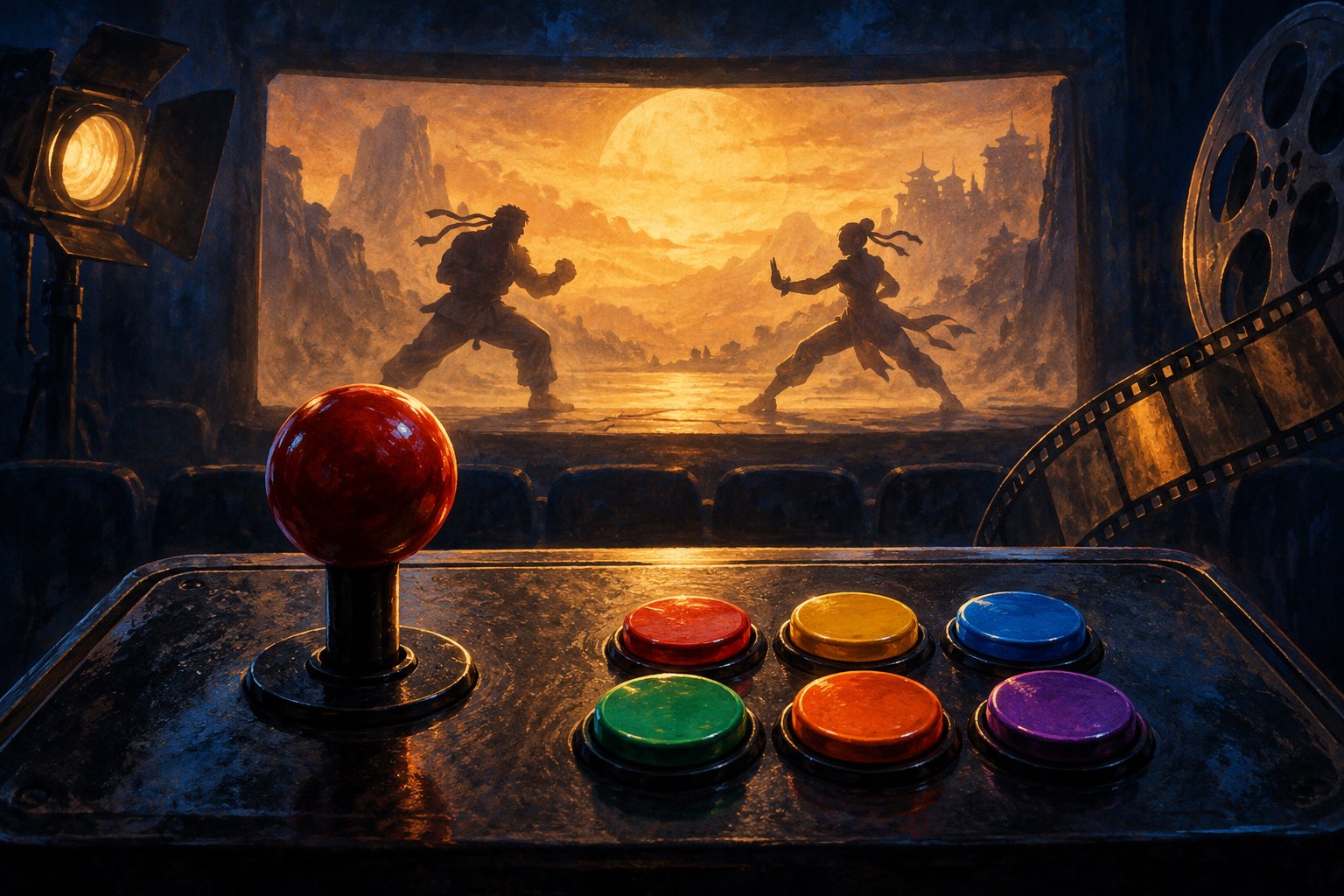
Street Fighter has received a sharply negative assessment from Variety, whose review headline presents the video game adaptation as its own worst opponent. That establishes one publication’s verdict. It does not, by itself, establish which performances, fights, or storytelling decisions deserve the blame.
The distinction matters for anyone deciding what to expect from the film. A memorable dismissal can tell you how strongly a critic reacted without explaining whether the problems would bother you. For this particular adaptation, the more useful question is what happens when the pleasure of controlling a fighter becomes the experience of watching one.
This is spoiler-free critical commentary on that adaptation problem, not a firsthand review of the finished film. It does not assign a rating, reconstruct unverified scenes, or attribute dialogue to characters without confirmation.
The missing ingredient may be the player
A fighting game asks you to make decisions. You judge distance, anticipate an attack, commit too early, recover, and try again. Even a short exchange can feel intensely personal because your choices helped create its outcome. The excitement belongs partly to the character and partly to you.
A movie removes that direct participation. The audience cannot choose when to block or whether to risk another attack. The filmmaker has to create another reason to care about the next movement. Beautiful choreography can help, but physical complexity alone does not replace the tension of making a consequential decision.
My view is that the most persuasive adaptation would preserve the experience of reading an opponent. A fighter notices something, makes an assumption, and acts on it. The assumption proves right or wrong. Suddenly, an exchange has a dramatic shape that a viewer can follow without knowing anything about special moves.
This is where a film can make familiar material newly interesting. It can show the hesitation that a player might never consider, or the fear concealed by a confident stance. Recognition brings the audience into the scene; uncertainty gives it a reason to stay.
A fight should tell us whose experience matters
Character perspective does not require constant dialogue or elaborate backstory. It can emerge from where the camera stays after a blow lands. Following the attacker emphasizes intention and dominance. Holding on the defender makes the same moment about pain, calculation, or the effort to remain composed.
Consider a hypothetical exchange rather than a claim about a scene in Street Fighter: one opponent keeps advancing while the other gives ground. That could express courage confronting fear. It could also reveal recklessness confronting patience. The movement becomes characterization only when the surrounding choices make those possibilities legible.
Our earlier analysis of Street Fighter’s central rivalry approaches the adaptation through its relationship stakes. The complementary question here concerns film form: how might framing, performance, and rhythm make a relationship visible during combat?
A close-up cannot manufacture that meaning by itself. If every clenched jaw receives identical emphasis, the film supplies intensity without distinction. A revealing reaction tells us something particular: this fighter recognizes a tactic, resents being underestimated, or realizes that an old advantage no longer works.
Clear action creates room for surprise
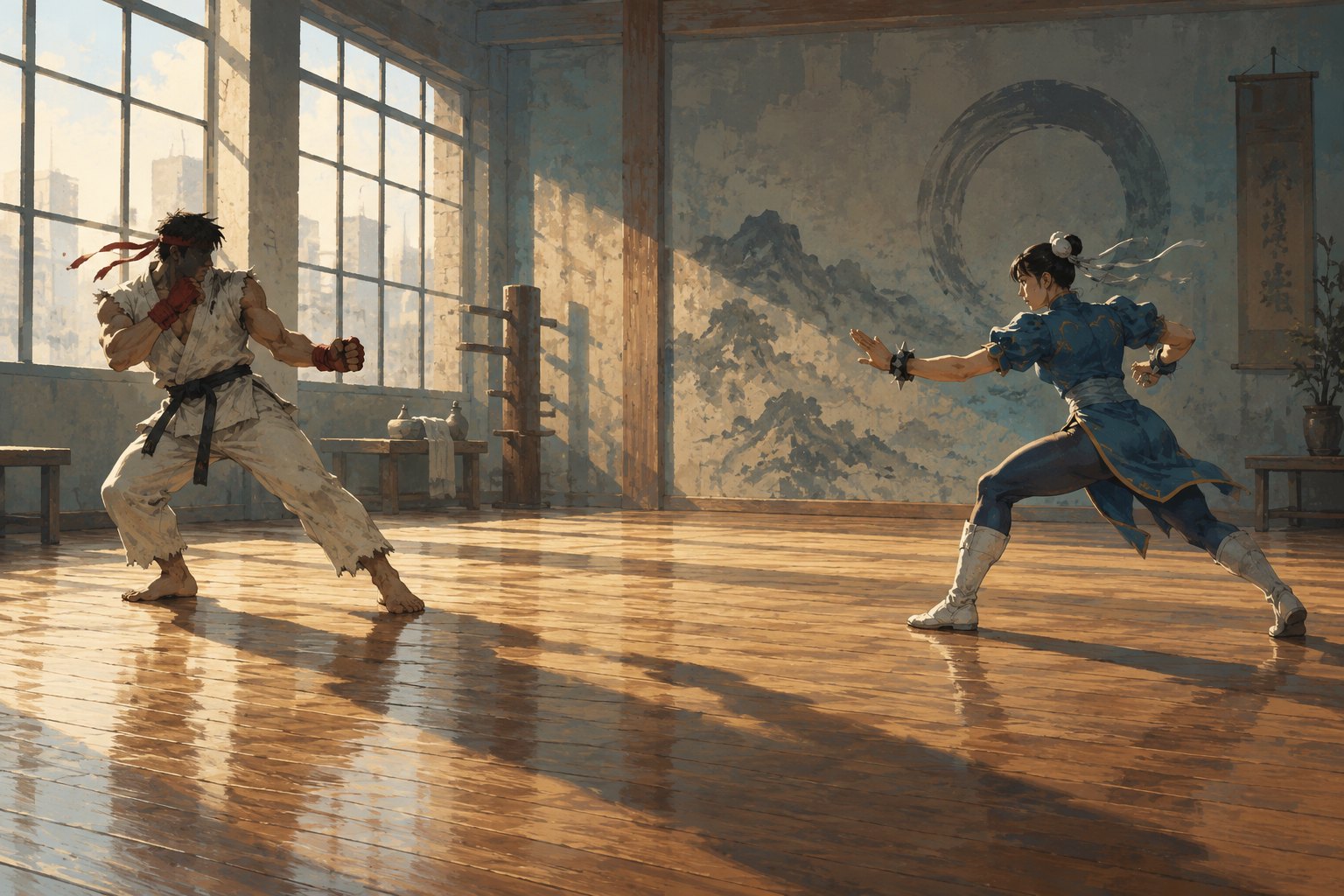
There is a practical reason to care about spatial clarity. An audience needs some understanding of a fight before it can appreciate a reversal. Where are the opponents? What distance separates them? Who has room to retreat? These are small questions, but their answers make an unexpected move satisfying.
Editing can accelerate an exchange without concealing its logic. A cut may redirect attention toward a vulnerability or reveal that an apparent opening was a trap. Trouble begins when the audience has to reconstruct basic movement while the scene is already demanding an emotional response.
That does not mean every fight must unfold in a long, uninterrupted shot. Different approaches can work. What matters is whether the chosen style communicates the information the moment needs. Confusion can express a character’s panic, but it loses that expressive value if it becomes the default condition of every confrontation.
The same distinction appears in our discussion of how competitive action becomes a story. A succession of impressive moments does not automatically create an arc. The arrangement has to establish expectation, alter it, and let the change register.
Exaggeration needs a consistent emotional scale
A Street Fighter adaptation invites a discussion of excess. Stylized bodies, extravagant movement, and heightened confrontations can belong comfortably in cinema. None of those qualities inherently prevents an audience from investing in a character.
The harder task is establishing how seriously consequences should be taken. Comedy and vulnerability can coexist, but the transition needs care. If embarrassment is treated as a disposable joke in one moment and a profound wound in the next, the performance and staging must help the audience understand the difference.
For me, sincerity is more useful here than solemnity. A film can remain playful while allowing its characters to want something without apology. It can make a fighter ridiculous and still respect the effort behind the pose. That respect gives humor a target more interesting than the mere fact that the material is unusual.
This is also why visual fidelity cannot settle the quality question. A recognizable appearance may provide immediate pleasure. Whether that pleasure lasts depends on what the person inside the costume does, wants, and risks.
What a negative review can—and cannot—tell you
Variety’s headline offers a clear negative judgment. It should not be stretched into an unsupported claim that every critic agrees, that audiences will reject the movie, or that any particular performer is responsible. Those are separate assertions requiring separate evidence.
A useful review also distinguishes different kinds of disappointment. Weak dramatic development, difficult-to-follow action, and an unsuccessful comic tone are not interchangeable complaints. A viewer who enjoys broad humor may tolerate one problem while finding another decisive.
For readers weighing the criticism, the most informative details are therefore concrete ones: whether a reviewer explains the action’s construction, identifies how a character changes, and separates personal taste from a demonstrable storytelling gap. The sharpness of a verdict matters less than the precision of its reasoning.
The deeper challenge: making victory mean something
The interpretive possibility behind Street Fighter is that fighting can reveal the limits of a person’s self-image. Strength might conceal insecurity. Restraint might require more courage than aggression. Defeat might expose an assumption that victory would have allowed a character to keep.
Those are possibilities, not claims about the film’s ending. They identify what cinema can contribute to a premise built around competition: the ability to distinguish winning a contest from understanding oneself.
That is the standard I would bring to the debate surrounding this adaptation. A spectacular blow can deliver an instant thrill. A meaningful blow changes what we understand about the person who throws it—or the person who gets back up. The strongest version of Street Fighter would make both experiences belong to the same moment.
Original content by this site's editorial team. Published: October 15, 2026 at 11:53:18 PDT (Los Angeles time)