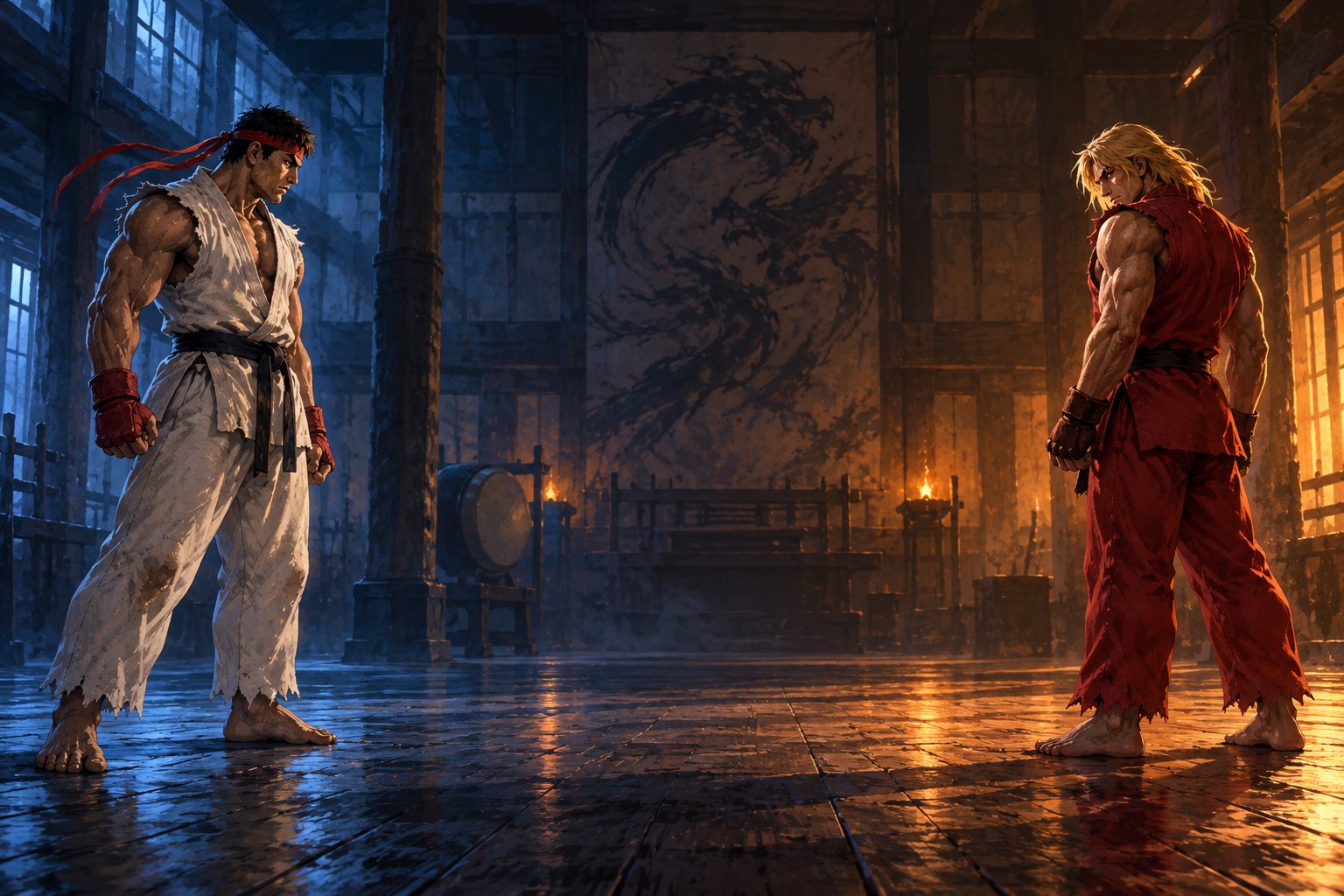
Street Fighter (2026) offers a compelling question beneath its tournament premise: what happens when the person who understands your strength best also knows exactly where you are weak? Ryu and Ken’s estrangement gives the adaptation an emotional problem that spectacular fighting alone cannot solve. Their relationship provides the most useful starting point for discussing the film’s characters, because a reunion requires more than getting two familiar uniforms into the same frame.
Spoilers follow for the premise and selected reported scenes. This is a critical reading of the official story setup and published accounts of the film, rather than a firsthand screening review. The illustrations are interpretive artwork, not depictions of verified scenes.
The tournament starts with a broken relationship
The official synopsis places director Kitao Sakurai’s film in 1993. Chun-Li, played by Callina Liang, recruits estranged fighters Ryu and Ken Masters for the World Warrior Tournament. Andrew Koji plays Ryu, while Noah Centineo plays Ken. That setup gives the competition two purposes: it assembles opponents and forces unfinished personal business back into view.
Estrangement matters because it changes how viewers interpret ordinary rivalry. Between close friends, competition can express affection: each person pushes the other because both understand the rules. After a rupture, the same challenge can sound like an accusation. A refusal to fight might mean restraint, contempt, fear, or a desperate wish to avoid reopening an old wound.
My reading is that this ambiguity supplies a stronger dramatic foundation than a simple contest between superior and inferior fighters. Physical skill can be demonstrated immediately. Trust takes longer. The film’s central relationship invites viewers to watch for the difference between proving an ability and earning the right to be believed.
Ryu: withdrawal can protect others and punish them
Nintendojo’s account describes Ryu awakening the dangerous Dark Hado, attracting Akuma’s attention, and retreating from fighting. He later fears that Ken’s tournament success will expose Ken to Akuma. Those reported details complicate the familiar image of a disciplined martial artist: Ryu’s restraint has a frightening practical reason.
There is a persuasive moral problem here. Someone who believes his presence endangers others may experience disappearance as an act of care. The people left behind experience an absence. Both perspectives can be sincere, and neither automatically cancels the damage done to the relationship.
For a film club discussion, the useful question is whether protection gives someone permission to make another person’s decisions. Ryu may understand a threat more clearly than Ken does. That knowledge still leaves him with a responsibility to communicate. Concern becomes difficult to distinguish from control when it arrives as an instruction without an explanation.
The distinction also changes what strength means. Refusing a fight may require courage, but refusal cannot become a permanent substitute for confronting its consequences. A character’s virtue becomes dramatically interesting when the same behavior can be admirable in one situation and evasive in another.
Ken: confidence is a public performance
Nintendojo describes Ken’s intervening years as a period of celebrity and commercial appearances. Set beside Ryu’s retreat, that detail suggests two contrasting responses to a damaged identity: becoming harder to find and becoming impossible to overlook.
Visibility can look like recovery from the outside. An audience sees energy, confidence, and a recognizable personality. It cannot necessarily tell whether those qualities express fulfillment or help someone avoid a more painful conversation. That is an interpretation of the contrast, not a claim that every flamboyant gesture conceals a particular emotion.
The critical opportunity is to take Ken’s personality seriously without demanding that he stop being entertaining. A loud character deserves emotional specificity as much as a quiet one. Brooding is not evidence of greater depth; exuberance is not evidence of its absence.
For viewers, a useful test is whether humor reveals how Ken relates to people or merely delays that understanding. A joke can show generosity, defensiveness, vanity, or affection. When its only function is to erase discomfort, the character loses an opportunity to become more than an appealing surface.
Chun-Li and the importance of having a purpose
Chun-Li’s recruitment role makes her the person who puts the central relationship under pressure. From a storytelling perspective, that is a powerful position: she changes what the other characters must do next.
It also creates a familiar adaptation challenge. A character can be indispensable to the machinery of a plot while receiving too little room as a person. The meaningful question is whether viewers can explain her decisions from her own perspective, beyond their usefulness to Ryu and Ken.
This is where a character-centered discussion improves on a checklist of recognizable appearances. Ask what each fighter wants before the next confrontation begins, what information they possess, and what they stand to lose. These questions are accessible even to viewers unfamiliar with the games. They are also harder for an adaptation to satisfy through costume accuracy alone.
Our discussion of making an adaptation’s world feel personal explores the same problem: recognition can establish familiarity, but choices establish dramatic investment.
When comedy interrupts the emotional fight
Nintendojo identifies a moment in which Ken’s serious commitment to the tournament is quickly interrupted by a joke. That reported example raises a useful issue about comic timing: an interruption can humanize solemnity, but it can also prevent a feeling from registering.
My preference is for action comedy that trusts a sincere beat to survive without an immediate escape hatch. The audience does not need every emotion underlined. It does need enough time to understand why a character’s decision matters.
That does not require a uniformly grave tone. Exaggeration can make vulnerability more affecting because it breaks through an otherwise extravagant surface. The key is consequence. After laughter, does the decision still carry weight? Does another character respond to it? Does it affect the next encounter?
Those are more revealing questions than whether the film is sufficiently serious. As our essay on why movies stay with us considers, emotional recognition often outlasts the immediate excitement of a scene.
A familiar line, and a deeper reading of strength
One reported game callback is Guile telling Vega to “go home and be a family man.” Nintendojo identifies the exchange in its review. The line illustrates how a familiar phrase can give longtime players a quick moment of recognition while functioning as a dismissive taunt within the movie.
Its value as an Easter egg is straightforward. Its dramatic value depends on placement and delivery: recognition alone cannot establish whether a joke improves a scene. The same principle applies to signature moves. Familiarity creates anticipation; character context determines whether the payoff means anything beyond identification.
The deeper interpretive question running through Ryu and Ken’s setup is whether strength makes someone more capable of connection or more determined to avoid dependence. Friendship asks for qualities that a tournament cannot measure: explanation, patience, accountability, and the willingness to accept another person’s judgment.
That is the most productive lens for discussing Street Fighter. Watch who treats another fighter as a rival, a responsibility, or a person entitled to choose. The distinction can reveal more about these characters than the outcome of any single match.
Original content by this site's editorial team. Published: October 19, 2026 at 04:38:54 PDT (Los Angeles time)