Stars and screenwriters are in town for the Austin Film Festival, bringing attention to two kinds of creative work audiences experience together: the construction of a character and the performance that makes that character feel alive. Texas Standard’s coverage places both groups in the spotlight. For moviegoers, that pairing opens a rewarding conversation about what we actually mean when we call a role well written or beautifully acted.
Film commentary: The most interesting question is how a character moves from an imagined person on a page to someone whose smallest hesitation can hold our attention. A festival gathering provides a reason to consider that transformation—and to sharpen the questions we ask about it.
What a Star and a Screenwriter Can Reveal About the Same Role
We tend to remember a movie through faces. An expression stays with us; a voice becomes inseparable from a sentence. Yet a performance also unfolds within a structure of decisions: what the character knows, what they want, what they conceal, and when their options disappear.
A screenwriter and an actor can approach that structure from different directions. The writer may discuss why a confrontation arrives late in the story. The actor may explain how the character avoids that confrontation moment by moment. One perspective concerns the placement of the scene; the other concerns the experience of living through it.
That distinction makes their presence at Austin especially interesting as a subject for film discussion. A useful conversation can connect the large design of a story to its smallest human details. Why does a character finally speak? Why do they choose this listener? What have they already tried that failed?
Those questions also complicate the idea of individual authorship. Our examination of the relationship between writing a role and wanting to perform it considers a related tension: creating a character and embodying that character involve connected, but distinct, ambitions.
Start With What the Character Wants in the Room
For viewers hoping to take something useful from the Austin Film Festival conversation, character objectives offer a practical starting point. Before judging whether dialogue sounds natural, ask what the speaker hopes to accomplish.
Consider an invented example: a character arrives at a sibling’s home to request a loan but spends several minutes discussing a broken kitchen cabinet. The surface subject is household repair. The dramatic subject might be shame, resentment, or an attempt to prove usefulness before asking for help.
The writing establishes that mismatch. The performance can make it legible without explaining it. A glance toward the sibling’s wallet might be too obvious; an unnecessary offer to fix the cabinet might be enough. Either choice changes how much work the audience must do.
My preference is for scenes that allow viewers to discover the need through behavior. But indirectness is not automatically depth. If the character’s objective remains incomprehensible, a scene can become merely vague. Effective restraint gives us something specific to notice.
Memorable Dialogue Depends on Who Is Listening
Festival conversations about screenwriting can easily gravitate toward quotable lines. The more revealing question is what a line changes between the people in the scene.
A declaration can sound confident while functioning as a plea. An apology can become an attempt to end an uncomfortable conversation. A joke can invite intimacy or punish someone for getting too close. The words alone do not settle the matter; delivery, context, and the listener’s response help determine their meaning.
When revisiting a favorite movie, watch the person receiving the line. Does the listener believe it? Do they respond immediately, or allow the speaker to become uncomfortable? Does the camera preserve their reaction? A celebrated speech may owe part of its force to another performer’s refusal to interrupt.
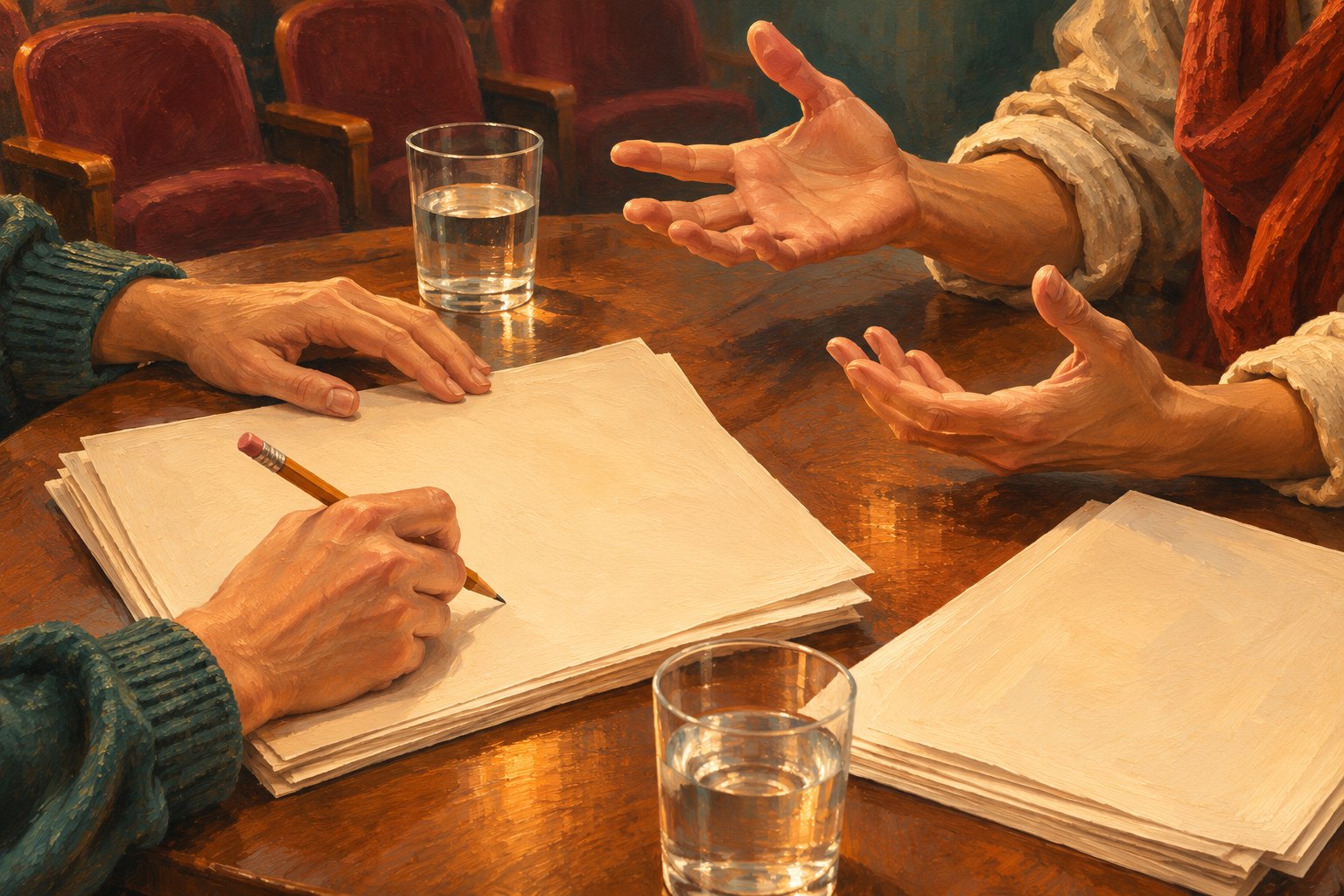
This is where an exchange between actors and screenwriters could become particularly illuminating. A writer can explain the intended pressure inside a conversation. A performer can describe the playable action they found there: persuading, deflecting, testing, intimidating, or seeking reassurance. Those descriptions give audiences a more precise vocabulary than simply calling dialogue strong.
Separate the Character’s Knowledge From Your Own
A useful habit for character analysis is to track information. Viewers sometimes criticize a decision because they know something the character has not learned. We also excuse decisions because we already like the performer making them.
Try approaching a pivotal scene with three questions: What does this person know right now? What do they believe incorrectly? What would admitting the truth cost them? These questions help distinguish a plausible mistake from a convenient piece of plotting.
The same approach protects supporting characters from becoming invisible. A protagonist may experience someone else as an obstacle, but that other person should still have a reason to resist. A convincing conflict allows us to understand competing aims even when we strongly favor one side.
That attention to perspective also informs our character-focused reading of The Graduate. Looking beyond the central figure’s immediate desires can change the emotional meaning of an apparently decisive moment.
Questions Worth Bringing to a Festival Conversation
When opportunities for discussion arise, specific questions are more likely to produce useful answers than requests for general inspiration. The Austin gathering suggests several productive lines of inquiry:
- For a screenwriter: Which decision made the character difficult to write, and what competing desires caused that difficulty?
- For an actor: What did the character want in a scene where they appeared to be doing very little?
- For either: Did a reaction change the meaning of a line without changing its wording?
- About collaboration: Was there a moment when a simpler action made an explanation unnecessary?
These questions do not assume that every film follows the same process. They invite concrete accounts while leaving room for disagreement. A performer and a writer might describe the same scene differently, and that difference can be useful rather than something to resolve immediately.
The Best Takeaway Is a More Attentive Next Viewing
Hearing a filmmaker explain a choice can enrich a movie, but the explanation does not replace what appears on screen. Intention is valuable context. The finished scene still has to communicate through the evidence available to the audience.
For me, the deeper appeal of actors and screenwriters sharing attention at the Austin Film Festival is the chance to understand character as a relationship between structure and behavior. Writing establishes pressures and possibilities. Performance gives those pressures a voice, a rhythm, and a physical presence. Direction, editing, and the other performers shape what we finally perceive.
After the festival conversation ends, that understanding remains useful. Watch who changes tactics. Notice when a familiar phrase acquires a different meaning. Ask whether a final decision grows from the person you have spent the movie learning to understand. Those are the details that turn admiration for a star—or appreciation of a clever script—into a fuller encounter with the film.
Original content by this site's editorial team. Published: November 2, 2026 at 19:16:02 PST (Los Angeles time)