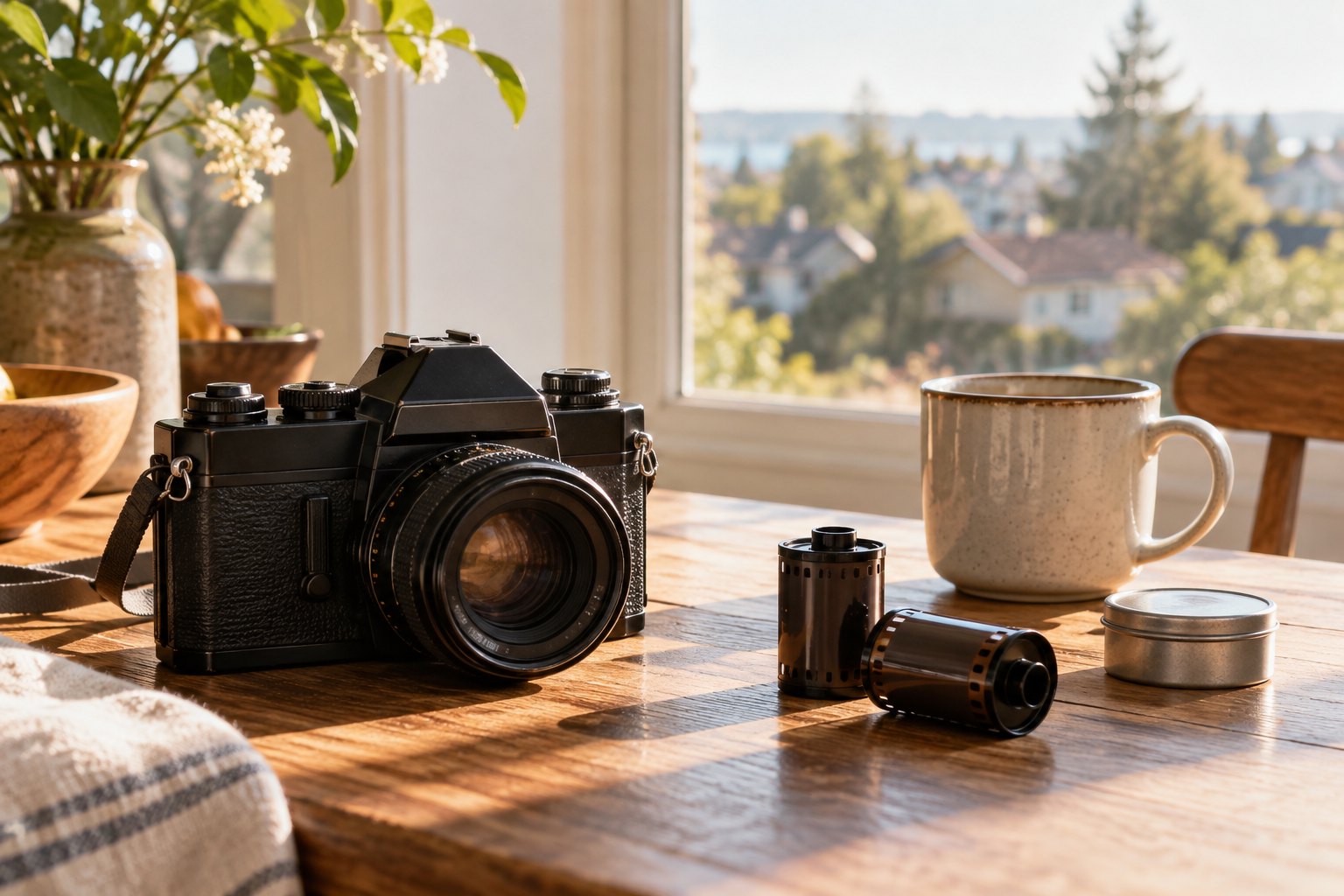
Cinema film can be used for everyday photos. Whether you should use it depends on what you want from those pictures—and how much attention you want to give the process. My editorial judgment: it makes sense as a deliberate experiment for someone curious about photographic craft. Its connection to filmmaking, by itself, is a weak reason to make it your everyday choice.
Wirecutter has promoted an investigation involving nine rolls, raising an appealing question for movie lovers: can a material associated with the big screen bring something worthwhile to ordinary photographs? The announcement establishes the experiment’s scope, but it does not establish which stock performed best or what its testers ultimately recommended. Those findings should not be guessed.
The more useful starting point is to separate three desires that often get bundled together: wanting a particular appearance, wanting to enjoy shooting film, and wanting photographs that feel like stories. They overlap, but each calls for a different kind of decision.
What Are You Actually Hoping Cinema Film Will Change?
Before choosing a roll, describe the result you want without using the word cinematic. Perhaps you want an evening portrait with gentle transitions between light and shadow. Perhaps you like an image that feels textured rather than immaculate. Perhaps you simply want to photograph familiar streets with renewed attention.
Those are useful goals because you can assess them afterward. Wanting your weekend to resemble a movie is harder to evaluate: it leaves the film responsible for everything from color to atmosphere to emotional significance.
Movie imagery offers more than an attractive surface. Framing determines what we notice. Lighting directs attention. A performance gives a gesture meaning. Editing changes how we understand the image that came before. When we admire a frame, we may be responding to several decisions simultaneously, even if we initially credit its texture.
That is why choosing a photographic material should follow an intention. It can become part of your visual vocabulary, but it cannot decide what deserves a picture.
A Cinematic Photograph Needs a Point of View
Consider an imagined everyday scene: a friend waiting beside a cafe window. You could photograph the glow of the lamp and the colors outside. You could also notice the empty chair opposite your friend, the untouched second cup, or the moment their expression changes as someone approaches.
The second approach gives the scene a human center. The light matters because it helps us read anticipation. The empty chair matters because it suggests a relationship. None of this requires inventing drama in your subject’s life; it requires paying attention to what is already visible.

For a film enthusiast, this is a productive way to approach everyday photography: think about whose experience organizes the image. Are we close enough to understand their reaction? Does the setting reveal something useful? Is a visually striking background competing with the person we came to see?
A similar principle guides our discussion of how movie theme songs gain meaning through characters. An expressive device becomes more compelling when it serves someone’s experience. Applied to photography, that means asking what the appearance contributes to the subject.
Check the Whole Process Before Buying a Roll
The phrase cinema film is not enough information to make a purchase. Treat the exact product’s instructions and your intended lab’s requirements as the starting point. Avoid assuming that every roll sold under that description can be handled in the same way.
Before committing, get clear answers to these questions:
- Camera compatibility: Is this particular product supplied in a format your camera accepts?
- Exposure guidance: What settings and lighting considerations does its maker specify?
- Processing: Will your chosen lab accept this exact film, and what service does it require?
- Delivery: What negatives, scans, or prints will you receive, and when?
- Total cost: What will the roll, processing, scanning, and any shipping cost together?
These questions are more valuable than a generic promise of a movie look. A roll that interests you aesthetically may still be a poor fit for your camera, your local options, or your patience. Conversely, a process you enjoy may justify extra effort even when the resulting photographs are not dramatically different.
For an initial experiment, choose an ordinary outing you would be happy to repeat. Keep another familiar camera available for moments you consider essential. The point is to create room to learn without making every exposure feel like an exam.
What a Nine-Roll Test Can—and Cannot—Tell You
Nine rolls sound substantial enough to invite confidence, but a roll count alone does not explain a test. To interpret any hands-on review, look for the conditions behind its conclusions: what was photographed, how exposure was handled, how the images were processed, and what the reviewers valued.
Were they seeking reliable everyday results, an unusual visual character, or an enjoyable experience? A recommendation can be sensible for one of those priorities and less useful for another.
Distinguish an observed result from a preference. A reviewer can describe what happened in their photographs; deciding that the appearance is beautiful or distracting is a critical judgment. Both matter, provided readers can tell them apart.
This is the same discipline behind evaluating early film enthusiasm before forming a verdict: attention gives us a reason to investigate, while the supporting evidence tells us what to believe. Wirecutter’s nine-roll announcement is an invitation to examine its review, not a substitute for its conclusions.
Make Your Own Trial Small and Specific
You do not need to reproduce a large experiment to learn something useful. Begin with one question: do you enjoy what this film brings to the subjects you actually photograph?
- Choose familiar subjects. Photograph the people, rooms, and streets that usually interest you. Familiarity makes it easier to identify what feels different.
- Keep brief notes. Record the light, your settings, and your intention. An unsuccessful frame is easier to learn from when you remember what you attempted.
- Judge the complete result. Consider the photographs alongside the effort, expense, and experience required to obtain them.
- Review again after the novelty fades. Ask which pictures still hold your attention and why.
Resist declaring a universal winner from a small personal trial. You are answering a narrower, more practical question: does this belong in your photography?
The Verdict: Let the Subject Justify the Choice
I would encourage the experiment if you enjoy learning a process and can identify something specific you want to explore. I would be less enthusiastic if your only expectation is that cinema film will automatically make casual pictures emotionally richer.
The deeper attraction is understandable. Movies teach us to see ordinary things as worthy of attention: a doorway, a face in a window, the distance between two people. Carrying that attention into daily life can be rewarding. But the decisive creative act happens when you recognize the moment and choose how to frame it.
Use cinema film if the experience and results help you make photographs you value. When you look back at them, the strongest reason to keep a picture should be what it lets you see.
Original content by this site's editorial team. Published: September 13, 2026 at 04:25:30 PDT (Los Angeles time)