Photographing SEMA on film makes an apparently straightforward assignment into a question of selection: which sights deserve a finite number of exposures? The Autopian’s account centers on that deliberately inconvenient choice. Its appeal reaches beyond camera enthusiasts because it touches a familiar concern in film criticism: how the way an image is made shapes what we notice inside it.
Here, film means photographic film, rather than a feature movie. The useful critical angle is therefore visual storytelling: framing, emphasis, texture, and the relationship between one picture and the next. My view is that the premise is compelling because it introduces resistance into the act of looking. That resistance can sharpen attention, although it cannot guarantee an interesting photograph.
What the SEMA premise establishes—and what it leaves open
The Autopian presents a first-person account of shooting SEMA on film. That establishes the subject and the chosen medium. It does not, by itself, establish which camera or film stock was used, how many exposures succeeded, or what particular vehicles appeared in the resulting photographs. Those details matter to any assessment of the actual work and should not be filled in through guesswork.
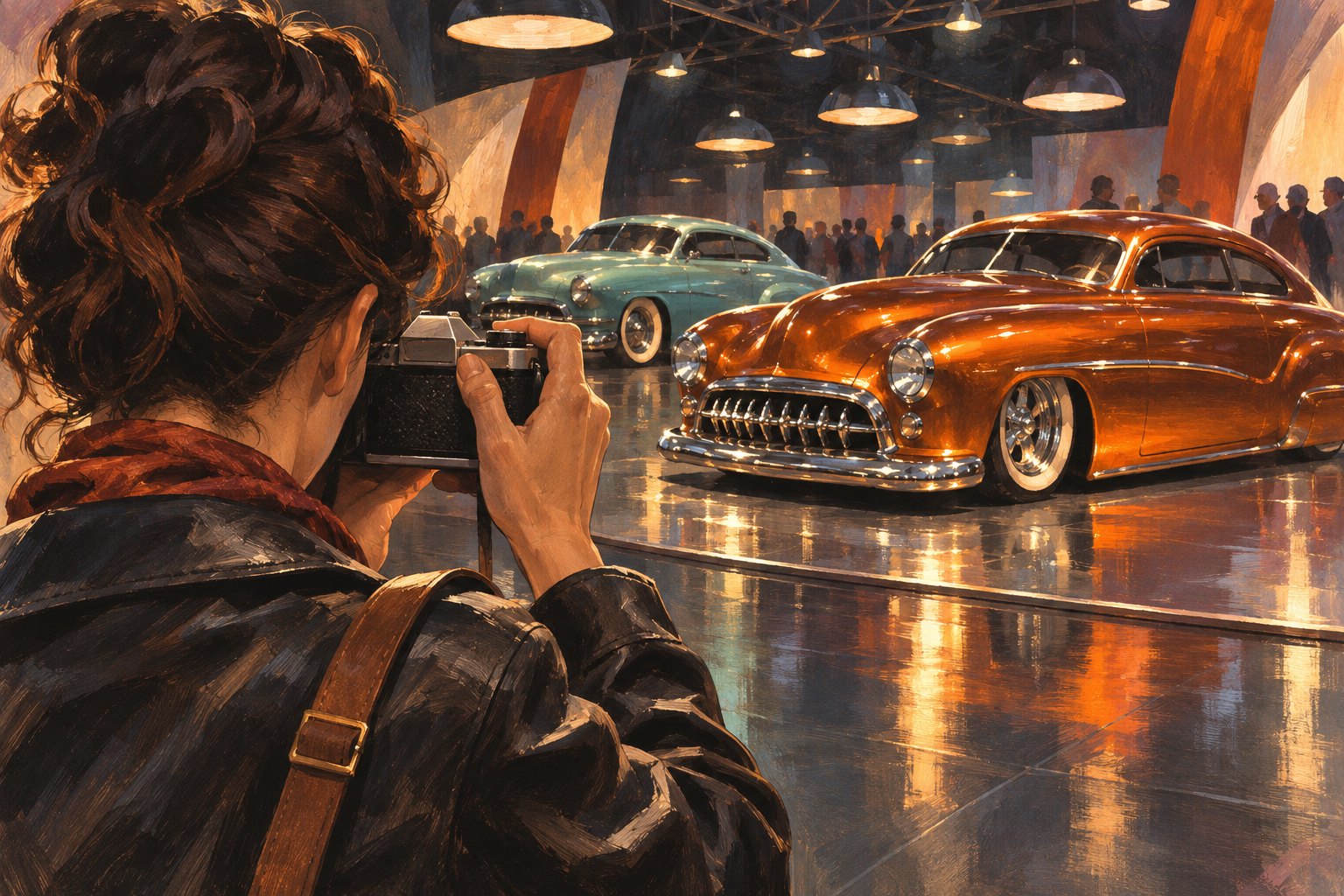
The discussion here concerns the creative implications of that premise, rather than a verdict on individual photographs. The accompanying illustrations are conceptual scenes, not records of particular exhibits. Keeping that distinction clear allows a more useful question to emerge: what might analog photography contribute to our understanding of a visually demanding automotive event?
A limited roll makes attention a practical decision
A roll of film has a physical endpoint. Every exposure moves the photographer closer to changing rolls, and the result usually cannot be inspected immediately. Those conditions create a different working rhythm from photographing with instant playback. A promising composition must be assessed before the photographer knows whether it worked.
That delay can encourage a second look. Is the subject actually interesting, or merely bright? Does the background support the shape of the car? Would waiting for a person to enter the frame give the image scale? These are ordinary photographic questions, but a limited supply of exposures can make their consequences feel more immediate.
There is also a less romantic possibility: caution can become timidity. A photographer concerned about wasting film may pass up the uncertain frame that would have been the most revealing. Digital abundance can support experimentation, while analog scarcity can discourage it. The creative value lies in how someone responds to the constraint, not in the constraint alone.
Reflective surfaces turn framing into interpretation
Consider the visual problem posed by a polished car at an exhibition. Its bodywork reflects its surroundings, so the photographer is effectively composing both an object and the world appearing across that object. A change in position can alter a highlight, reveal a distracting reflection, or make a curved panel easier to read.
For a film viewer, this is a useful way to think about cinematography. Lighting does more than make something visible. It directs attention toward particular contours and away from others. A gleaming surface can communicate precision or excess; a darker treatment might emphasize mass, mystery, or wear. None of those meanings lives permanently inside the object.
At SEMA, the interesting possibility is that photography can interpret the spectacle through choices of distance and angle. A wide view might emphasize display and competition for attention. A close detail might make craftsmanship the subject. Neither approach is inherently deeper. What matters is whether the framing gives the viewer something specific to discover.
The human viewpoint gives the machinery context
Cars offer strong shapes, but a sequence devoted entirely to attractive surfaces can become monotonous. Human presence creates another set of relationships: the size of a vehicle beside a body, the direction of someone’s attention, or the space people leave around an object they are examining.
Imagine a photograph that includes a visitor leaning toward a small mechanical detail. That hypothetical composition would tell us something about looking itself. It would invite us to follow the visitor’s attention and ask what deserves closer inspection. The person would give the image a point of entry without needing to become its dominant subject.
This is also where interpretation needs restraint. Posture can suggest concentration, but a photograph cannot establish a stranger’s private thoughts. Our discussion of what a portrait reveals beyond a public role raises a related issue: an image can invite a story without proving that story true.
The edit determines whether the pictures become a story
Taking photographs and arranging them are different creative acts. Even a collection of individually strong images can lose momentum if every frame uses the same distance, angle, and visual emphasis. A sequence needs variation that helps the viewer understand why the next image follows the previous one.
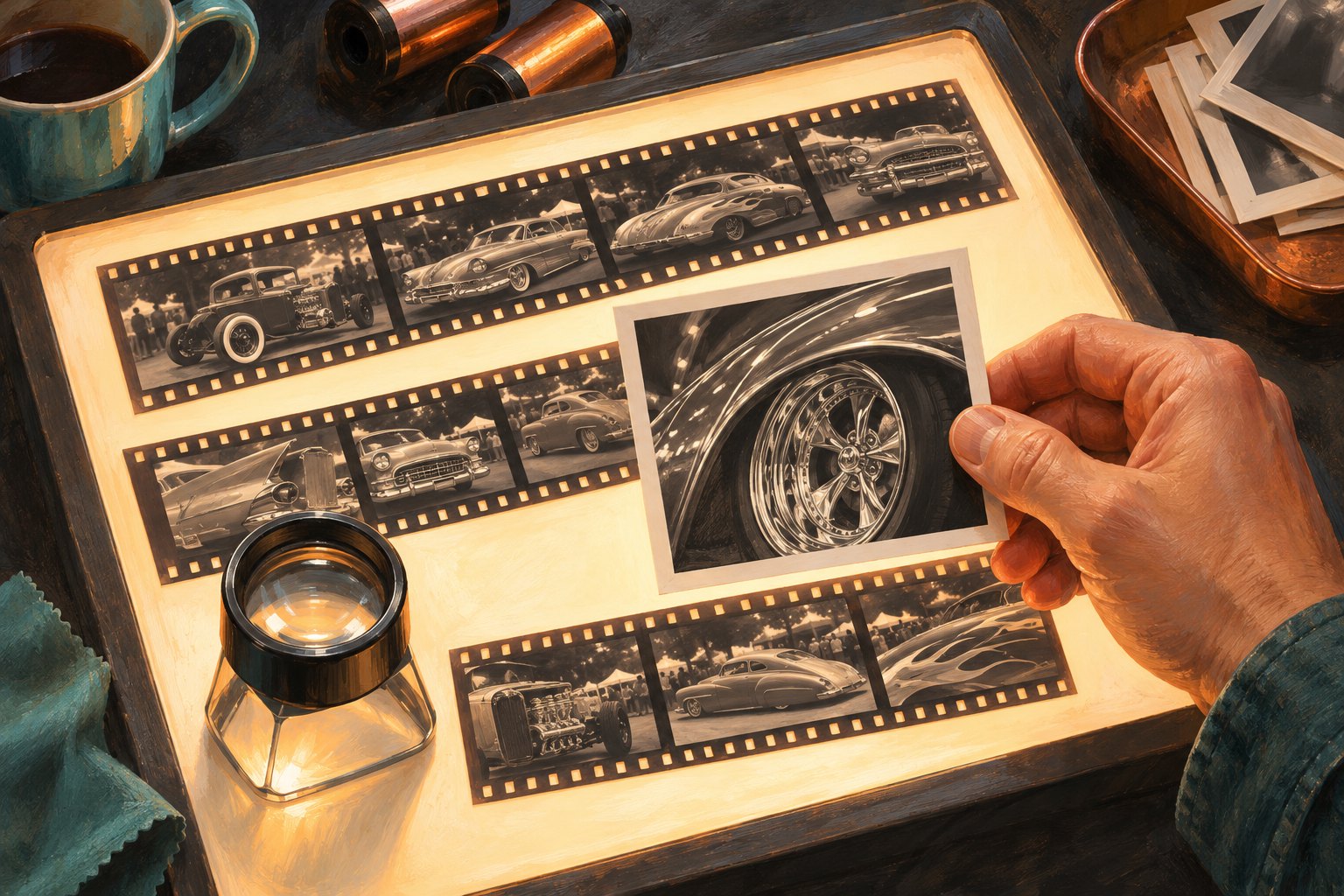
A possible structure for an automotive photo essay would begin with an environment, move toward a vehicle, examine a revealing detail, and then return to the surrounding people. This is an illustrative approach, not a description of The Autopian’s sequence. Its strength would come from changing the viewer’s scale of attention while maintaining a recognizable subject.
The connection to cinema is especially clear here. An image acquires meaning partly through its neighbors. A gleaming wheel followed by another gleaming wheel reinforces a motif; followed by a crowded aisle, it reconnects an isolated detail to a social space. Our examination of how footage becomes a film through editing considers the same fundamental distinction between collecting material and giving it shape.
Analog texture deserves scrutiny, too
Film can become an aesthetic shortcut in the way people discuss images. Grain, softened detail, and unusual color are sometimes treated as evidence of authenticity before anyone asks what the photograph communicates. That reverses the critical process. Texture deserves attention when it contributes to the subject, not simply because it signals an older medium.
For the SEMA premise, I would judge the approach by three questions. Do the photographs make the cars easier to see in a fresh way? Does the selection convey a recognizable perspective? Does the sequence reward attention beyond the initial pleasure of its surfaces? Those standards leave room for both beautiful polish and productive imperfection.
The deeper attraction of shooting SEMA on film is the tension between spectacle and personal attention. An event offers more potential subjects than any one observer can fully absorb. Choosing what to photograph acknowledges that limit and turns it into a viewpoint. The artistic achievement, when it happens, is a set of images that makes someone else pause, look again, and notice what the photographer chose to preserve.
Original content by this site's editorial team. Published: November 15, 2026 at 04:30:54 PST (Los Angeles time)