Seth Rogen has commented on the long-awaited Figment movie based on a Disney World ride, according to Entertainment Weekly’s exclusive report. That brings the project back into conversation, but the immediate question for moviegoers is what the comment actually establishes. Without verified access to his exact remarks, it would be premature to describe them as a production breakthrough, a release announcement, or a revelation about the story.
The more interesting creative question is already clear: how does a ride-based property become a movie whose characters matter beyond their familiarity? For Figment, recognition can open the door. A feature still needs a reason to keep audiences emotionally involved after that first encounter.
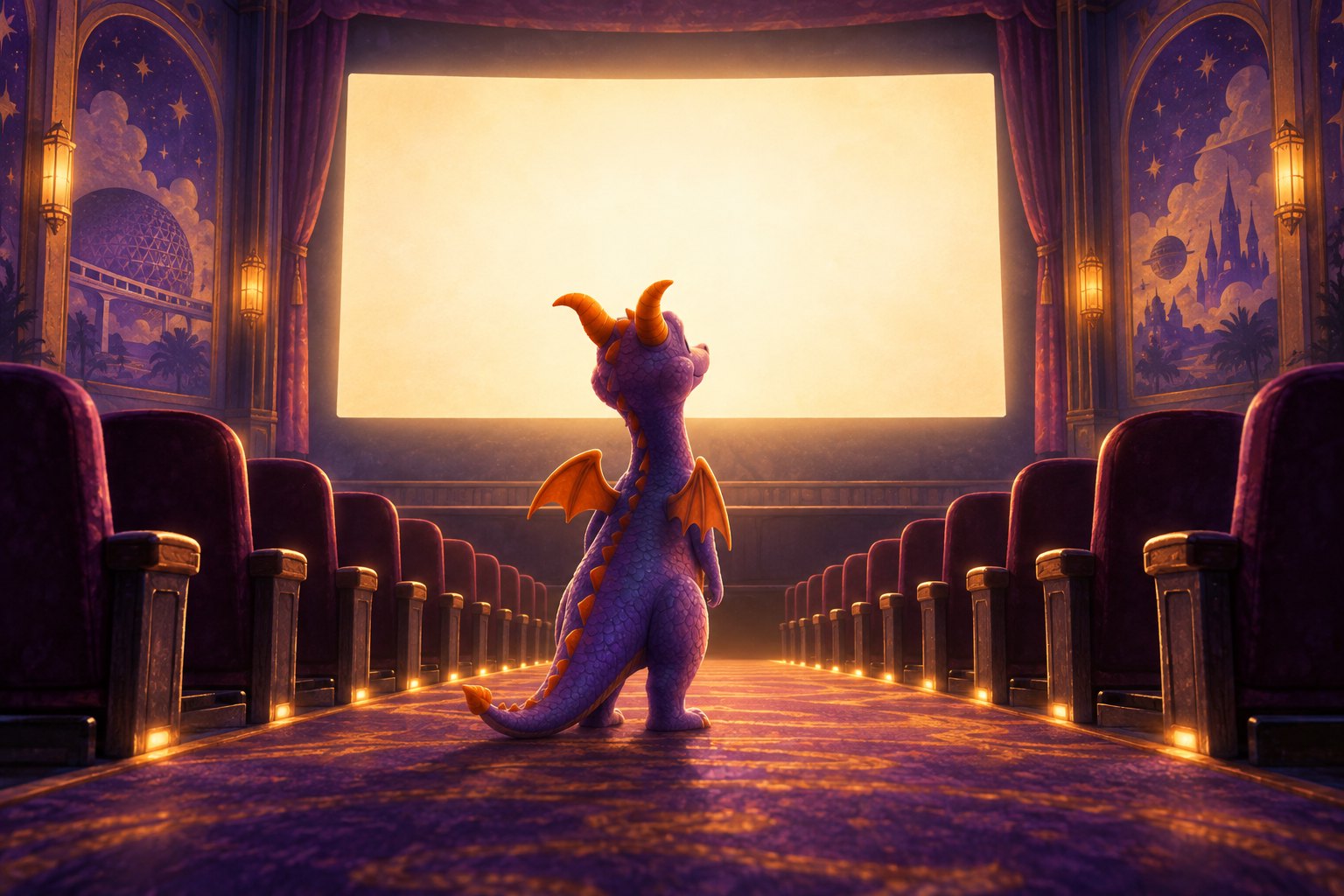
This is spoiler-free adaptation commentary, not a review of a completed film. Story possibilities discussed below are critical considerations, not reported plot details. The illustrations are conceptual artwork, not images from the production.
What the Rogen Update Establishes—and What Remains Unclear
The limited confirmed news is that Rogen has addressed the Figment project in an Entertainment Weekly exclusive. The report’s framing identifies a long-awaited movie connected to a Disney World attraction. Those points support discussion of the adaptation, but they do not establish a shooting schedule, final cast, distribution plan, or release date.
They also do not establish what Rogen said. A rare comment might concern progress, an obstacle, or simply the difficulty of discussing an unfinished project. Assigning a meaning without the words would turn an information gap into a story of our own.
For readers following the movie, the most useful next announcement would identify a concrete milestone and explain its significance. A finished screenplay, a production start, and a release commitment answer different questions. Our discussion of what a first screenplay draft means for the next James Bond movie examines that distinction through another closely watched project.
Figment Needs a Point of View That Can Carry a Feature
My central test for this adaptation would be whether Figment has a meaningful perspective inside the story. A title character can occupy every promotional image and still function mainly as a device that helps someone else learn a lesson. Screen time alone does not give a character agency.
The revealing questions are straightforward. What does Figment want? What does he misunderstand? Which decision could he make that another character would refuse? These are questions for the eventual film, not claims about its screenplay. They matter because a recognizable presence becomes dramatically engaging when its behavior has consequences.
A character does not necessarily need a tragic history or a complicated origin to sustain our attention. A distinct way of interpreting a situation can be enough. Humor might arise because two characters understand the same problem differently; tension might arise because each has a legitimate reason to resist the other’s solution. That gives a fantastical story something viewers can recognize emotionally.
I would be especially interested in whether the movie allows its central character to be wrong without treating that mistake as a betrayal of his appeal. Affection becomes more durable when a film trusts audiences to stay with someone through uncertainty. Protecting a character from every uncomfortable choice can leave the story strangely weightless.
A Ride’s Sequence of Surprises Needs Dramatic Consequences
A ride can organize pleasure around movement: enter a space, encounter a surprise, pass into another environment. A feature can borrow that rhythm, but repeated discoveries need to accumulate meaning. Otherwise, the experience risks becoming a procession of attractive settings with little reason for one event to follow another.
One useful critical test is to ask what changes when a spectacular sequence ends. Has a relationship shifted? Has somebody broken a promise? Has a seemingly easy solution created a harder problem? When the answer is yes, visual invention becomes part of the drama. When nothing changes, even an elaborate sequence can feel detachable.

This does not require constant danger or a world-threatening villain. A small disagreement can provide stronger momentum than a large emergency if we understand what each person stands to lose. For Figment, the scale of the adventure would matter less to me than the connection between its surprises and its characters’ decisions.
The camera could help establish that connection. Showing an extraordinary environment through a particular character’s attention tells us what that character values. A wide shot offers spectacle; a reaction, hesitation, or overlooked detail can turn the same spectacle into characterization.
Rogen’s Name Cannot Substitute for Evidence About the Tone
Rogen’s association naturally becomes part of how people anticipate the movie. But a familiar creative name does not establish a film’s rating, comic style, casting, or intended audience. Those judgments require evidence from the work and clarity about the person’s role in making it.
The useful question is how comedy might reveal relationships. A joke can expose vanity, relieve embarrassment, or show that one character understands another better than expected. If the humor merely interrupts an emotional scene, it can make sincerity feel disposable. If it grows from a character’s defensive habits, it can deepen that same scene.
That is the balance I would look for in Figment: playfulness with enough patience to let a feeling land. The broader issue of how a recognizable performer’s name shapes expectations also appears in our look at Kid Cudi’s acting and directing roles in Wrong Number. The work still has to establish its own identity.
The Movie Should Welcome People Who Have Never Taken the Ride
A strong Figment adaptation should give newcomers everything they need within the film itself. Familiarity with the attraction may add pleasure, but it should not be necessary to understand why a meeting matters or why a character deserves our concern.
That puts pressure on introductions. An early choice can communicate generosity, impatience, or curiosity more efficiently than an explanation of background history. Viewers who arrive without an existing attachment need an encounter that creates one. Recognition is immediate; affection takes dramatic work.
References could enrich that experience if they serve the scene first. A background object might delight an established fan while also telling a newcomer something about its owner. There are no verified film Easter eggs to identify here, however, and guessing at them would confuse wishes with discoveries.
The Deeper Opportunity Is Giving Wonder Emotional Weight
The most promising version of this project, in my view, would explore what happens when an unusual way of seeing the world meets someone else’s needs. That is an interpretive possibility, not a disclosed theme. It could make room for both exuberance and limits: having an inventive idea does not automatically mean understanding another person.
A satisfying feature could let those two forms of discovery develop together. Its imaginative moments would change how characters relate to one another, and those relationships would change what the imaginative moments mean. The audience would leave remembering more than a succession of clever images.
Rogen’s comment gives readers a reason to follow Figment again. The eventual movie will need to supply a different reason to care: a character whose choices make the journey worth taking.
Original content by this site's editorial team. Published: September 12, 2026 at 17:53:33 PDT (Los Angeles time)