
Sense and Sensibility has ample room for a grittier interpretation. Beneath the courtship lies a family learning that its comfort depends on other people’s willingness to help. The New York Times’ characterization of the 2026 adaptation as a tougher makeover points toward a worthwhile critical question: can a rougher treatment make the Dashwood sisters’ vulnerability more visible while preserving Austen’s humor and emotional precision?
The strongest argument for that approach begins with Elinor and Marianne. Their different ways of managing disappointment expose the same predicament: women can exercise excellent judgment and still lack control over their circumstances. Making that predicament tangible would give the new adaptation a substantial purpose.
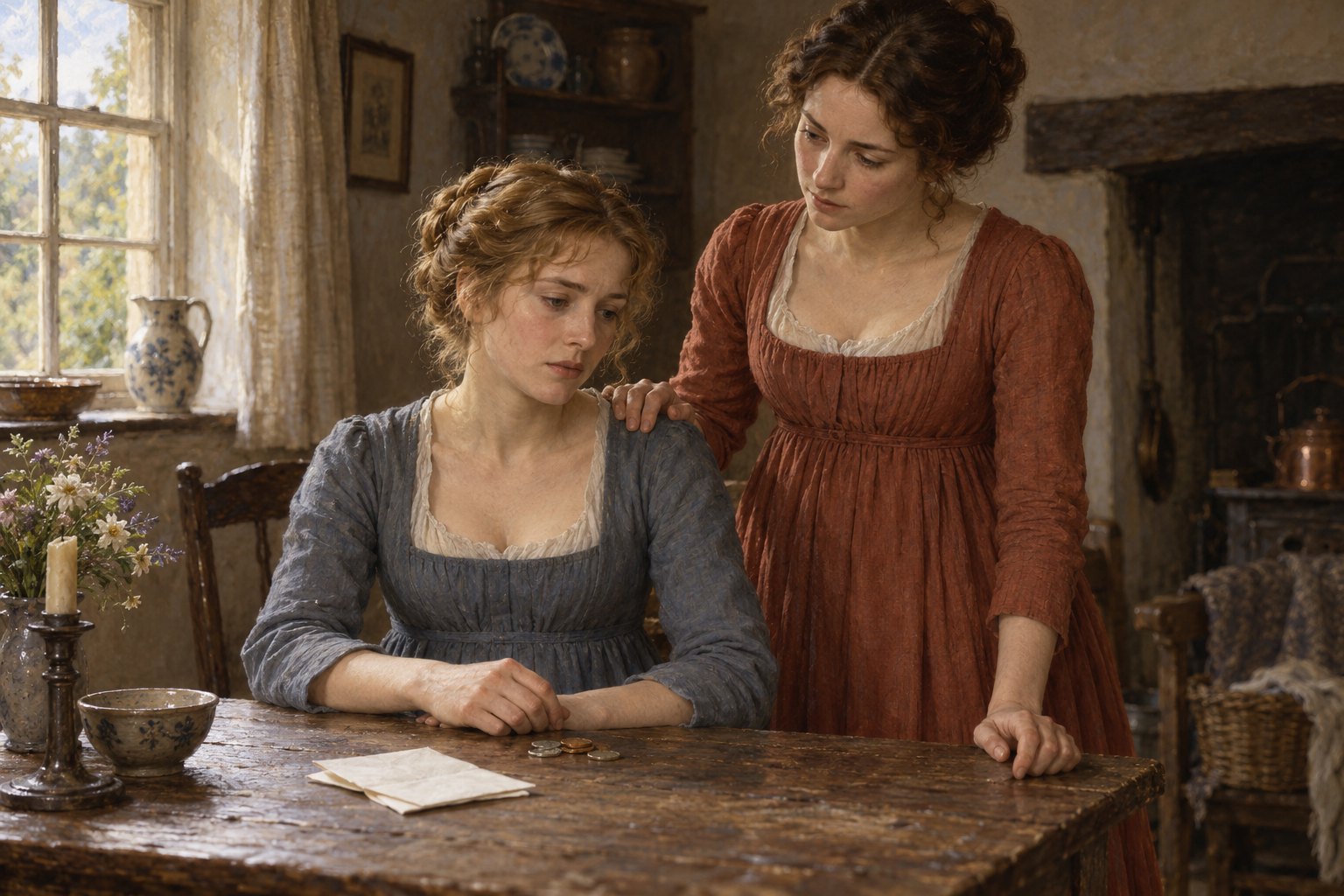
Scope and spoilers: This is character-focused adaptation commentary, rather than a firsthand verdict on the finished film. The discussion below includes major spoilers for Austen’s novel. Quoted dialogue comes from the novel and is not presented as verified dialogue from the 2026 screenplay. The illustrations are literary interpretations, not production stills.
The first injury is losing the power to choose
In Austen’s story, the Dashwood women’s reduced circumstances follow their father’s death. Norland passes to their half-brother John, whose intention to provide meaningful financial assistance steadily contracts under his wife Fanny’s influence. The family eventually moves to Barton Cottage.
The disturbing element is how easily John can regard himself as decent while doing less. He does not need to announce his selfishness. He needs an argument that makes keeping his money sound responsible. Austen allows the reasoning to become funny without making its consequences harmless.
From Elinor’s perspective, the move introduces practical limits that somebody must acknowledge. From Marianne’s, it means separation from a beloved home and the life she expected. Neither response is trivial. One sister registers what the family can afford; the other registers what it has lost.
A grittier adaptation has an opportunity here, provided it distinguishes reduced gentility from destitution. The Dashwoods retain social connections and receive assistance. Their vulnerability comes from dependence and diminished choice. Showing worn surroundings would matter most if it clarified who can offer help, who can withhold it, and who must remain agreeable in order to receive it.
Elinor’s composure has a personal cost
Elinor is easily reduced to the sensible sister who quietly knows best. That description misses the burden of her position. She repeatedly has to consider what information will do to everyone else before deciding what she can reveal about herself.
Her attachment to Edward Ferrars becomes especially painful when Lucy Steele discloses their secret engagement. Elinor must absorb the discovery while maintaining the confidence Lucy has imposed on her. Her restraint leaves other people free to underestimate her distress.
Early in the novel, Marianne mocks Elinor’s measured language about Edward: Esteem him! Like him! Cold-hearted Elinor! The accusation mistakes a manner of speaking for an absence of feeling. It also establishes a problem the story gradually corrects: emotional intensity cannot reliably be measured by how visibly someone expresses it.
For a screen interpretation, this makes Elinor’s quietness dramatically demanding. A pause must communicate more than good manners. It can hold competing impulses: ask for comfort, protect a confidence, avoid upsetting her mother, or prevent Marianne from acting on incomplete information. My reading is that Elinor’s most affecting quality is the effort involved in choosing among those obligations.
Marianne confuses recognition with knowledge
Marianne’s attraction to Willoughby grows from the exhilarating feeling of being understood. Their shared tastes seem to promise a shared moral character. For someone who values emotional candor, immediate affinity can feel more trustworthy than patient observation.
She defends that conviction in the novel: It is not time or opportunity that is to determine intimacy;—it is disposition alone. The thought has genuine appeal. Time does not automatically produce understanding. Yet Marianne turns that insight into permission to stop asking what she does not know.
Willoughby’s conduct exposes the danger. His rejection of Marianne and marriage to a wealthy woman make financial self-interest inseparable from romantic disappointment. The revelation that he has also abandoned Colonel Brandon’s young ward, Eliza Williams, after making her pregnant gives his behavior consequences beyond the central courtship.
A tougher treatment should preserve the distinction between Marianne’s misjudgment and Willoughby’s responsibility. Her confidence makes her vulnerable; it does not make her responsible for his choices. An adaptation that treats her suffering as punishment for being expressive would flatten the character and excuse the person who exploits her trust.
This is also why character perspective matters when familiar material returns to the screen. Our discussion of how a new Carrie adaptation reframes its heroine considers a related question: which aspects of a woman’s experience become clearer when the storytelling changes its emphasis?
The men reveal different relationships with responsibility
Edward and Willoughby offer a useful comparison because their decisions connect affection with material security. Edward’s refusal to abandon his engagement to Lucy costs him his mother’s favor and inheritance. Willoughby allows the attractions of wealth to outweigh obligations he would rather escape.
Edward’s loyalty does not make every part of his behavior toward Elinor fair. An existing commitment can explain his unhappiness without erasing the confusion his attentions create. The story becomes more interesting when honorable conduct in one relationship is allowed to coexist with injury in another.
Brandon, meanwhile, expresses concern through practical assistance. His care for Eliza and his help during Marianne’s illness give substance to a temperament Marianne initially finds unromantic. Dependability becomes visible through action.
Still, a persuasive treatment must allow Marianne a developing interior life. Gratitude alone is an inadequate basis for romantic fulfillment. Her eventual relationship with Brandon needs to remain part of her changing understanding of affection, rather than a reward assigned to a deserving man.
Austen’s humor is part of the hardness
The risk in emphasizing grit is that solemnity can seem like an automatic sign of seriousness. Austen’s comedy already performs serious work. John and Fanny’s self-serving calculations reveal how people disguise cruelty from themselves. Social conversation becomes a place where financial interests acquire respectable language.
Removing that humor would sacrifice a particularly uncomfortable truth: harmful people may sound perfectly reasonable. Their manners can be excellent. Their explanations can even make them feel generous.
A useful adaptation therefore needs more than a severe atmosphere. Watch whether politeness changes what a character can say, whether money changes an apparently romantic decision, and whether a moment of comedy leaves somebody else paying the price. Those relationships determine whether the tougher approach deepens the drama.
The deeper resolution belongs to the sisters
After her illness, Marianne resolves that my feelings shall be governed and my temper improved. The line can sound like a rejection of her earlier self. In context, it also expresses a growing recognition that other people have endured distress she failed to see.
Her development is most moving when understood as an expansion of sympathy. Elinor, in turn, needs space to receive care and express feelings that responsible behavior has kept hidden. The sisters’ reconciliation makes the romantic conclusions emotionally meaningful.
That distinction between an ending and its emotional preparation also informs our analysis of what makes narrative closure feel earned. A resolved relationship matters because of the understanding that makes it possible.
The 2026 makeover’s grittier framing is compelling as an interpretive direction because Austen’s story already contains dependency, humiliation, and unequal consequences. Its deepest opportunity lies in making care as tangible as hardship. Elinor and Marianne need to understand each other’s pain before happiness can become something they share.
Original content by this site's editorial team. Published: October 7, 2026 at 21:34:22 PDT (Los Angeles time)